

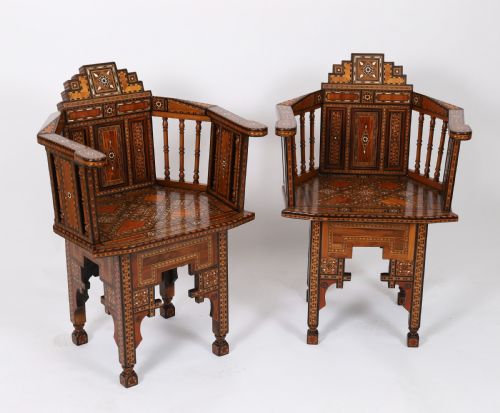


Bone Inlaid Armchairs
Bone inlaid armchairs bring intricate geometric detail and rich regional craft into a room, spanning styles from Moorish Revival to Traditional Chinese.
Bone Inlaid Armchairs
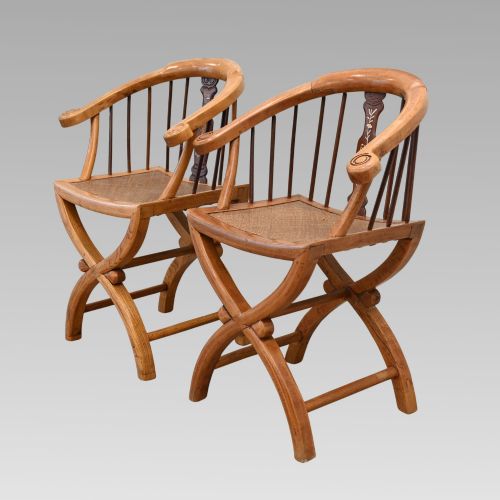
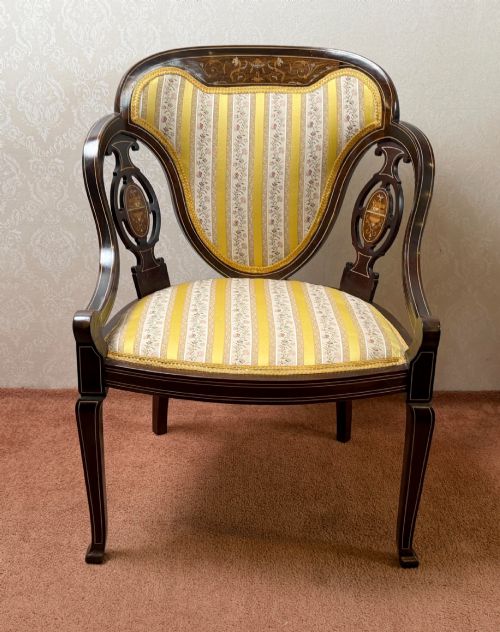
Bone inlaid armchairs encompass seating forms created across the nineteenth and early twentieth centuries, including folding chairs, easy chairs, and conversation seats. The selection draws on distinct regional traditions such as Syrian, Levantine, North African, and Traditional Chinese workshop practices.
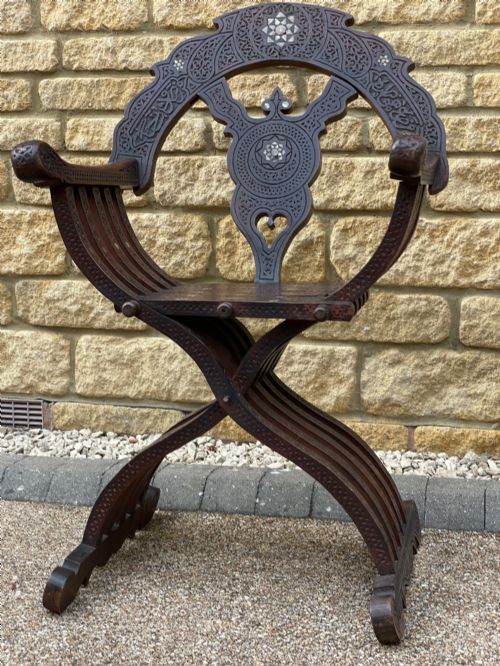
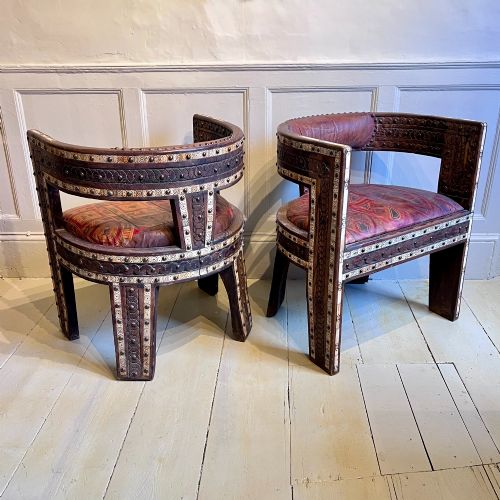
The most common examples on this page reflect Moorish Revival, Syrian, and nineteenth-century European interpretations, often utilising hardwood, walnut, or fruitwood. Forms range from Savonarola and hip-joint chairs to horseshoe chairs and corner chairs with carved panels.
Buyers encounter pieces originating from specific periods like the nineteenth century alongside early twentieth-century examples from 1900 to 1930. These seats function both as decorative focal points and functional accent seating within historic or eclectic interiors.
How they were made
Maker workshops constructed the structural frames using dense hardwoods, walnut, mahogany, or fruitwood, shaped through traditional joinery, turning, and pierced carving. Selected timbers provided a stable dark background to contrast with pale decorative elements.
Artisans embedded individual pieces of bone and mother-of-pearl into recessed channels within the wood surface to form geometric and floral patterns. Additional detailing incorporates boxwood inlay, cane seating panels, leather upholstery, and bone button decorations.
Bone Inlaid Armchairs Retail Price Guide 2026
Typical asking prices for bone inlaid armchairs among the pieces listed under this phrase on Sellingantiques today, from the lower quarter to the upper quarter. They describe what is for sale here now, not the wider market.
Listings feature pieces spanning from the 19th century through to 1930, utilising bone, mother-of-pearl, cane, and leather across various regional styles.
What varies in quality
Quality differences emerge in the precision of the inlay work and the complexity of the carved wooden elements, such as pierced crest rails and Mashrabiya panels. Tighter geometric alignment and complete retention of small bone tesserae distinguish finer examples.
The structural integrity of the hardwood frame and the preservation of secondary materials like cane, leather, and mother-of-pearl accents influence the overall standard of a piece. Workshop attribution, such as work associated with Liberty and Co, also differentiates specific items.
Liberty and Co
The Bone Inlaid Armchairs Glossary
- Bone inlay
- A decorative technique where small carved pieces of animal bone are embedded into a wooden substrate to create contrasting patterns.
- Mashrabiya
- An architectural wooden screen made from turned wood intersecting to form intricate geometric lattices, often incorporated into furniture panels.
- Savonarola chair
- A type of folding chair formed from multiple curved wooden slats that cross to create a supportive X-shaped base.
- Parquetry
- Geometric mosaic woodwork formed by fitting small pieces of wood, bone, or mother-of-pearl together to cover a surface.
- Hip-joint chair
- A historic chair design characterised by turned wooden framing joints, frequently associated with Spanish Renaissance styles of the nineteenth-century revival.
Bone Inlaid Armchairs: Frequently Asked Questions
How do I clean bone inlay?
Dust surfaces gently using a soft, dry cloth without applying water or chemical polishes that might loosen the small bone pieces.
Maintain stable humidity levels in the room to prevent the wood base from expanding and causing the inlay to lift.
Are these chairs comfortable for daily use?
Many examples feature upright wooden backs and carved frames designed primarily for formal reception spaces rather than deep lounging.
Upholstered versions, leather seats, and cane panels offer varying degrees of support depending on the specific historic form.
Where were these chairs made?
Production centres include Damascus, Egypt, Spain, North Africa, and China, reflecting diverse regional craftsmanship and trade connections.
European workshops also produced revival pieces inspired by Moorish, Islamic, and traditional Eastern designs during the nineteenth century.
How do I identify a Moorish Revival chair?
Look for dense geometric parquetry, intricate bone and mother-of-pearl inlay, and pierced wooden crest rails or lattice panels.
These characteristics often appear alongside walnut or hardwood frames dating from the late nineteenth or early twentieth centuries.