


Bone Inlaid Armchair
A bone inlaid armchair brings intricate geometry and Near Eastern craftsmanship directly into a room, offering both seating and striking decorative presence.
Bone Inlaid Armchair
When buyers search for a bone inlaid armchair, they encounter heavily ornamented seating spanning the nineteenth and early twentieth centuries. These pieces draw on Moorish Revival, Syrian Ottoman, and Levantine traditions, showcasing complex geometric surface patterns.
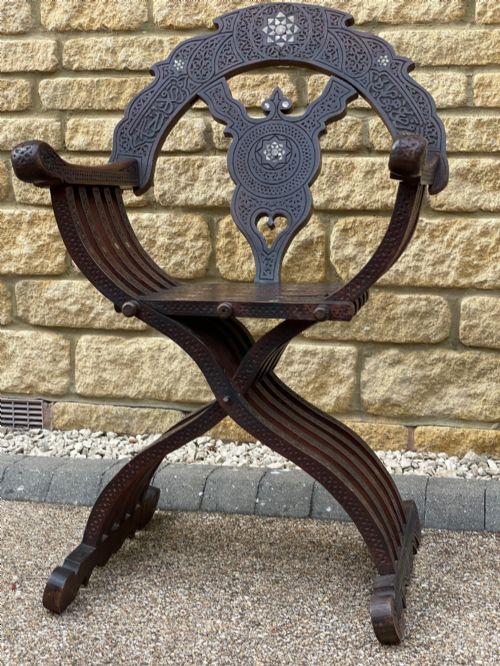
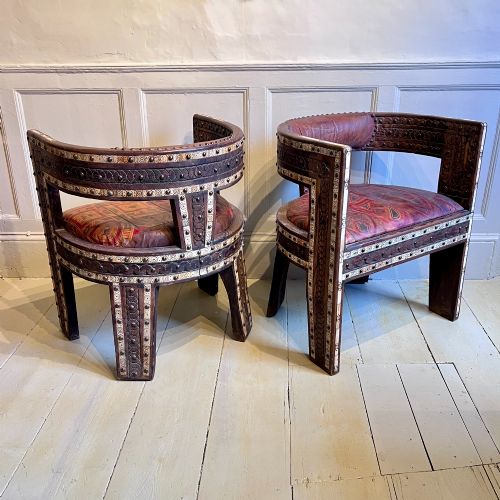
The selections available here range from folding Savonarola and campaign chairs to rigid corner chairs and conversation seats. Walnut and various hardwoods form the foundational structures, embellished extensively with bone and mother-of-pearl.
Origin points span Damascus, Egypt, North Africa, and Spain, alongside British adaptations from the Anglo-Moorish aesthetic. Buyers frequently meet pairs and larger seating suites rather than isolated pieces.
Materials and construction methods
Workshops construct these chairs using dense hardwoods and walnut as the primary structural frame. Artisans inset individual fragments of animal bone and mother-of-pearl into carved recesses across the wooden surfaces to create geometric mosaics.
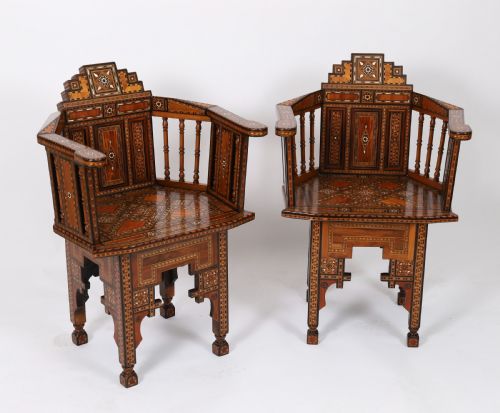
Joinery techniques include folding mechanisms, pegged joints, and pierced carved crest rails supplemented by brass details and leather elements. Mashrabiya panels and intricate turned spindles appear frequently within the framework.
Certain folding chairs manage to look like portable architecture while remaining completely folding.
Assessing craftsmanship and execution
Quality separates through the density and precision of the inlaid mosaic work rather than basic age alone. Tighter tessellation of bone and mother-of-pearl segments indicates superior workshop output.
The complexity of the structural carving, such as deep piercing on crest rails and refined turning on spindles, distinguishes high-tier examples. The preservation of original surface elements like bone buttons and brass accents dictates the overall integrity.
Liberty and Co
The Bone Inlaid Armchair Glossary
- Bone inlay
- A decorative technique where small pieces of shaped bone are embedded into a wooden base to form geometric or floral patterns. This method defines the primary visual appeal of these seats.
- Mashrabiya
- A traditional architectural element featuring turned wooden lattices arranged in intricate geometric patterns. These panels frequently form the backrests or side supports of Syrian and Levantine chairs.
- Savonarola chair
- A folding armchair constructed from multiple curved wooden slats that intersect in an X-shape. Originating in the Renaissance, this form was later adopted by nineteenth-century revivalists.
- Mother-of-pearl
- The iridescent inner layer of certain mollusc shells used alongside bone for contrasting luminosity. Artisans shape this material into small geometric tiles for surface embellishment.
- Moorish Revival
- An architectural and decorative style popular in the nineteenth century that reinterpreted Islamic design motifs. This aesthetic heavily influences the Damascus and North African pieces found here.
Bone Inlaid Armchair: Frequently Asked Questions
What is a bone inlaid armchair?
A bone inlaid armchair is a wooden seat decorated with intricate geometric patterns formed from small pieces of animal bone and mother-of-pearl. These items originate predominantly from nineteenth-century Middle Eastern, North African, and European revival workshops.
They serve as both functional seating and decorative statement items, reflecting Moorish and Ottoman design traditions through detailed carving and complex joinery.
How do I identify a Syrian inlaid chair?
Syrian inlaid chairs typically feature dense geometric parquetry using bone and mother-of-pearl on walnut or hardwood frames. They often incorporate regional motifs and architectural elements like turned spindles.
Craftsmen from Damascus and surrounding areas produced these pieces during the late nineteenth and early twentieth centuries for both local use and export to Western markets.
Are these chairs comfortable for daily use?
While structurally robust, many of these chairs feature rigid wooden backs and upright seating angles designed for formal reception rooms rather than lounging. Some variations include leather upholstery or padded seats for added comfort.
Placing them in low-traffic areas or utilising them as accent pieces helps preserve their delicate surface inlays over time.
How should I care for bone inlay?
Bone inlay requires stable indoor humidity levels to prevent the wood base from expanding and causing the inlaid fragments to loosen. Dusting gently with a dry, soft cloth is sufficient for routine maintenance.
Avoid using liquid polishes or harsh chemical cleaners that might seep into the microscopic joints between the bone and the surrounding hardwood.
What is an Anglo-Moorish chair?
An Anglo-Moorish chair is a nineteenth-century British interpretation of traditional Islamic and North African furniture styles. British firms and designers adapted regional geometric carving and inlay techniques for domestic Victorian interiors.
These pieces combine European seating forms, such as corner chairs and folding frames, with Damascus-inspired surface decoration.