


Bombee Marquetry Chest
A bombee marquetry chest brings dramatic bombé proportions and intricate floral wood inlay into a room, offering both bold statement design and practical storage.
Bombee Marquetry Chest
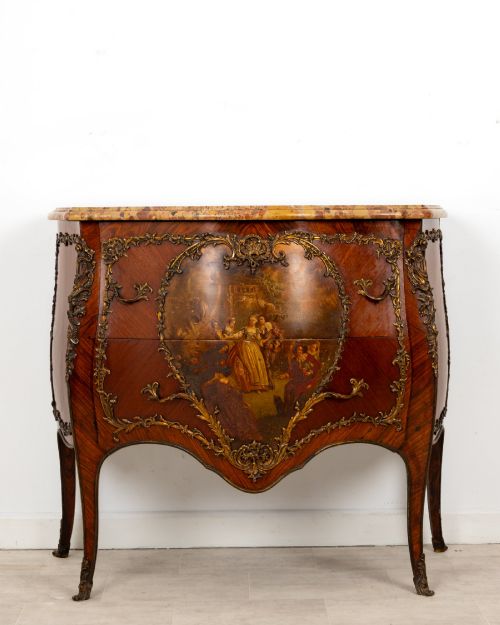
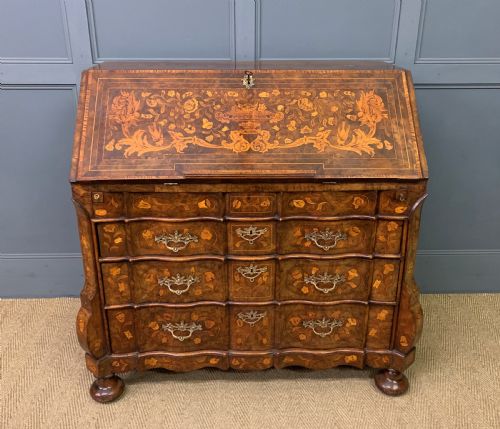
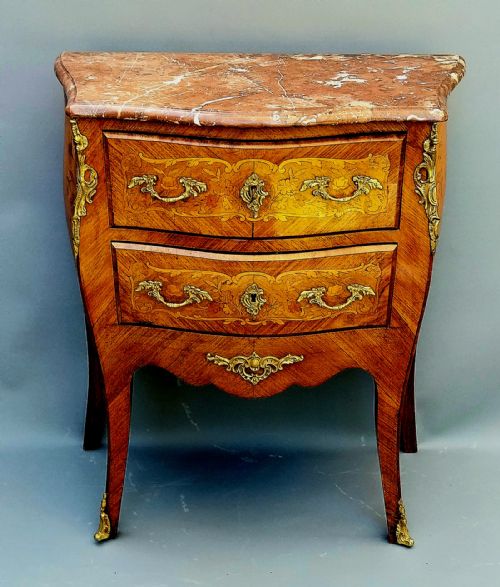
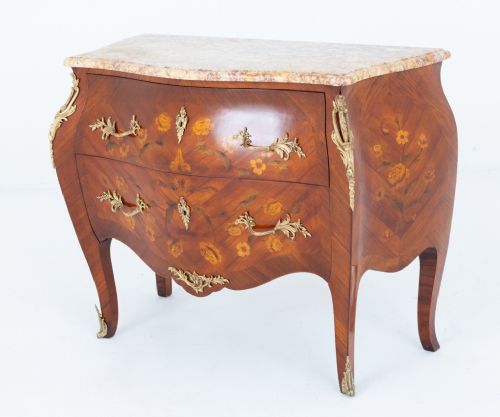
A bombee marquetry chest is a substantial storage piece defined by its swelling, outward-curving sides and fronts, heavily decorated with detailed wood inlay. These pieces encompass commodes, bureaus, bedside tables, and small miniature cabinets originating primarily from eighteenth-century and nineteenth-century France and the Netherlands.
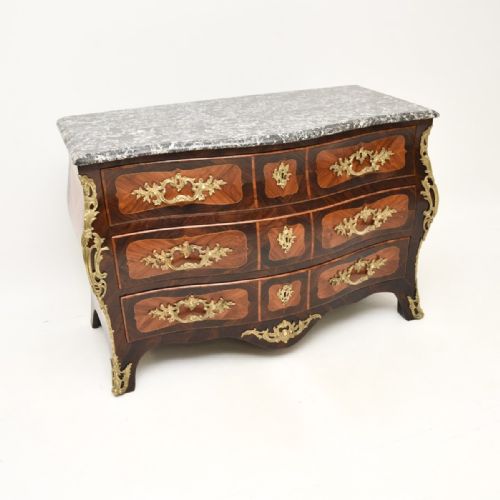
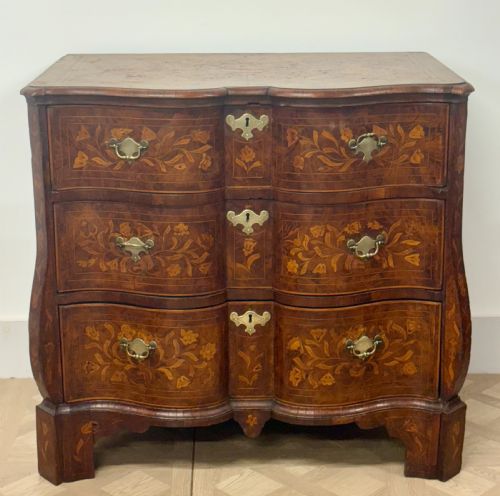
The version most commonly met on this page is the French Louis XV style or revival commode, typically featuring a shaped marble top above three or more undulating drawers. Alongside these, Dutch Baroque and Rococo examples appear, showcasing elaborate floral marquetry in walnut and kingwood across shaped bodies.
Makers and workshops across Paris and the Netherlands produced these striking forms using distinct regional aesthetics, ranging from the restrained curves of mid-eighteenth-century pieces to the ornate revivals of the late nineteenth century. Whether standing as a large bedroom commode or a compact bedside table, each piece relies on its swelling profile and patterned surface for visual impact.
How they were made
Cabinetmakers constructed these swelling carcasses from dense secondary timbers such as oak or pine, shaping the framework to achieve the signature curved silhouette. Over this structural core, they applied choice veneers of walnut, kingwood, fruitwood, and rosewood, carefully matched to enhance the sculptural form.
Surface decoration relied on intricate floral marquetry, where contrasting woods were meticulously cut and fitted together to form elaborate botanical motifs across the drawer fronts and sides. Ormolu and gilt-bronze mounts, cast and chased, were then added to frame the key corners and handles, protecting vulnerable edges while accentuating the curves.
Heavy marble slabs, cut to follow the undulating contours of the top surface, were fitted directly to the upper carcass of many commodes. This required precise stonemasonry to ensure the heavy top sat flush against the complex wooden profile beneath it.
What varies in quality
The standard of a bombee marquetry chest rests largely on the ambition and precision of its wood inlay. Superior examples display tightly detailed floral marquetry with subtle tonal shading in the fruitwoods, whereas lesser pieces rely on repetitive, flat patterns.
Constructional depth defines the upper tier of these pieces, particularly in the handling of the curved carcass and the thickness of the mounted ormolu. Finer items integrate cast bronze mounts that match the exact contours of the woodwork, whereas simpler versions show standard fittings that lack individual definition.
The integration of the marble top indicates the tier of the piece, with high-quality commodes featuring thick, finely profiled stone slabs that mirror every swell of the timber. Poorer examples utilise thinner marble with basic edge profiles that sit less harmoniously upon the base.
Jacques Bircklé
The Bombee Marquetry Chest Glossary
- Bombe
- A swelling, bulging contour used on chests and commodes that curves outward on the front and sides. This French-influenced shape demands advanced cabinetmaking techniques to fit drawers into a rounded carcass.
- Marquetry
- A decorative technique where small pieces of tinted or natural wood veneer are arranged into pictorial or floral patterns. It differs from inlay by covering the entire surface as a unified veneer layer.
- Ormolu
- Gilt bronze mounts applied to furniture edges, feet, and corners for both decoration and structural protection. The best examples are hand-chased after casting to sharpen the fine details.
- Commode
- A low chest of drawers, typically standing on cabriole legs and originating in France during the eighteenth century. These pieces often feature marble tops and elaborate veneering.
- Kingwood
- A dense, richly grained tropical timber used extensively in eighteenth-century and revival marquetry. Its deep brown colour and contrasting pale streaks make it ideal for framing floral panels.
Bombee Marquetry Chest: Frequently Asked Questions
What is a bombe chest?
A bombe chest is a piece of furniture featuring distinct outward-swelling sides and drawer fronts that curve in multiple directions. This volumetric shape creates a strong sculptural presence within a room.
Cabinetmakers achieved this form through complex framing and careful shaping of the underlying wooden carcass before applying fine veneers.
How do I clean the marquetry?
Marquetry surfaces require gentle maintenance using a soft, dry cloth to remove dust without disturbing the delicate veneer joints. Avoid modern chemical polishes that can seep into the grain.
Applying traditional beeswax sparingly helps nourish the old timber and preserves the natural lustre of the various woods used in the floral designs.
Are these chests French or Dutch?
These chests originate from both French and Dutch traditions, each bringing distinct characteristics to the form. French pieces often lean towards refined ormolu mounts and serpentine marble tops.
Dutch examples frequently display denser, more exuberant floral marquetry across walnut carcasses, reflecting the rich tradition of floral cabinetry in the Netherlands.
Why do some have marble tops?
Heavy marble tops were added to commodes to provide a durable, heat-resistant surface that also anchored the weighty wooden carcass below. The stone added stability and a luxurious contrast to the timber veneers.
Stonemasons shaped these marble slabs by hand to match the exact undulating curves of the individual cabinet.
What is floral marquetry?
Floral marquetry is the craft of cutting and assembling different coloured woods into detailed botanical designs. Craftsmen used contrasting fruitwoods and tinted veneers to create lifelike flowers and leaves.
This intricate work covers the drawer fronts and sides of the chest, turning functional storage into a decorative canvas.