


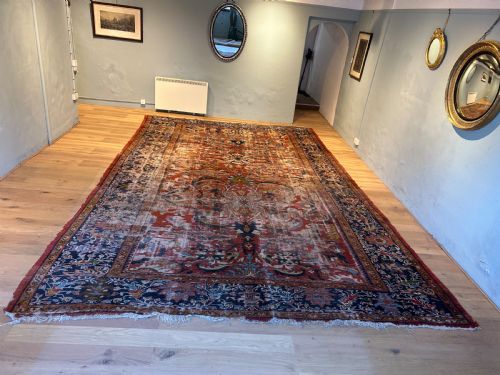


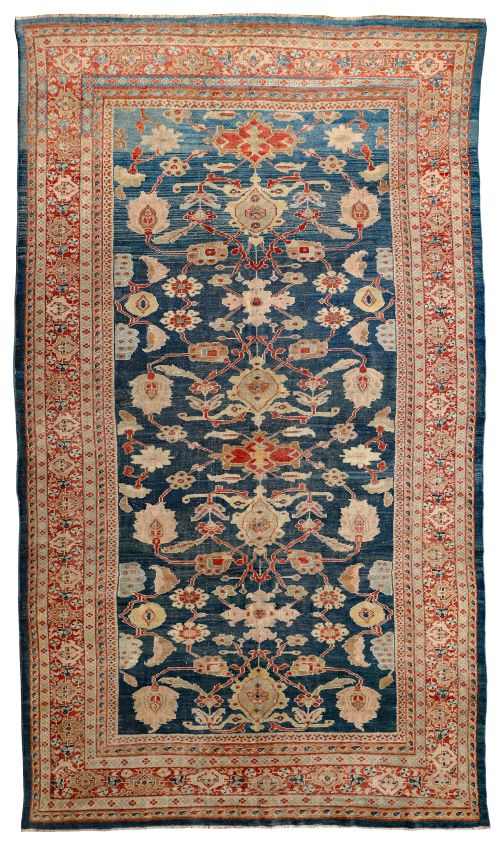


Blue Ziegler Mahal Carpet
A blue ziegler mahal carpet brings monumental scale and subtle palette control into a room through nineteenth century Persian weaving.
Blue Ziegler Mahal Carpet
A blue ziegler mahal carpet represents a distinct branch of nineteenth century Persian floor coverings, created to satisfy Western taste with understated colourways and expansive dimensions. These large formats and palace size examples dominate our listings, reflecting the commercial output of workshops working around Sultanabad.
Buyers seeking this phrase encounter pieces dated across the late nineteenth century, specifically from 1880, 1890, and 1900. The aesthetic relies on softer blues and muted grounds rather than the saturated hues of traditional village weaving.
How they were made
These carpets rely on a sturdy combination of wool pile knotted onto cotton foundations, ensuring structural stability for large formats. The materials were chosen for durability, allowing grand room sizes to withstand regular traffic while retaining flexibility.
The workshops utilised traditional hand-knotting techniques characteristic of nineteenth century Persian production, combining durable natural fibres to achieve expansive fields that often exceed five metres in length.
Materials documented across the available pieces consist entirely of wool and cotton.
What varies in quality
The distinction between standard room sizes and palace size examples dictates the primary hierarchy among these carpets. Greater scale combined with precise nineteenth century dating separates monumental pieces from more standard formats.
Fereghan and Sultanabad influences introduce subtle variations in structural fineness and design execution across the period. The coherence of the blue palette and the integrity of the cotton foundation define the upper tier of the range.
The Blue Ziegler Mahal Carpet Glossary
- Ziegler
- A nineteenth century commercial enterprise and style known for adapting traditional Persian designs for Western interiors. These carpets typically feature muted palettes and oversized motifs.
- Mahal
- A designation for carpets produced in the Sultanabad region of Persia during the nineteenth century. They often display all-over patterns rather than strict central medallions.
- Sultanabad
- The central Persian district associated with large scale carpet production for export markets in the late nineteenth century. Workshops here produced substantial palace size carpets.
- Fereghan
- A regional style associated with fine Persian weaving traditions. Pieces bearing this attribution display tighter knotting and refined botanical details.
- Cotton foundation
- The warp and weft structure composed of cotton threads that carries the wool pile. This material choice provides dimensional stability for large floor coverings.
Blue Ziegler Mahal Carpet: Frequently Asked Questions
What is a blue ziegler mahal carpet?
A blue ziegler mahal carpet is a nineteenth century Persian floor covering produced for Western export markets, featuring muted blue tones and large formats. These pieces originate from the Sultanabad region.
The scale ranges from standard room sizes to monumental palace dimensions, utilising wool pile on cotton foundations.
How do I date these carpets?
Dating relies on historical attribution to the late nineteenth century, specifically spanning from 1880 through 1900. Stylistic markers and structural characteristics help place each piece within this window.
Evidence from listings points to specific decades within the 19th century, linking the aesthetic to known commercial production periods in Persia.
Where were they made?
These carpets were woven in Persia, specifically within workshops around Sultanabad that catered to European and American tastes. The production combined local weaving traditions with imported design preferences.
The output reflects commercial enterprise designed to supply large scale rugs for substantial nineteenth century homes and public spaces.
How do I live with a large carpet?
Living with a palace size carpet requires adequate floor space to let the expansive field and border design breathe without obstruction. Proper underlay protects the cotton foundation and wool pile from wear.
Positioning these substantial pieces away from direct, harsh sunlight preserves the muted blue dyes characteristic of the Ziegler aesthetic.