

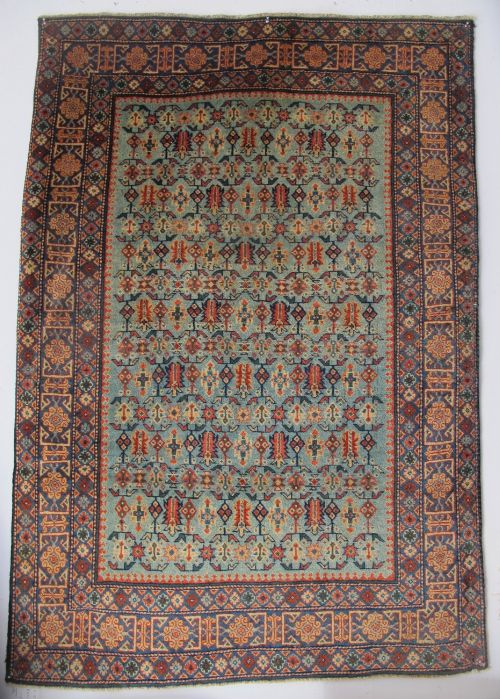


Blue Wool Tabriz Carpet
A blue wool tabriz carpet brings Persian knotwork into a room, offering durability and traditional design.
Blue Wool Tabriz Carpet
A blue wool tabriz carpet is a woven floor covering originating from North-West Persia, produced across the eighteenth, nineteenth, and early twentieth centuries. These pieces display traditional floral medallions, overall floral patterns, or hunting motifs tied to Persian Safavid, Qajar, and Zand traditions.
The versions most commonly met on this page date from the late nineteenth century and the early twentieth century, spanning room-size carpets down to smaller area rugs. They combine wool pile with cotton foundations, maintaining the classical design vocabulary associated with the Tabriz region.
How they were made
Makers built these carpets using wool pile knotted onto cotton foundations, a structure that provided both surface softness and dimensional stability. Weavers executed intricate floral and medallion designs by hand, tying thousands of individual knots across the expanse.
Natural dyeing techniques produced the deep blue grounds characteristic of these pieces, which were then washed and finished to set the pile and soften the palette.
Blue Wool Tabriz Carpet Retail Price Guide 2026
Typical asking prices for blue wool tabriz carpet among the pieces listed under this phrase on Sellingantiques today, from the lower quarter to the upper quarter. They describe what is for sale here now, not the wider market.
Some carpets feature hidden hunting scenes tucked between floral vines, giving sharp-eyed viewers animals to spot in the wool.
What varies in quality
Knot density and precision of execution separate the finer examples from standard village production, dictating how sharply the floral motifs and medallion outlines register. The crispness of the drawing and the complexity of the design, such as figurative hunting scenes or master-weaver attributions, mark the upper tier of the range.
The condition of the wool pile and the integrity of the cotton foundation determine structural longevity, while the subtlety of the blue dye saturation dictates visual depth.
Haji Jalili·Benlian
The Blue Wool Tabriz Carpet Glossary
- Pile
- The upright yarn loops that form the usable surface of a carpet. In these pieces, the pile is woven entirely from wool.
- Foundation
- The underlying grid of warps and wefts that supports the knotted pile. These listings employ cotton for this structural base.
- Medallion
- A central ornamental design motif placed in the middle of the carpet field. Traditional examples feature symmetrical floral arrangements around this focal point.
- Safavid
- A historical Persian dynasty associated with classical periods of carpet weaving. Pieces referencing this era reflect traditional design idioms.
Blue Wool Tabriz Carpet: Frequently Asked Questions
Where were these carpets made?
These pieces originated in North-West Persia, specifically centered around the city of Tabriz. This region has a long history of workshop and village carpet production.
Weavers utilised traditional Persian techniques to construct these floor coverings for domestic and international markets.
How do I date a Tabriz carpet?
Dating relies on stylistic markers, structural analysis, and comparative examples from periods such as the Qajar era or the early twentieth century. Specific workshop attributions also help narrow the timeframe of manufacture.
Examinations of the wool pile and cotton foundation provide additional clues regarding age.
How should I place one in a room?
Room-size carpets anchor large living spaces or dining rooms, while smaller area rugs suit studies or bedrooms. Placing them away from direct sunlight protects the blue wool pile from fading.
Using a quality underlay prevents slipping and reduces friction against hard flooring.
What is a Haji Jalili carpet?
Haji Jalili refers to a specific master weaver and workshop style from the Tabriz region known for distinctive palettes and fine knotting. These pieces often feature muted or soft tones combined with intricate floral designs.
They represent a sought-after subset within nineteenth-century Persian carpet production.