
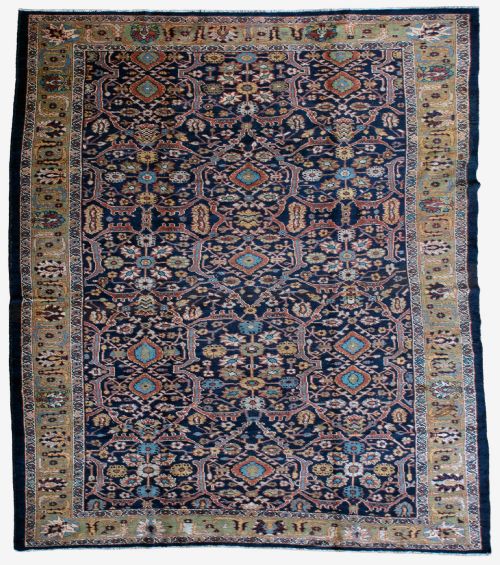


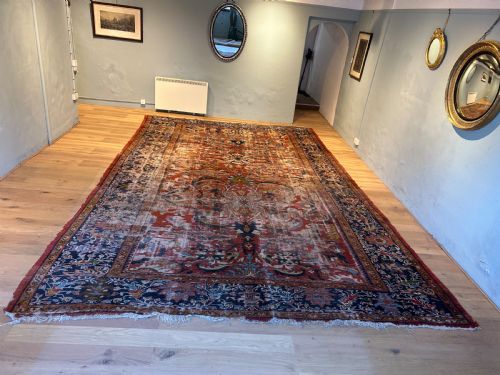
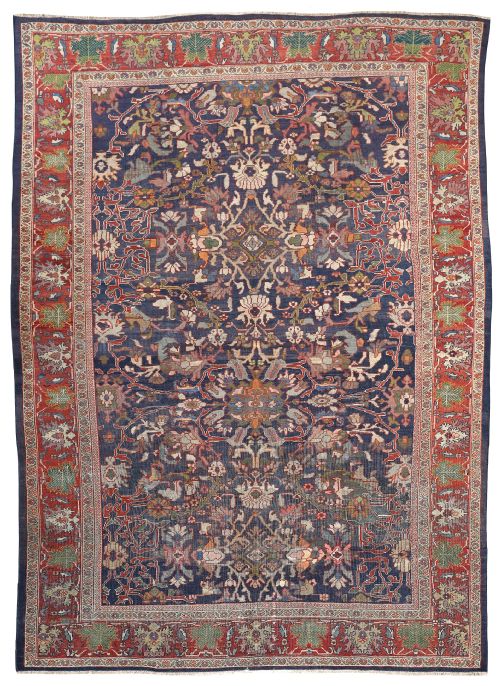

Blue Sultanabad Rug
A blue sultanabad rug brings grand Persian scale and rich indigo depth into a room, offering durability alongside botanical elegance.
Blue Sultanabad Rug
When searching for a blue sultanabad rug, collectors look at hand-knotted floor coverings originating from the West Persia region during the late nineteenth and early twentieth centuries. These pieces encompass related workshop styles including Mahal and Ziegler productions, often sharing large-scale floral and trellis patterns.
Buyers will encounter distinct nomenclature in the titles, interchanging Sultanabad, Mahal, and Ziegler designations for floor coverings that share closely allied design idioms and regional origins.
What varies in quality
Quality differences emerge in the precision of the knotting and the crispness of the drawing across the field. Finer density in the wool pile allows complex floral and lattice designs to retain sharp definition rather than blurring into the surrounding ground.
The handling of the blue dye ground dictates much of the visual success of the piece, with richer saturation and subtle tonal variation elevating the visual weight. Condition of the wool foundation and edge binding also separates standard room-size examples from exceptional palace-scale survivals.
Listings span production dates from 1870 through 1920, incorporating nineteenth-century examples alongside early twentieth-century workshop pieces.
Ziegler & Co
The Blue Sultanabad Rug Glossary
- Sultanabad
- A West Persian rug-producing region known for large-scale floral patterns created for Western export markets during the nineteenth century. Pieces from this area frequently share workshops and design traits with Mahal carpets.
- Mahal
- A designation for Persian carpets woven in and around Sultanabad, characterised by spacious floral motifs and softer pastel or saturated colour palettes. These works date primarily from the late nineteenth and early twentieth centuries.
- Ziegler
- A reference to the Manchester firm Ziegler & Co that established manufacturing and design operations in Sultanabad during the nineteenth century. Carpets bearing this attribution typically feature large, relaxed floral layouts tailored for European drawing rooms.
- Mostafi
- A traditional Persian carpet design layout featuring repeating compartments enclosing floral bouquets or blossoms. This pattern appears in select nineteenth-century room and palace-size examples.
- Pile
- The upright yarn loops forming the usable surface of a rug. In these antiques, the wool pile provides both the tactile warmth and the colour field.
Blue Sultanabad Rug: Frequently Asked Questions
How do I tell Sultanabad and Mahal rugs apart?
Sultanabad and Mahal rugs originate from the same West Persian producing area and share similar materials, making strict separation difficult. The terms often overlap in the trade.
In general, pieces designated as Sultanabad may display slightly larger patterns or commercial export formats, while Mahal can describe related village and workshop production from the identical district.
Where were these rugs made?
These rugs were woven in West Persia, centred around the town of Sultanabad, which is known today as Arak. This region served as a major hub for carpet production.
Local workshops and surrounding villages employed traditional hand-knotting techniques, utilising local wool and natural dyes to create durable carpets for international distribution.
How do I care for an antique wool rug?
Caring for an antique wool rug involves gentle vacuuming without a beater bar to protect the delicate pile and cotton foundation. Regular rotation ensures even wear across high-traffic areas.
Professional cleaning tailored for antique textiles should be utilised periodically to remove embedded dust while preserving the integrity of the natural dyes and wool fibres.