




Blue Stone Earrings
Blue stone earrings bring colour to the earlobe through sapphire, aquamarine, turquoise, topaz, zircon, and paste.
Blue Stone Earrings
Blue stone earrings encompass a broad sweep of historic and mid-century designs ranging from Victorian hoop styles to Art Deco clusters and modern gold drops.
Buyers browsing blue stone earrings frequently encounter mid-century pieces set in nine-carat gold alongside earlier silver and platinum mountings.
The selections span simple stud earrings, elaborate drop configurations, and matching jewellery sets incorporating diverse blue minerals.
Materials and construction
Goldsmiths utilise nine-carat gold, white gold, silver, and platinum to fabricate secure settings for gemstones such as diamond, sapphire, aquamarine, and turquoise.
Lapidaries shape stones into emerald cuts, oval cuts, pear cuts, and cluster arrangements, often securing them alongside marcasite or paste accents.
Listings feature periods spanning the Victorian era, the nineteenth century, and mid-century decades up to nineteen sixty, utilising sapphire, turquoise, and aquamarine.
Distinctions in quality
Quality rests upon the clarity and saturation of the central stones, whether natural aquamarine, sapphire, topaz, turquoise, or blue zircon.
The precision of the metalwork, from delicate platinum cluster mounts to screwback mechanisms, determines the enduring structural integrity of each piece.
The Blue Stone Earrings Glossary
- Aquamarine
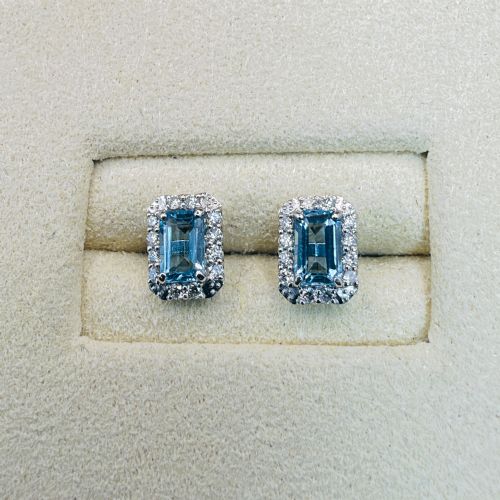
- A pale blue variety of beryl utilised frequently in mid-century drop and cluster earrings. It often appears in emerald or pear cuts.
- Turquoise
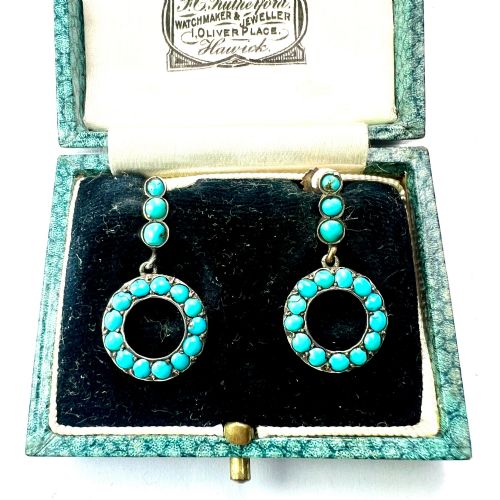
- An opaque blue-to-green mineral set in Victorian hoops and vintage gold studs. It provides a distinct matte texture against polished metal.
- Screwback
- A mechanical fastening device common in vintage earrings that allows the wearer to adjust pressure on the earlobe without a pierced fitting.
- Marcasite
- Small faceted crystals of pyrite set in silver jewellery to produce a sparkling border around central blue stones in Art Deco pieces.
- Cluster
- An arrangement of smaller stones gathered tightly around a central focal gem, standard in platinum and gold stud configurations.
Blue Stone Earrings: Frequently Asked Questions
Are blue stone earrings comfortable to wear daily?
Most stud and drop designs distribute weight evenly across the earlobe for comfortable daily wear.
Screwback and dangling hoop variations offer secure positioning without requiring pierced ears.
How do I identify Art Deco blue stone earrings?
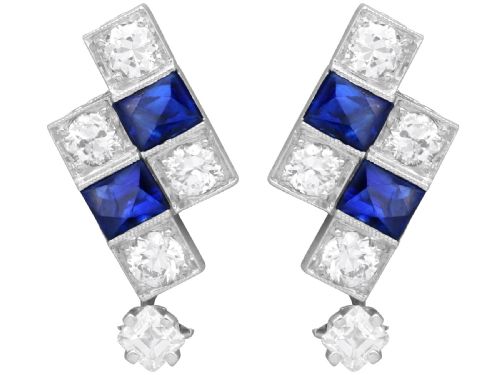
Art Deco examples frequently combine platinum or silver with geometric sapphire, paste, or marcasite elements.
These pieces reflect the distinct architectural symmetry popular during the 1920s and 1930s.
What metals are common in these earrings?
Makers utilise nine-carat yellow gold, nine-carat white gold, silver, and platinum across different eras.
Platinum and silver appear more frequently in earlier twentieth-century designs, while gold dominates mid-century productions.
Can I find matching sets?
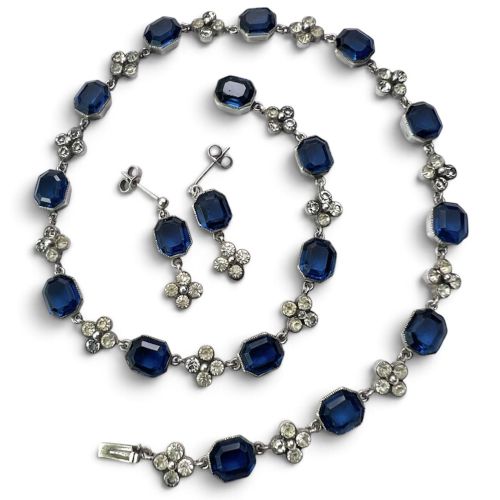
Certain listings pair earrings with complementary necklaces featuring matching blue stones and metalwork.
These coordinated sets originated primarily during the early twentieth century.