





Blue Sapphire Marquise Ring
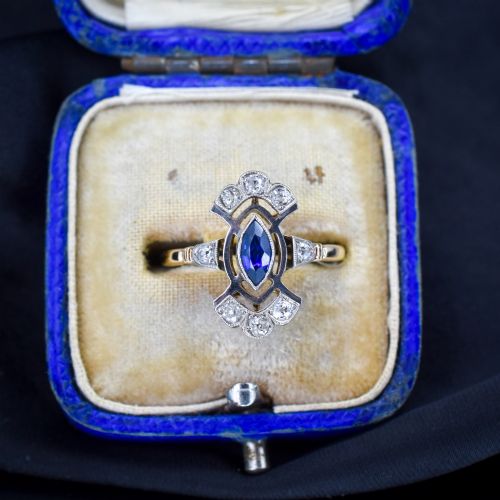
A blue sapphire marquise ring offers an elongated navette silhouette set with vivid blue stones, prized for flattering the finger with geometric elegance.
Blue Sapphire Marquise Ring
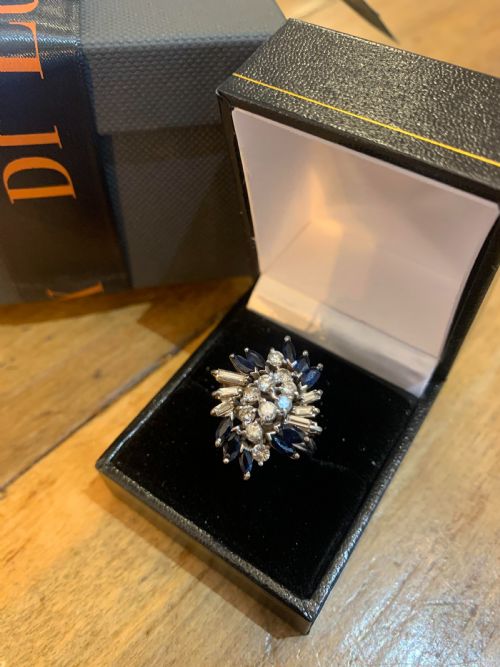
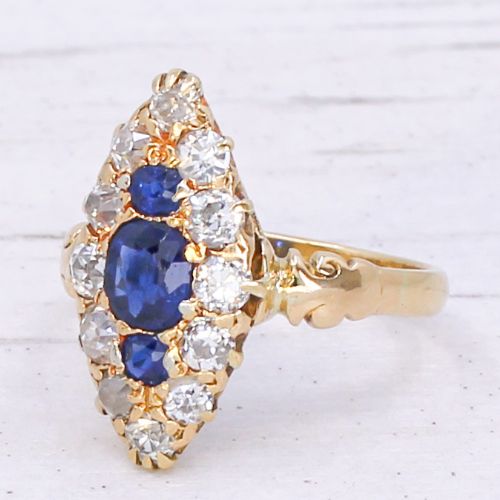
A blue sapphire marquise ring presents a distinctive boat-shaped or navette profile that stretches along the length of the finger. These pieces combine central blue sapphires with sparkling diamond accents, drawing the eye with their striking geometry.
Most examples found here span the Edwardian era through the mid-twentieth century, encompassing Victorian, Art Deco, and Retro designs. The selection relies heavily on platinum settings, 18ct yellow and white gold mountings, and occasional lower gold purities.
Makers often fashioned these jewels as dress or cocktail rings, balancing substantial gemstone carat weights with delicate openwork metal galleries. Buyers encounter variations ranging from restrained Edwardian cluster arrangements to bolder mid-century statements.
Materials and construction
Goldsmiths utilised platinum and various karats of yellow and white gold to construct the foundational metalwork for these navette clusters. Platinum provided the tensile strength needed for intricate Edwardian and Art Deco pierced wirework without adding excessive bulk.
Jewellers secured central sapphires and old cut diamonds using delicate claw, bezel, or millegrain settings. This meticulous handiwork ensured the sharp pointed ends of the marquise outline remained secure while maximising light entry into the stones.
Blue Sapphire Marquise Ring Retail Price Guide 2026
Typical asking prices for blue sapphire marquise ring among the pieces listed under this phrase on Sellingantiques today, from the lower quarter to the upper quarter. They describe what is for sale here now, not the wider market.
Listings feature platinum, yellow gold, and white gold mountings paired with sapphire and diamond combinations spanning 1900 to 1960.
Assessing quality and proportion
The distinction between tiers rests upon the saturation and uniformity of the blue sapphire colour alongside the cut grade of the accompanying diamonds. Superior stones display an even, intense hue without dark patches, paired with clean facet symmetry.
Structural integrity of the delicate pointed shoulders and the crispness of millegrain borders also separate standard examples from finer workshops. Master jewellers maintained precise proportional harmony between the central navette length and the surrounding diamond halo.
The Blue Sapphire Marquise Ring Glossary
- Marquise
- A boat-shaped gemstone cut or ring silhouette featuring pointed ends and curved sides. This shape is also historically known as a navette.
- Navette
- French for little ship, describing the elongated, boat-like profile typical of these cluster rings. It refers to both the gemstone arrangement and the overall metal outline.
- Millegrain
- A decorative technique featuring a row of tiny raised metal beads along the edges of a setting. Jewellers utilised this finish extensively during the Edwardian and Art Deco periods to soften metal borders.
- Old Cut
- A precursor to modern brilliant cuts, hand-fashioned with a smaller table, higher crown, and open culet. These diamonds display distinct facet patterns under candlelight.
- Cluster Ring
- A design featuring a prominent central stone surrounded by a tighter grouping of smaller gems. This configuration maximises visual impact and perceived gemstone spread on the hand.
Blue Sapphire Marquise Ring: Frequently Asked Questions
How do I wear a marquise ring safely?
The pointed ends of a blue sapphire marquise ring require mindful daily wear to avoid snagging on fabrics or striking hard surfaces. Rotating the ring inward during heavy manual tasks protects the delicate tips of the navette setting.
Storing the piece in a dedicated lined compartment prevents the sharp platinum or gold shoulders from scratching neighbouring jewellery. Regular professional checks ensure the tiny claws securing the end points remain tight.
What periods do these rings come from?
The available inventory spans from the late Victorian and Edwardian eras through the 1920s Art Deco movement and into mid-century modern design. Each era introduced distinct stylistic shifts, moving from delicate platinum filigree to bolder geometric gold clusters.
Edwardian and Art Deco pieces frequently employ platinum wirework, whilst later 1950s and 1960s examples often favour heavier 18ct white or yellow gold mountings. Examining the gallery construction and metal purity marks helps pinpoint the exact decade of manufacture.
How are sapphires graded in vintage rings?
Vintage sapphires are evaluated primarily on the richness and distribution of their blue body colour rather than strict modern laboratory standards. Ceylon origins and natural unheated stones occasionally appear in these historical mounts, adding notable provenance.
Inclusions visible under magnification often confirm natural origin rather than synthetic production. The interplay between the sapphire's saturation and the surrounding old cut diamonds dictates the visual depth of the cluster.
Can these rings be resized easily?
Resizing a blue sapphire marquise ring depends entirely on the condition of the shoulders and the continuity of any engraving or channel-set diamonds. Plain gold shanks adjust simply by a jeweller adding or removing metal, whereas intricate filigree shanks require laser welding to preserve side details.
Consulting a specialist workshop ensures the elongated navette head maintains its structural tension during the heating and hammering process. Extreme size changes should be avoided to prevent warping the slender boat-shaped silhouette.