



Blessed Mother Medallion
These blessed mother medallion pieces combine devotion and metalwork, offering wearers a tangible link to early twentieth-century French religious craftsmanship.
Blessed Mother Medallion
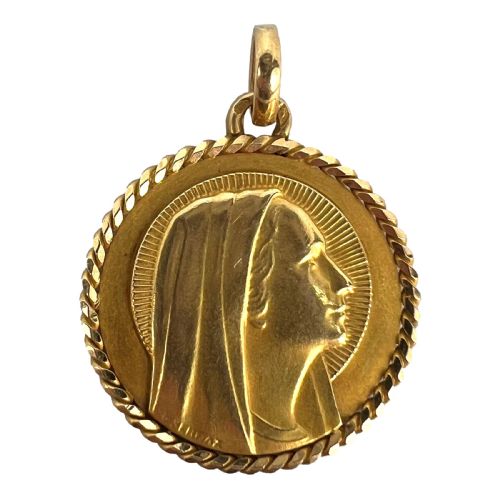
A blessed mother medallion takes the form of a pendant or charm, usually worn around the neck as a devotional item. These devotional pieces emerge primarily from French makers working between the Edwardian era and the mid-century period.
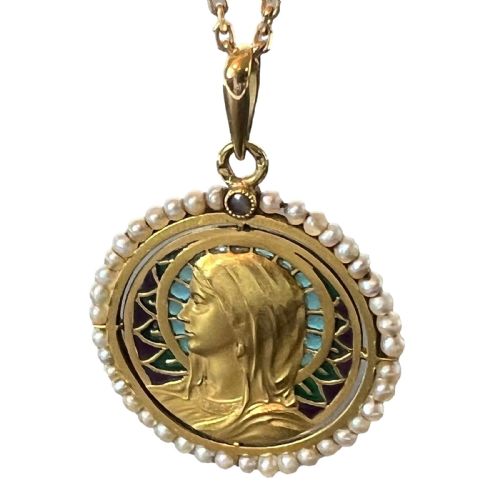
The most common examples on this page date from the nineteen-tens, rendered in yellow gold and featuring the likeness of the Virgin Mary, often styled as Notre Dame of Lourdes. These medals frequently incorporate French religious and art nouveau design elements from the period.
Materials and construction
Goldsmiths constructed these medals predominantly in eighteen-carat yellow and white gold, providing a warm or luminous metal ground for the iconography. Enamel work, specifically translucent plique-à-jour, appears alongside seed pearls and occasional diamonds to highlight the borders and details.
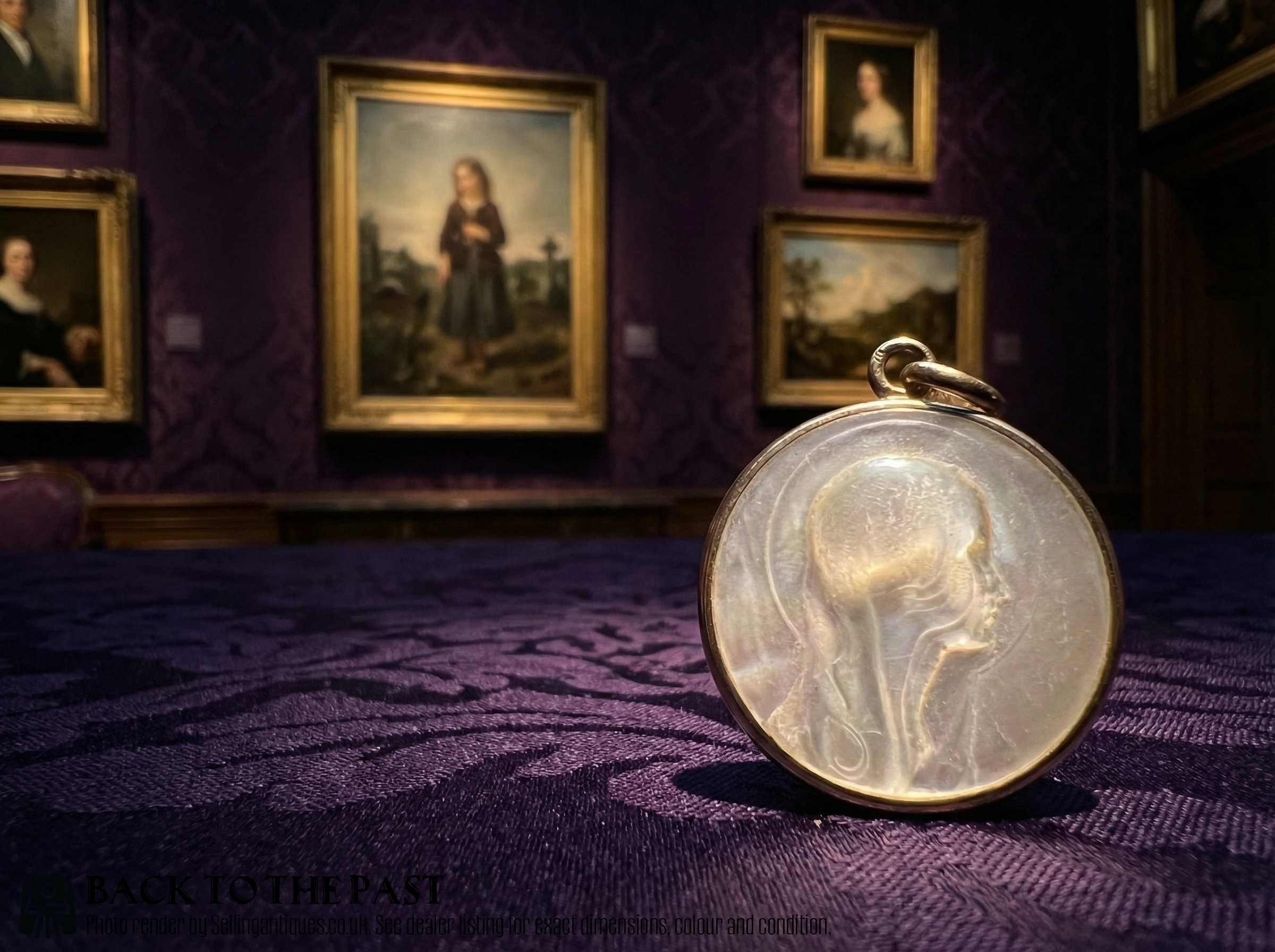
Medallion faces often combine stamped metal reliefs with hand-finished enamel and bezel-set pearls. Mother of pearl also serves as a backing or primary disc material in specific turn-of-the-century examples.
Materials recur consistently in gold, enamel, seed pearls, and mother of pearl across the inventory.
Quality factors in religious pendants
The precision of the metal stamping and the finesse of the maker's signature separate standard production from superior examples. Skilled medallists achieved remarkable depth and expression within small circular or oval fields.
The condition and complexity of the enamel work heavily influence the overall standard. Intact plique-à-jour or finely preserved polychrome enamel requires superior technical mastery compared to plain gold surfaces.
Emile Monier·Pageli Perriat·Emile Dropsy·Pageri Perroud·Serraz·Augis and Mazzoni
The Blessed Mother Medallion Glossary
- Plique-à-jour
- An enamelling technique where translucent enamel is fired without a backing, resembling miniature stained glass. Light passes directly through the coloured glass areas.
- Medal
- A flat piece of metal struck with a commemorative or devotional design, intended to be worn as jewellery. These often feature loops for suspension.
- Seed pearl
- A very small, naturally formed or cultured pearl used to border or accent jewellery designs. They are frequently drilled and strung or pegged into gold settings.
- Charm
- A small decorative pendant attached to a bracelet or necklace. In this context, charms share identical devotional imagery with larger pendants.
Blessed Mother Medallion: Frequently Asked Questions
What metals are these medallions made from?
These pieces are predominantly formed from eighteen-carat yellow gold, with occasional variations in white gold. The gold provides a durable and rich setting for the enamel and pearl embellishments.
Makers utilised this high standard of gold purity to ensure the longevity of intricate devotional reliefs.
How are these pendants worn?
Owners typically suspend these medals from gold chains to wear them close to the heart as traditional necklaces. They also function as charms when attached to charm bracelets.
The integrated suspension loops on each piece accommodate standard chains and jump rings for daily wear.
What periods do these pieces represent?
The available selection spans from the nineteen hundreds through to the nineteen fifties. The majority originate from the nineteen-tens, reflecting early twentieth-century French religious jewellery production.
Art Nouveau, Art Deco, and mid-century design movements all influence the aesthetic of these respective decades.
Are these items French in origin?
Yes, the overwhelming majority of these devotional pieces originate from France. They reflect French religious iconography and the signatures of renowned French medallists.
Inscriptions and maker marks on the medals frequently point to French workshops active during the first half of the twentieth century.