


Devotional French Jewellery
Devotional French jewellery brings together finely chased gold pendants, medals and charms depicting saints, the Virgin Mary and sacred hearts from the late nineteenth and mid twentieth centuries.
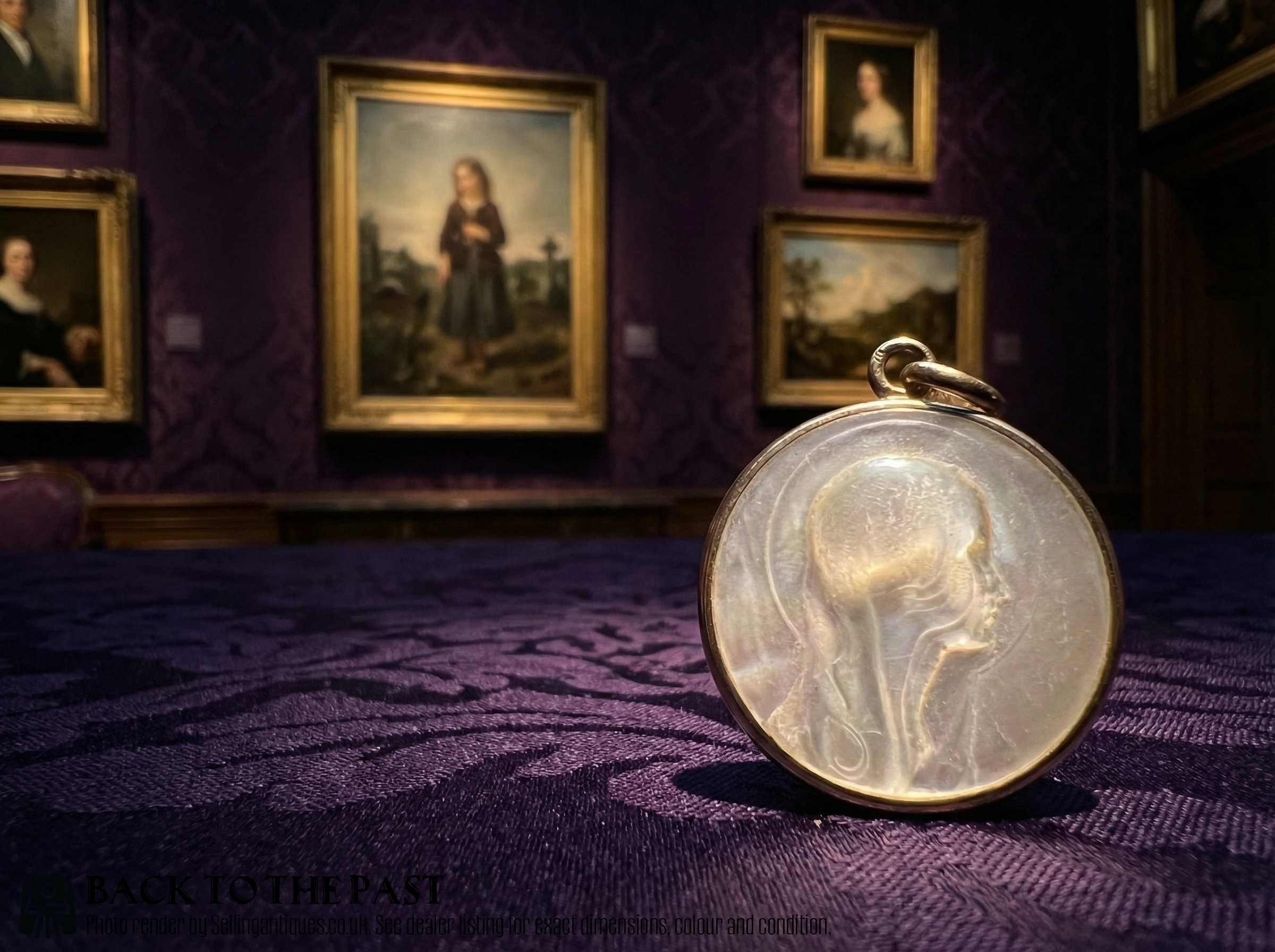
Devotional French Jewellery
Devotional French jewellery comprises religious pendants, medals and charms originating from France across several decades spanning the late nineteenth to the mid twentieth century. When searching for devotional French jewellery, buyers encounter pieces explicitly tied to Catholic iconography such as the Virgin Mary, the Madonna and Child, Saint Christopher, and the Sacred Heart.
The most common forms seen on this page are circular and oval medal pendants designed to be worn close to the heart on chains. These pieces frequently manifest characteristics of French religious art, Art Nouveau design, and ecclesiastical aesthetics.
The periods represented stretch from the 1890s through to the 1950s, capturing shifts in metalwork styles alongside traditional devotional imagery. Each pendant or charm serves both as an item of personal adornment and a tangible expression of faith.
How devotional french jewellery was made
The materials recorded in these pieces rely heavily upon 18ct yellow gold, rose gold, and occasionally white gold, providing a warm and durable foundation for religious iconography. Artisans employed detailed engraving techniques to render facial expressions, drapery, and symbolic motifs upon the metallic surfaces of pendants and medals.
Specialised decorative methods such as plique-a-jour enamel and the setting of seed pearls or mother of pearl appear alongside goldwork to introduce colour and texture. These techniques require precise craftsmanship to suspend translucent enamel within wire frames or to mount delicate organic materials securely into the gold structure.
Listings span periods from 1890 to 1950, capturing decades of French religious medal design.
What varies in quality in devotional french jewellery
Quality within these pieces is determined by the crispness of the engraving and the depth of relief in the depiction of figures like the Virgin Mary or Jesus Christ. Master medallists achieve subtle facial expressions and sharp textual lettering that elevate a standard devotional item into a work of miniature sculpture.
The integration of secondary materials such as plique-a-jour enamel or seed pearls introduces another tier of distinction. Pieces exhibiting clean enamel work and balanced compositions reflect a higher degree of atelier skill than simpler stamped alternatives.
Emile Monier·Mazzoni·Pageli Perriat·Emile Dropsy·Sellier·Tairac·Perriat·Pageri Perroud·Arnault·Grün·Monet·Ruffony·Serraz
The Devotional French Jewellery Glossary
- Pendant
- A piece of jewellery that hangs from a necklace or chain. In this collection, pendants primarily take the form of religious medals and charms.
- Sacred Heart
- A traditional Catholic devotion representing the physical heart of Jesus Christ as a symbol of divine love. It frequently appears on these medals alongside flames, crowns of thorns, or rays of light.
- Plique-a-jour
- An enamelling technique where enamel is applied in cells without a backing, resembling miniature stained glass. This allows light to shine through the translucent coloured material.
- Medal
- A flat piece of metal struck or cast with commemorative or religious imagery. Devotional medals are typically worn as pendants for spiritual protection.
- Art Nouveau
- An international style of art and architecture popular around the turn of the twentieth century. It is characterised by organic, flowing lines and natural motifs.
Devotional French Jewellery: Frequently Asked Questions
How were these religious medals worn?
These medals were typically suspended from gold chains and worn daily close to the heart as visible expressions of faith and protective talismans.
Many examples feature integrated loops or rings designed specifically for attachment to necklaces or charm bracelets.
How do I identify the period of a medal?
The period can often be deduced from stylistic indicators such as the sinuous lines of Art Nouveau designs around 1900 or the cleaner, geometric trends of the 1920s and 1930s.
Maker signatures and French gold hallmarks stamped onto the metal also provide definitive clues to the exact era of production.
What materials are used in these pieces?
The listings consist almost entirely of 18ct yellow gold, rose gold, and white gold as the primary structural and decorative metals.
Select pieces incorporate decorative elements such as plique-a-jour enamel, seed pearls, and mother of pearl to enhance the visual appeal of the religious iconography.