

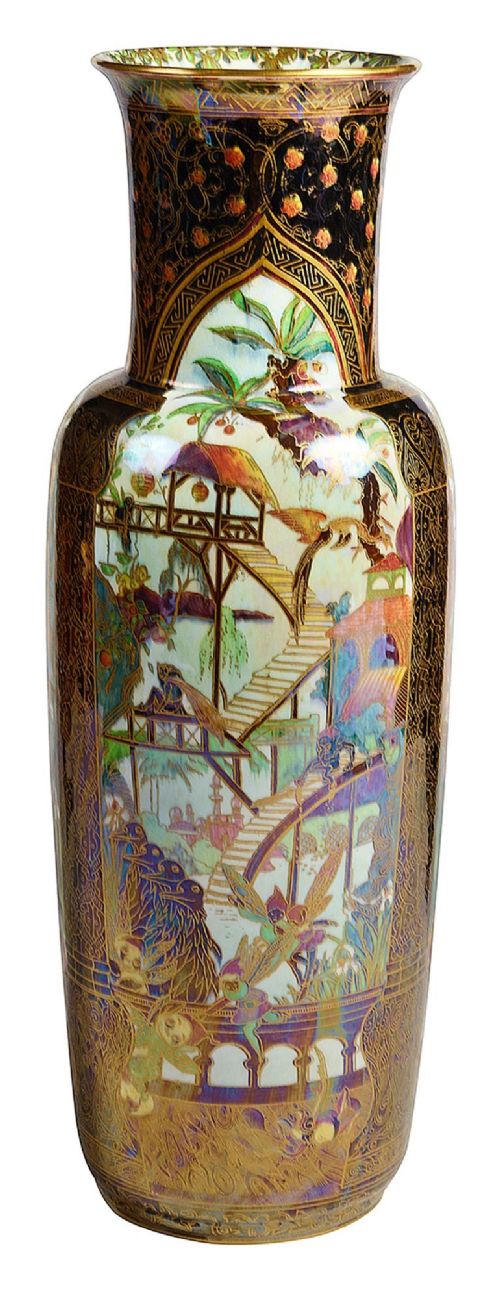


Black Pottery Vase
These black pottery vase pieces combine striking monochrome ceramic form with intricate hand-painted decoration, offering a dramatic focal point for any room.
Black Pottery Vase
When you search for a black pottery vase, you encounter a diverse selection of ceramic and porcelain vessels spanning the Victorian era through the early twentieth century. The items listed here encompass distinct stylistic movements, ranging from Japanese Meiji period Satsuma wares to European Art Nouveau and Art Deco creations.
You are most likely to meet pieces finished with elaborate hand-painted details, gilt decoration, or textured glazes rather than plain monochrome surfaces. The forms vary from tall bulbous vessels to paired mantle ornaments and converted table lamps.
The origins span British manufactories, continental European ateliers in Holland and France, and Japanese workshops. Each piece reflects the dominant decorative tastes of its specific period, whether that is classical Greek Revival or flowing organic design.
Materials and construction
The physical objects utilise standard ceramic bodies including earthenware, porcelain, bone china, and general ceramic paste. Artisans shaped these materials into robust vessels before applying specialised surface treatments.
Surface decoration relies heavily on hand painting, enamel work, and rich gold leaf application. Many examples incorporate specialised finishes such as lustre glaze and drip glaze to achieve textural depth and chromatic variation.
Black Pottery Vase Retail Price Guide 2026
Typical asking prices for black pottery vase among the pieces listed under this phrase on Sellingantiques today, from the lower quarter to the upper quarter. They describe what is for sale here now, not the wider market.
Object forms span standard display vases, paired mantel ornaments, and porcelain table lamps.
Assessing quality and execution
The distinction between standard production and superior execution rests upon the precision of the hand-painted details and the complexity of the surface ornamentation. Finer examples display meticulous brushwork in the depiction of figures, birds, and geometric panels.
The application of secondary materials like enamel and gold leaf dictates the visual impact of the piece. Superior items maintain crisp gilding and vibrant enamel colours that integrate harmoniously with the underlying ceramic body.
Daisy Makeig-Jones·Gallilleo Chini·Bernhard Bloch·Mougin
The Black Pottery Vase Glossary
- Earthenware
- Porous pottery fired at lower temperatures, requiring a glaze to achieve impermeability to liquids. It serves as the structural foundation for many traditional ceramic vessels.
- Lustre glaze
- A type of metallic glaze that imparts an iridescent sheen to the ceramic surface upon firing. This technique creates a reflective quality that shifts under changing light.
- Meiji period
- The era of Japanese history spanning from eighteen sixty-eight to nineteen twelve, characterised by intensive artistic output for export. Satsuma wares from this time feature dense pictorial narratives.
- Art Nouveau
- An international style of art and architecture prevalent around nineteen hundred, noted for asymmetrical organic lines and natural motifs. Pottery from this movement often depicts stylized flora and fauna.
- Art Deco
- A design style emerging in the nineteen twenties that prioritizes geometric symmetry and streamlined forms. Pieces from this period contrast sharply with the preceding organic curves of Art Nouveau.
Black Pottery Vase: Frequently Asked Questions
What periods do these pieces represent?
The inventory spans the late nineteenth century through the early twentieth century, capturing Victorian, Edwardian, and Art Deco design sensibilities.
You will find items specifically dated from eighteen ninety up to nineteen thirty, encompassing both British and international workshops.
How were these decorative vases used?
These vessels functioned primarily as ornamental display pieces rather than utilitarian containers for cut flowers. Pairs were traditionally placed on mantels or pedestals to demonstrate household refinement.
Some later examples were adapted into table lamps, shifting their purpose toward functional domestic illumination while retaining their decorative ceramic bases.
How do I distinguish Art Nouveau from Art Deco?
Art Nouveau pieces, produced around nineteen hundred, feature flowing, plant-inspired lines and asymmetric motifs. The aesthetic emphasises natural forms and hand-painted organic scenes.
Art Deco items, arriving by nineteen thirty, rely on strict geometric patterns, symmetry, and stylized industrial shapes. The transition marks a shift from organic curves to sharp angles.
What is Satsuma ware?
Satsuma ware is a type of Japanese pottery traditionally characterised by an ivory craquelure glaze decorated with rich colours and gold leaf. These pieces often illustrate traditional figures, arhats, and dragons.
Production expanded significantly during the Meiji period to satisfy international demand for detailed oriental ceramics.