


Black Painted Overmantel Mirror
A black painted overmantel mirror brings deep, dark tones and historic presence to a chimney breast, offering both reflection and architectural weight.
Black Painted Overmantel Mirror
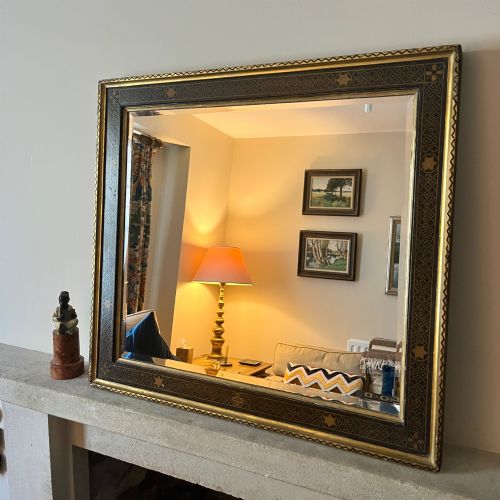
When you search for a black painted overmantel mirror, you encounter large horizontal looking glasses designed to sit above a fireplace. The examples on this page span the nineteenth century and the twentieth century, with strong representation from the Victorian and Edwardian eras. These pieces function as principal room focal points, originally scaled to match the width of a domestic hearth.
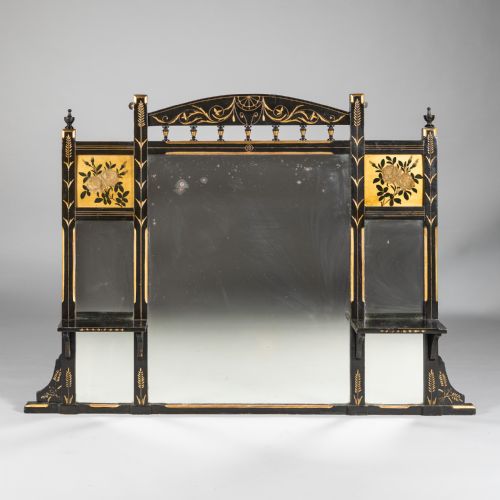
Most pieces you meet here belong to the Aesthetic Movement or the broader Victorian period, finished in ebonised wood or dark paint with contrasting highlights. Alongside standard wall mirrors and overmantel mirrors, the selection includes related forms such as display cabinets and carousel mirrors. Their origins stretch from Victorian fairgrounds to refined parlours, showing diverse aesthetic ambitions within dark painted frames.
How they were made
Maker construction relies heavily on timber frames coated in black paint, ebonised finishes, or black lacquer. Artisans built substantial wooden carcasses, applying gesso layers to shape decorative mouldings and ornate surface details before adding the final dark finish.
Gilding and silvering provide the contrasting highlights seen across these frames. Craftsmen applied gold leaf and parcel silvering to raised carvings, edges, and incised details to catch the light against the dark painted background.
Listings feature pieces spanning the nineteenth and twentieth centuries, including Victorian, Edwardian, and Art Deco styles.
What varies in quality
Quality reveals itself in the depth and complexity of the frame decoration, moving from simple painted mouldings to heavily carved wood and gesso relief work. Frames featuring intricate Aesthetic Movement detailing or specialised finishes display superior craftsmanship compared to plain utility pieces.
The treatment of metallic highlights distinguishes the workmanship of different pieces. Hand-applied gold leaf and parcel silvering require greater skill than flat yellow paint, creating a richer play of light across the ebonised surfaces.
The Black Painted Overmantel Mirror Glossary
- Overmantel mirror
- A large horizontal mirror designed specifically to hang on the wall directly above a fireplace mantelpiece. They often feature wide frames intended to balance the hearth below.
- Ebonised
- Wood finished to imitate expensive ebony through staining or dark painting. This technique became popular during the nineteenth century, particularly within the Aesthetic Movement.
- Gesso
- A plaster-like mixture applied to wooden frames and carved to create raised decorative details before gilding or painting. It allows for crisp, intricate ornamentation.
- Parcel-gilt
- A decorative treatment where only specific portions of an object are covered in gold leaf. The technique highlights carved details against a contrasting dark background.
- Aesthetic Movement
- A late nineteenth-century design style emphasising decorative art for its own sake, often featuring ebonised surfaces, Japanese-inspired motifs, and gilt highlights.
Black Painted Overmantel Mirror: Frequently Asked Questions
Where should an overmantel mirror hang?
These mirrors traditionally hang on the wall directly above a fireplace mantelpiece, matching the horizontal proportions of the hearth below. Their width helps anchor the surrounding wall space.
While designed for the chimney breast, larger examples also function effectively on principal walls in high-ceilinged rooms to bounce light around the space.
What is an ebonised finish?
An ebonised finish is a dark treatment applied to timber to mimic the appearance of dense, costly ebony wood. Makers achieved this look using dark paints, stains, or specialised chemical processes.
This finish became a defining characteristic of nineteenth-century design, providing a dark, uniform surface that made gilt highlights stand out.
How do I identify an Aesthetic Movement mirror?
Aesthetic Movement pieces typically combine ebonised wood surfaces with gold leaf or parcel-gilt highlights, reflecting a late nineteenth-century taste for refined, artistic decoration.
Their frames often incorporate incised geometric patterns, stylistic floral motifs, or Japanese-inspired details that set them apart from heavier, standard Victorian designs.
Can these mirrors be used in modern rooms?
The dark painted and ebonised frames provide a strong graphical element that anchors contemporary interior schemes just as well as historic ones. Their deep tones complement neutral walls and mixed antique or modern furniture.
Because they combine dark wood with reflective glass, they add both visual weight and brightness to a room without overwhelming the space.