


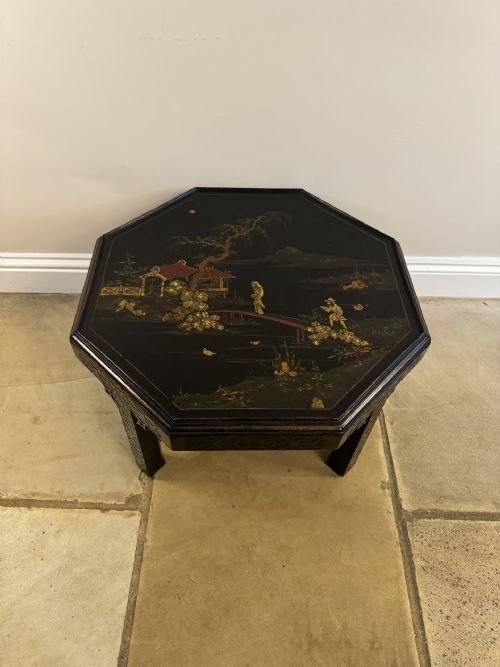


Black Octagonal Table
A black octagonal table offers a striking geometric silhouette in dark finishes, bringing grounded character to a room.
Black Octagonal Table
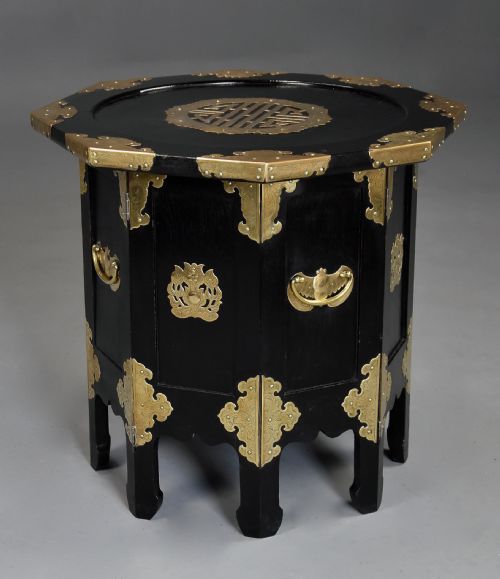
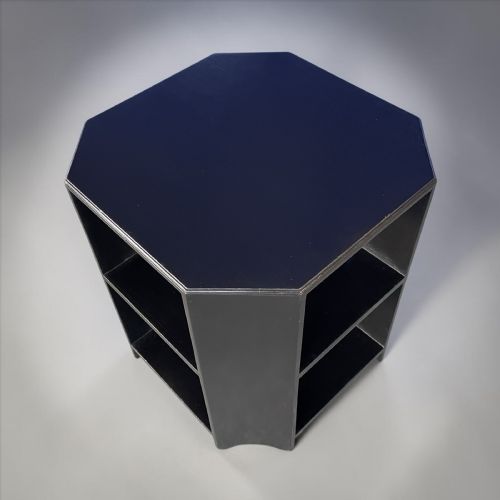
A black octagonal table appears in forms ranging from side tables and occasional tables to centre tables and coffee tables. These surfaces emerge across the nineteenth century, the Victorian era, the Regency period, and into the twentieth century around 1900, 1910, 1920, and 1930.
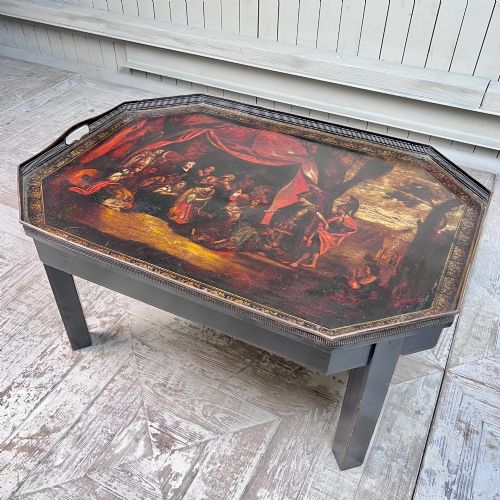
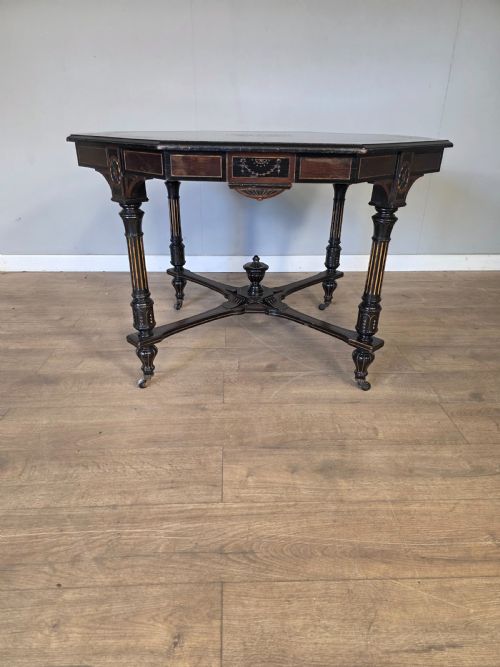
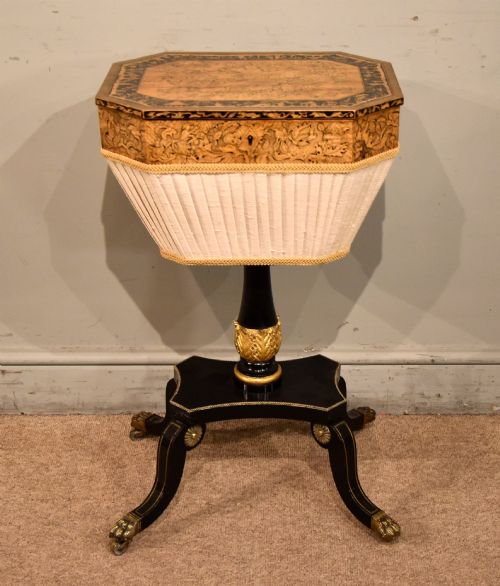
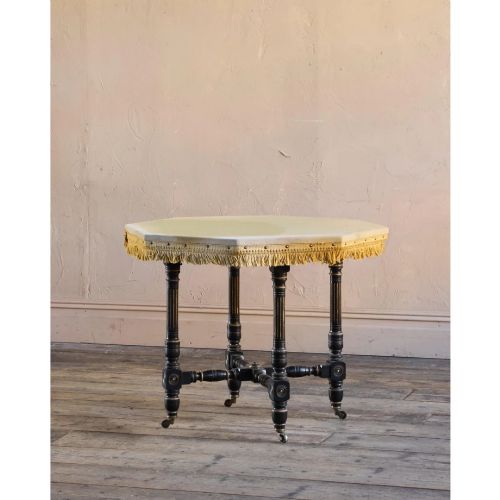
The aesthetic vocabulary encompasses Victorian, Aesthetic Movement, Regency, Anglo-Indian, Anglo-Burmese, Grand Regency, Chinoiserie, and Art Deco styles. Buyers most frequently encounter ebonised wood or lacquered finishes shaped with eight sides, often serving practical duties as small display or lamp surfaces.
What varies in quality
The depth and durability of the ebonisation or lacquer finish distinguish the standard of production across different workshops. Superior examples display crisp joinery along the eight-sided perimeters and stable, well-balanced support structures.
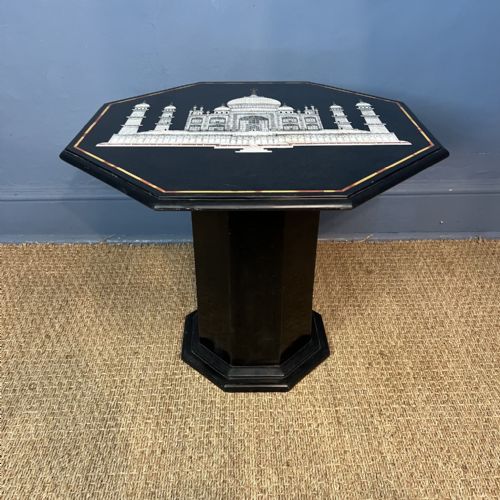
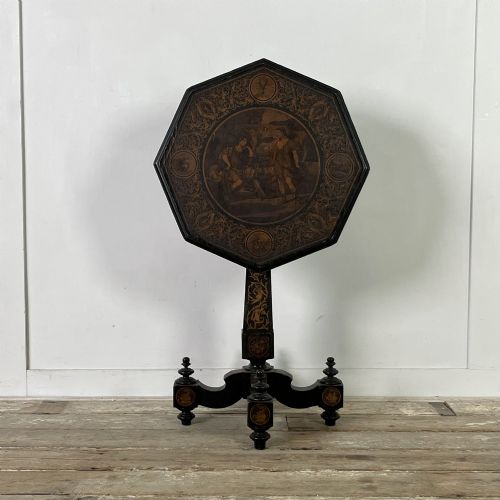
Ornamentation accounts for further distinction, where hand-painted chinoiserie, penwork, or precise metal and stone inlay reflect greater artisan skill than simpler baseline production.
One historical table depicts the specific literary scene of the family of Darius before Alexander.
Hindley & Sons·Gillows
The Black Octagonal Table Glossary
- Ebonised wood
- Timber treated with stain, dye, or paint to simulate the appearance of costly ebony. This technique gained immense popularity during the Victorian and Aesthetic Movement periods.
- Penwork
- A meticulous surface decoration technique utilising ink and a pen to draw intricate motifs directly onto prepared wood. It appears on nineteenth-century pieces alongside related ink work.
- Pietra dura
- An artistic technique using cut and fitted polished coloured stones to create geometric or pictorial designs on tabletops. It requires immense precision from the stonemason.
- Chinoiserie
- European decorative style reflecting Chinese artistic influences, frequently featuring painted or lacquered landscapes and figures. It thrives on early twentieth-century coffee tables and stands.
Black Octagonal Table: Frequently Asked Questions
What rooms suit a black octagonal table?
These tables adapt well to sitting rooms, studies, and hallways as functional lamp stands or display surfaces.
Their distinct eight-sided geometry helps break up linear room layouts while maintaining a compact footprint.
How do I identify an Aesthetic Movement piece?
Look for ebonised wood finishes combined with incised gilt decoration or Japanese-inspired motifs characteristic of late nineteenth-century design.
These works often prioritise balanced asymmetry and refined craftsmanship over heavy Victorian ornamentation.
Are these tables solid ebony?
Most examples utilise domestic timbers like beech or walnut that receive an ebonised finish to mimic solid ebony.
True solid ebony versions do exist from the nineteenth century, though they represent a smaller proportion of the available selection.
How do I care for lacquered surfaces?
Dust gently with a soft, dry microfibre cloth and keep the surface away from direct sunlight and moisture.
Avoid chemical polishes that can degrade historical lacquer and painted finishes over time.