


Black Marble Desk Lamp
A black marble desk lamp brings weight and classical polish to a room, combining dark stone with brass, bronze, and gilt details.
Black Marble Desk Lamp
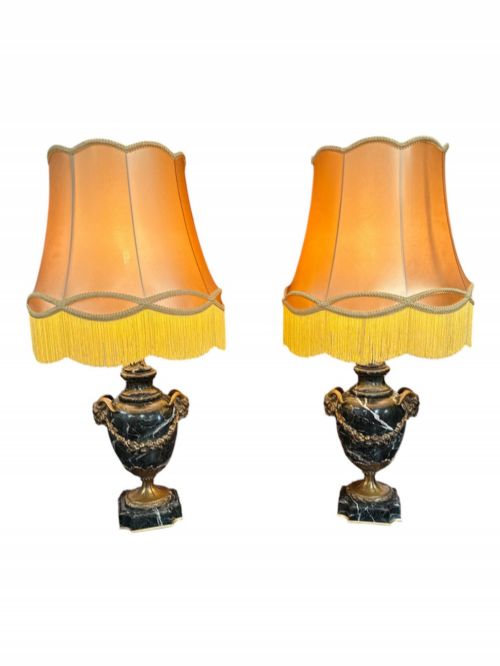
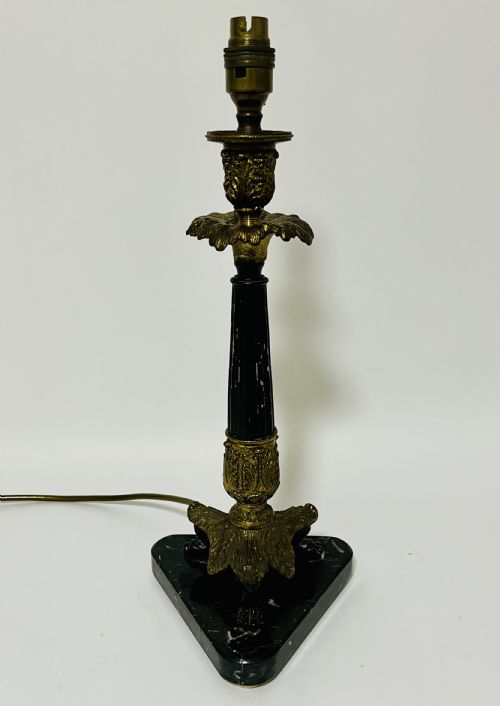
A black marble desk lamp combines natural stone bases with metal mounts, drawing on French Empire, Neoclassical, and Art Deco traditions. These pieces function primarily as decorative table lighting for desks, reading tables, and sideboards.
The versions met most frequently on this page originate from the nineteenth and early twentieth centuries, spanning Edwardian designs and the 1920s and 1930s. Many examples incorporate classical urns, columns, or figural motifs alongside marble.
Makers often paired the dark stone with contrasting brass, gilt bronze, spelter, or toleware to catch the light. Buyers encounter both single lamp bases and matched pairs configured for domestic illumination.
How they were made
Craftsmen shaped solid blocks of black marble to form heavy bases, columns, and urn bodies, often turning the stone on a lathe to achieve smooth architectural profiles. These heavy stone foundations were selected to anchor tall or ornate lighting fixtures securely.
Foundries cast decorative mounts, columns, and figural elements in brass, bronze, spelter, or gilt metal, which were then fitted directly to the marble. Metal components frequently received gilt or patinated finishes to contrast sharply against the polished black stone.
Listings feature pieces spanning the nineteenth century, Edwardian era, 1900, 1920, and 1930.
What varies in quality
Quality rests in the crispness of the metal casting and the depth of the marble polish. Superior pieces display sharply chiselled bronze or brass mounts that fit flush against the turned stone without awkward gaps.
The choice of materials also dictates the standing of a piece, with heavy bronze and detailed gilt work occupying the upper tier. Simpler spelter or toleware combinations represent more modest domestic production from the period.
The Black Marble Desk Lamp Glossary
- Spelter
- A zinc alloy commonly used as a substitute for bronze in decorative figures and lamp mounts. It was often given a dark or gilt finish.
- Toleware
- Painted or lacquered sheet metal, frequently used for shades and bodies on early twentieth-century lighting. It offers a smooth, matte contrast to polished stone.
- Gilt Bronze
- Bronze that has been coated with a thin layer of gold or gold-coloured alloy. Also known asormolu, it brings a bright metallic contrast to dark marble.
- Urn
- A classical vase-shaped vessel, frequently employed as the main body for nineteenth-century lamp conversions. These forms derive directly from ancient stone and ceramic precedents.
Black Marble Desk Lamp: Frequently Asked Questions
What periods do these lamps come from?
These lamps primarily date from the nineteenth century through the 1930s, encompassing Edwardian productions and Art Deco designs.
Earlier examples often lean towards French Empire and Neoclassical styles, while later pieces adopt streamlined geometric lines.
Are these lamps sold as pairs or singles?
Both single lamp bases and matched pairs appear across the listings depending on their original domestic use.
Pairs frequently originate from larger nineteenth-century garnitures or mantle garnitures converted later into lighting.
How do I identify French Empire style?
French Empire pieces rely on classical architectural forms such as columns, heavy square bases, and military or laurel motifs in gilt metal.
The combination of dense black marble and bright gilt brass or bronze is characteristic of this classical revival.
How do I care for marble and brass?
Marble should be dusted with a dry cloth and kept away from acidic liquids that can etch the polished stone surface.
Metal mounts require gentle cleaning without abrasive polishes to preserve the original period patination.