


Black Lacquered Accent Chair
A black lacquered accent chair brings deep tone and hand-painted detail into a room, offering both seating and decorative presence.
Black Lacquered Accent Chair
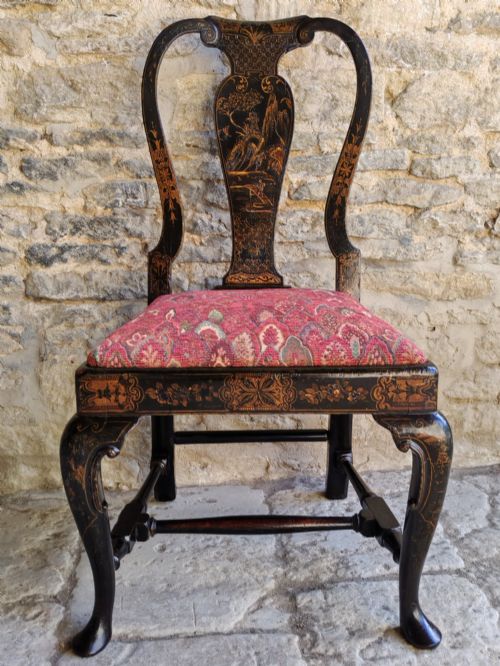
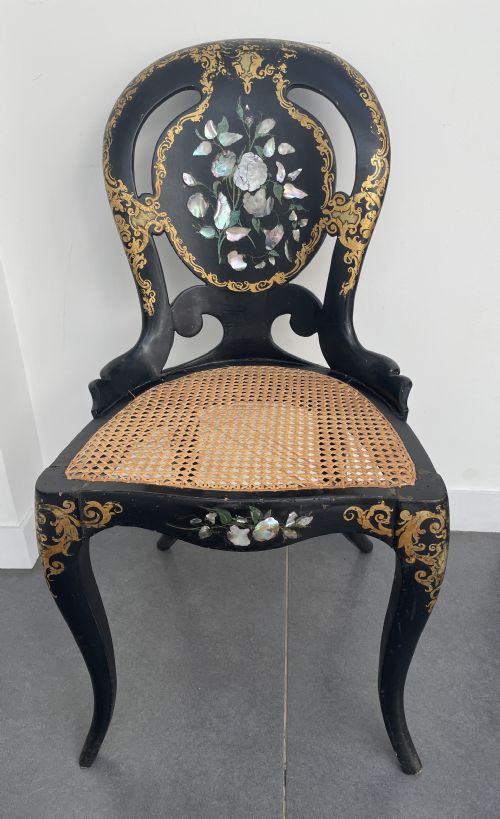
When you search for a black lacquered accent chair, you are looking at seating finished in dark lacquer, often enriched with gilt or painted ornamentation. These pieces range from early eighteenth-century Dutch and English examples to Victorian papier-mâché and Edwardian creations.
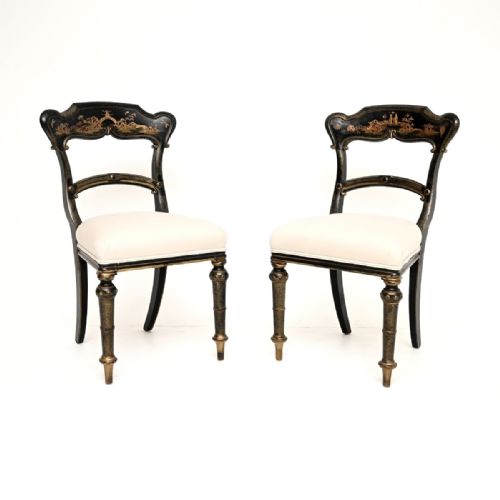
The versions you are most likely to meet on this page include side chairs and armchairs from the Victorian and Regency periods, alongside earlier eighteenth-century designs. They draw on Chinoiserie styles and Japanned finishes to create a distinct visual anchor in a space.
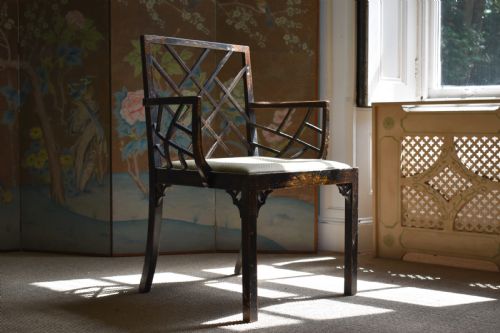
Forms vary from library chairs and bedroom chairs to dining sets and Cockpen armchairs. Each type displays the dark surface and decorative motifs characteristic of this tradition.
How they were made
Construction relies upon timbers such as ebonised wood or papier-mâché, finished with successive coats of lacquer to achieve a dark, reflective surface. Artisans then applied gilt decoration and occasionally inlaid mother-of-pearl to create pictorial or geometric patterns.
Seating surfaces often incorporate fabric, textile, or cane panels set within the wooden or papier-mâché framework. Carved details and faux bamboo turnings frequently shape the structural elements before the final surface treatment is applied.
Listings span the eighteenth, nineteenth, and early twentieth centuries, incorporating materials from cane and fabric to mother-of-pearl and gilt.
What varies in quality
The distinction between tiers of work rests upon the crispness of the carving and the depth of the lacquer finish. Pieces featuring hand-applied gilt decoration and intricate Chinoiserie scenes demonstrate a higher level of artisanal skill than simpler commercial outputs.
Original surface preservation heavily influences the character of each piece. Surviving gilding, intact mother-of-pearl inlay, and well-maintained cane or textile elements reflect the care taken over centuries.
The Black Lacquered Accent Chair Glossary
- Chinoiserie
- European decorative style inspired by Chinese art and design, frequently featuring landscapes and figures. It appears across eighteenth-century and Victorian furniture.
- Japanned
- European imitation of Japanese and East Asian lacquerwork, built up through layered varnishes and often decorated with raised gilt motifs. This technique defines many pieces on this page.
- Papier-mâché
- Composite material made from paper pulp mixed with glue and pressed into moulds before being dried and lacquered. It forms the lightweight structure of several nineteenth-century bedroom and side chairs.
- Cockpen
- Chinese-style lattice woodwork forming open square or geometric patterns within chair backs and arms. This structural form is associated with eighteenth-century revival and Edwardian seating.
- Ebonised
- Wood stained or painted to resemble ebony, providing a dark matte or polished finish. It serves as a base for gilt highlights in Victorian seating.
Black Lacquered Accent Chair: Frequently Asked Questions
Where should I place a black lacquered accent chair?
These chairs work well in halls, bedrooms, and sitting rooms where their dark finish creates a visual focal point. They function effectively as single statement pieces alongside contrasting upholstery.
Because of their decorative surfaces, they suit spaces where they can be viewed clearly rather than crowded against heavy furniture.
How do I care for a lacquered finish?
Dust the surface regularly with a soft, dry cloth to prevent particles from scratching the lacquer. Avoid chemical polishes and keep the piece away from direct sunlight and damp environments.
Maintaining a stable room temperature helps protect both the wooden or papier-mâché substrate and the delicate gilt details.
What is the difference between Chinoiserie and Japanned?
Chinoiserie refers broadly to European interpretations of Chinese artistic motifs, focusing on pictorial scenes of figures, pavilions, and gardens. Japanned describes the specific varnishing and lacquering technique used to achieve the dark, polished ground.
Many pieces combine both terms, using Japanned techniques to create a Chinoiserie design.
Are papier-mâché chairs sturdy enough for daily use?
Nineteenth-century papier-mâché furniture is surprisingly strong due to the compressed layers of material and reinforced internal framing. However, these pieces function best as accent seating rather than heavy everyday dining chairs.
Treating them with care preserves the lacquered surface and any inlaid mother-of-pearl.