
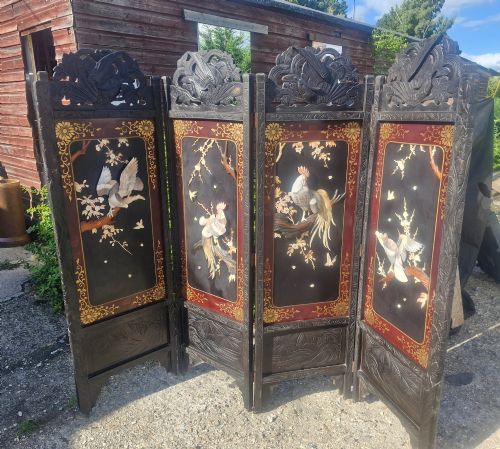


Black Lacquer Floor Screen
A black lacquer floor screen divides a room with deep panels and dark surfaces that catch the light.
Black Lacquer Floor Screen
When you search for a black lacquer floor screen, you are looking at large folding panels designed to divide interior spaces and ornament rooms with rich surface decoration. These pieces function as architectural dividers while introducing striking pictorial scenes into a domestic interior.
The versions you meet on this page span the nineteenth and twentieth centuries, originating from Chinese, Japanese, and Burmese workshops. They appear in varying panel counts, ranging from fourfold and sixfold designs up to substantial eightfold configurations.
Stylistically, these room dividers draw upon Chinoiserie traditions, Japanese Meiji aesthetics, Chinese Qing Dynasty motifs, and Art Deco interpretations. The forms include folding screens and room dividers constructed to stand independently across a floor space.
How they were made
Construction relies upon a robust wooden or hardwood framework built to support multiple folding panels joined by hinges, often incorporating brass hardware. Artisans applied layers of black lacquer to form the foundational ground, creating a deep, reflective surface.
Decoration involved intricate techniques such as carving directly into the lacquer layers, applying gold leaf, and painting detailed pigments. Many examples feature applied details in bone and hardstone to build raised, tactile figures and motifs across the panels.
Deep carved bone figures peer out from black lacquer folds, bringing entire miniature worlds into the middle of your sitting room.
What varies in quality
Quality reveals itself in the depth and precision of the carved decoration, particularly where artisans cut through layers of lacquer or set bone and hardstone into the wood. Finer examples display meticulous control in the painted pigments and the crisp application of gold leaf across the panels.
The integrity of the structural joinery and the weight of the underlying hardwood determine how stably a multi-fold screen stands when extended. Pieces with harmonious composition across all folds maintain visual balance, whereas simpler variants rely on repetitive stencil work rather than bespoke hand execution.
The Black Lacquer Floor Screen Glossary
- Lacquer
- A durable resin finish applied in multiple coats to wooden panels, producing a smooth, dark surface that resists wear. It forms the protective and decorative skin of the screen.
- Coromandel
- A type of Chinese incised lacquer where the design is carved into the dark ground and filled with pigments or gold. This technique creates a recessed, multicoloured relief effect.
- Chinoiserie
- European artistic style reflecting Chinese decorative motifs and techniques, frequently adapted in nineteenth and twentieth-century furnishings. It appears widely across screens on this page.
- Meiji
- A Japanese imperial period spanning from 1868 to 1912, known for highly detailed craftsmanship in export arts. Pieces from this era often feature precise painted and carved elements.
- Hardstone
- Dense minerals such as jade or agate cut and polished for inlay work. Artisans mount these stones onto lacquer surfaces to depict robes, flora, and figures.
Black Lacquer Floor Screen: Frequently Asked Questions
How do I place a floor screen in a room?
Position the screen against a blank wall or angle the folds to create a private alcove within a larger living space. Ensure the panels are not stretched completely flat so the structure remains stable.
Allow enough clearance around the panels so the hinges can articulate without scraping against furniture or flooring.
How do I clean a lacquered screen?
Dust the panels regularly with a soft, dry cloth to prevent particulate accumulation on the lacquer surface. Avoid abrasive cleaners, strong solvents, or excessive water that could damage the pigment or inlay.
Keep the screen away from direct sunlight and strong heat sources to prevent the wood and lacquer from drying out or cracking.
How can I tell Chinese and Japanese styles apart?
Chinese screens often employ coromandel incision and heavy hardwood frames with deep pictorial narratives from court or landscape traditions. Japanese export pieces from the Meiji era tend to feature finely painted details, gilt accents, and applied bone figures.
Look closely at the character of the carving and the palette of the pigments to identify the regional workshop traditions.
What does a fourfold screen mean?
A fourfold screen consists of four distinct wooden panels joined vertically by hinges, allowing the piece to fold in on itself or stand in a zigzag configuration. This smaller format suits moderate room proportions while retaining the decorative impact of larger dividers.
Panels of this scale offer a manageable way to introduce dark lacquer surfaces into domestic interiors without dominating the floor plan.