

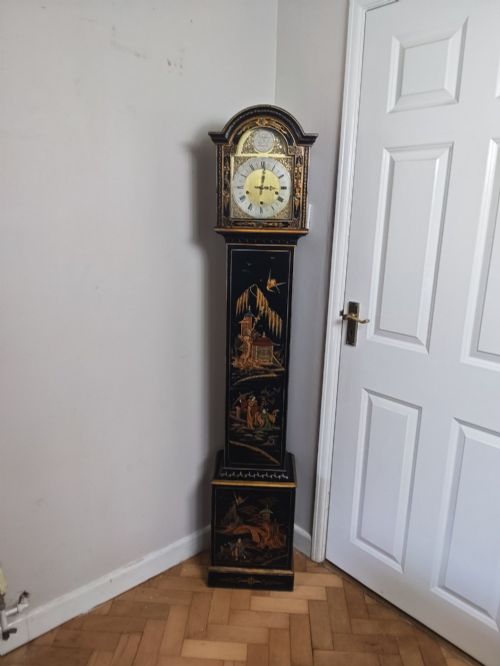


Black Lacquer Floor Clock
A black lacquer floor clock brings the distinct depth of Chinoiserie and Georgian design into a room with striking height and presence.
Black Lacquer Floor Clock
A black lacquer floor clock combines tall case construction with dark decorated finishes, taking the form of longcase clocks often referred to as grandfather or grandmother clocks. These timepieces appear across the Georgian period alongside later twentieth-century iterations dating up to nineteen thirty.
The aesthetic leans heavily on Chinoiserie decoration, placing gilt and painted figures against dark lacquered wood surfaces. Examples range from early eighteenth-century creations by named makers to smaller scaled grandmother clocks produced in the nineteen twenties and thirties.
Most variations on this page stem from the Georgian era and the early eighteenth century, utilising wood structures finished in japanned or lacquered treatments. Buyers encounter both full-size longcase formats and more compact musical movements housed in tall timber cases.
How they were made
Construction relies on timber cabinets shaped to house tall pendulum movements, subsequently treated with lacquer or japanned surfaces. Artisans applied successive coats to achieve a deep dark ground before adding gilt and painted detailing.
Dials incorporate brass and silvered brass components, often signed by the maker within the arch or chapter ring. Glass glazed hood doors protect the face while allowing a clear view of the timekeeping arrangement.
Black Lacquer Floor Clock Retail Price Guide 2026
Typical asking prices for black lacquer floor clock among the pieces listed under this phrase on Sellingantiques today, from the lower quarter to the upper quarter. They describe what is for sale here now, not the wider market.
The listings on this page span the Georgian period, the eighteenth century, and early twentieth-century decades up to nineteen thirty.
What varies in quality
Quality rests significantly on the depth and execution of the Chinoiserie decoration across the case surface. Finer examples display intricate gilt figures and landscapes that retain their crispness over centuries, whereas lesser pieces show flatter or more simplified painting.
The integrity of the timber case and the reputation of the dial maker also divide the range. Signed movements by makers such as Wise of Reading or Thomas Utting command greater attention than unsigned or later twentieth-century production.
Wise of Reading·Thomas Utting of Yarmouth·Gardner of London·Robert Berry
The Black Lacquer Floor Clock Glossary
- Japanned wood
- European furniture finished with varnishes and paints in imitation of East Asian lacquerwork. This technique creates the dark glossy ground typical of Chinoiserie clock cases.
- Longcase clock
- A tall pendulum clock enclosed in a wooden case standing directly on the floor. These pieces are frequently known by the traditional terms grandfather or grandmother clock.
- Chinoiserie
- European artistic style reflecting Chinese motifs and decorative patterns. It appears widely on eighteenth-century clock cases through raised gilt figures and pagodas.
- Grandmother clock
- A smaller, more compact version of the traditional longcase clock standing lower in height. They emerge in later twentieth-century manufacturing periods.
- Silvered brass
- Metal dials treated to achieve a bright silver-toned finish for numerals and chapter rings. This material contrasts sharply against the dark lacquer of the surrounding case.
Black Lacquer Floor Clock: Frequently Asked Questions
What is a black lacquer floor clock?
A black lacquer floor clock is a tall pendulum timekeeper housed in a wooden case finished with dark lacquer and Chinoiserie decoration. These pieces stand directly on the floor and range from eighteenth-century Georgian originals to twentieth-century variations.
They serve as both functional timepieces and prominent architectural furniture elements within a room. The dark surface serves as a backdrop for gilt and painted oriental scenes.
How do I date a black lacquer floor clock?
Dating relies on the stylistic markers of the case, the construction methods of the timber, and any signature inscribed upon the brass dial. Eighteenth-century examples display different proportions and hand-painted details compared to those from the nineteen twenties or thirties.
Maker signatures such as those by Robert Berry or Thomas Utting help anchor specific pieces to particular decades. Examining the movement type and the style of the Chinoiserie decoration further clarifies the period of origin.
Where should I place a floor clock?
Floor clocks require a stable, level surface against a wall where their height can be accommodated safely without obstruction. Hallways, landings, and principal living rooms traditionally host these tall timepieces.
Because direct sunlight can affect lacquered wood and painted surfaces over time, positioning away from intense windows preserves the finish. Adequate clearance is also necessary for the pendulum and weights to operate freely.
What is the difference between grandfather and grandmother clocks?
Grandfather clocks refer to full-sized traditional longcase clocks originating in the Georgian era and earlier. Grandmother clocks are smaller, more compact versions typically associated with twentieth-century production.
Both utilise similar lacquered wood construction and Chinoiserie decoration, but the grandmother clock occupies less vertical space. This smaller scale suits lower ceiling heights while retaining the traditional longcase aesthetic.