




Black and Gold Coffee Table
These black and gold coffee table pieces bring rich lacquerwork and gleaming gilt accents straight into a proper sitting room.
Black and Gold Coffee Table
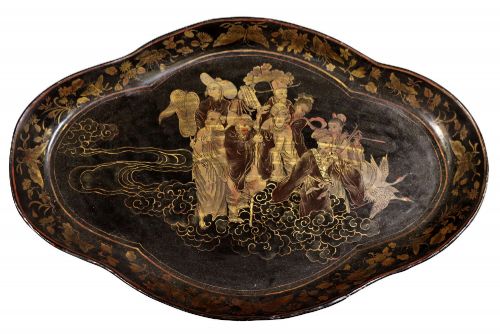
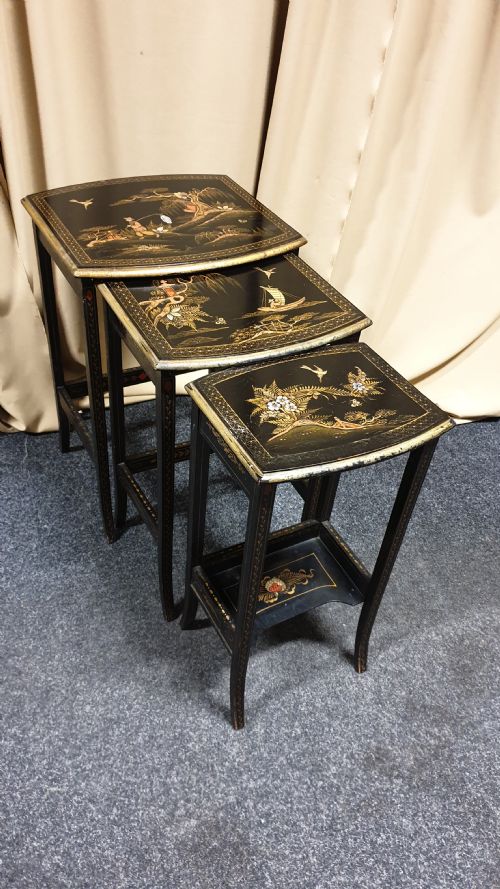
When you search for a black and gold coffee table, you are looking at dark surfaces brightened by gilding, lacquer, and Orientalist motifs. These pieces range from nineteenth century papier-mâché trays mounted on later stands to nests of occasional tables and low circular designs.
The most common versions on this page are Chinoiserie decorated nests and nineteenth century papier-mâché tray tables. You will also find Edwardian interpretations and Venetian style low tables that adapt these dark finishes for domestic use.
Makers utilised lacquer and gold leaf to create striking contrasts that suit both period drawing rooms and modern interiors. Each form serves as a functional surface while adding significant visual weight to a room.
Materials and construction
The construction of a black and gold coffee table relies heavily on wood, papier-mâché, and layered lacquer. Artisans applied successive coats of dark lacquer to create a deep, glossy ground before adding intricate painted scenes.
Gilding and gold leaf form the luminous highlights on these surfaces, often complemented by mother-of-pearl inlay. Many pieces combine a lightweight papier-mâché or wooden tray with a sturdy support stand.
Victorian tea drinkers relied on papier-mâché trays so sturdy they could carry heavy porcelain services without a single wobble.
Judging quality
Quality in a black and gold coffee table is visible in the depth of the lacquer and the precision of the hand-painted detailing. Superior examples exhibit crisp Chinoiserie figures and securely adhered gold leaf rather than flat, stencilled decoration.
The integrity of the underlying papier-mâché or wood also dictates the standard of the piece. Tables that retain their original stands and authentic surface crazing command greater appreciation than heavily restored equivalents.
Jennens and Bettridge
The Black and Gold Coffee Table Glossary
- Papier-mâché
- A composite material made from paper pulp or sheets of paper mixed with glue and resin, pressed into moulds and dried. It forms a remarkably strong, smooth base for lacquer.
- Lacquer
- A durable varnish applied in many thin layers to wood or papier-mâché, then polished to a hard sheen. It provides a deep black background that protects the painted decoration beneath.
- Gilding
- The application of gold leaf or powder to a surface. This technique illuminates the dark lacquer details on tables and trays.
- Nest of tables
- A set of graduated tables designed to fit neatly beneath one another. They offer practical surface space that packs away when not in use.
Black and Gold Coffee Table: Frequently Asked Questions
Are these tables sturdy enough for daily use?
Most pieces function well for holding books, cups, and decorative items during normal daily living. Papier-mâché tray tables and nested sets were originally built for portable utility in nineteenth century drawing rooms.
However, you should handle older joints with care and avoid placing excessively heavy loads on antique frames. Using coasters helps protect the original lacquer surface from moisture rings.
What is the difference between a tray table and a nest?
A tray table typically consists of a removable serving tray resting upon a folding or fixed wooden stand. This form allows the top to be lifted off independently of its support.
A nest of tables comprises multiple independent pieces built in graduated sizes to slide neatly together. Both styles utilise black lacquer and gold decoration but serve distinct spatial arrangements.
How can I tell if a table is nineteenth century?
Nineteenth century examples often display authentic hand-painted Chinoiserie motifs over genuine papier-mâché or solid timber bases. Closer inspection reveals subtle signs of age in the lacquer crazing and wear patterns.
Later reproductions frequently rely on modern stencilling techniques and lack the distinct material weight of period pieces. Examining the underside and joinery usually clarifies the age of the stand.