


Beige Landscape Painting
These beige landscape painting examples capture rural scenes, coastal views and townscapes in subtle earth tones.
Beige Landscape Painting
A beige landscape painting brings together historical works depicting natural views, coastal stretches and rural settlements rendered in neutral palettes. Collectors seek these pieces for their quiet tonal qualities and historical breadth spanning the Victorian era through the mid-twentieth century.
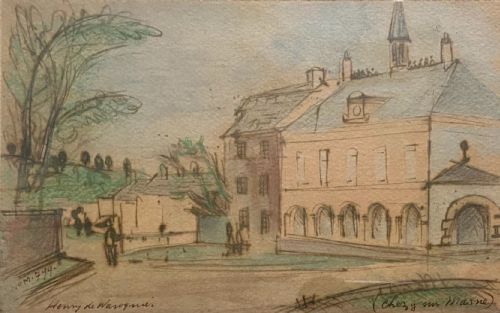
The selection here includes watercolours on paper, ink and mixed media drawings, and oil paintings on canvas. Buyers most frequently encounter framed works created by British and European artists working within impressionist, post-impressionist and traditional styles.
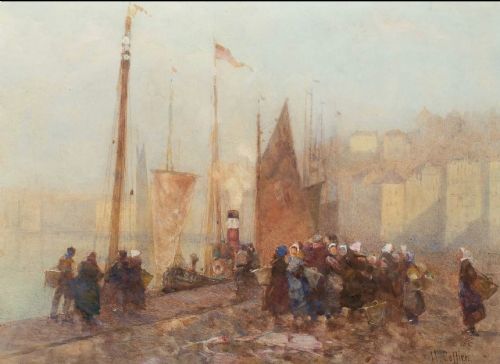
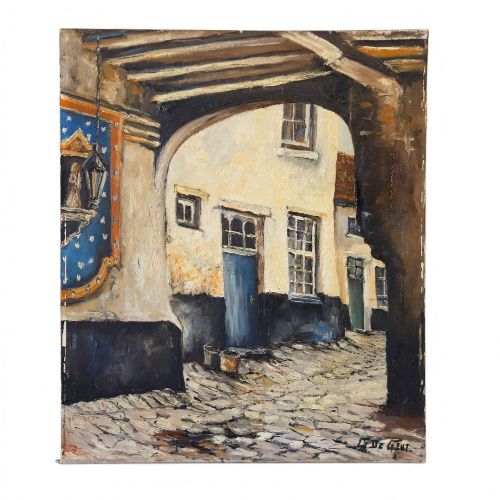
Subjects range from Yorkshire coastlines and Scottish rivers to Flemish street scenes and French cityscapes. Each piece records a specific topography through the distinct lens of its period, whether created in the late nineteenth century or during the 1940s and 1960s.
Materials and technique
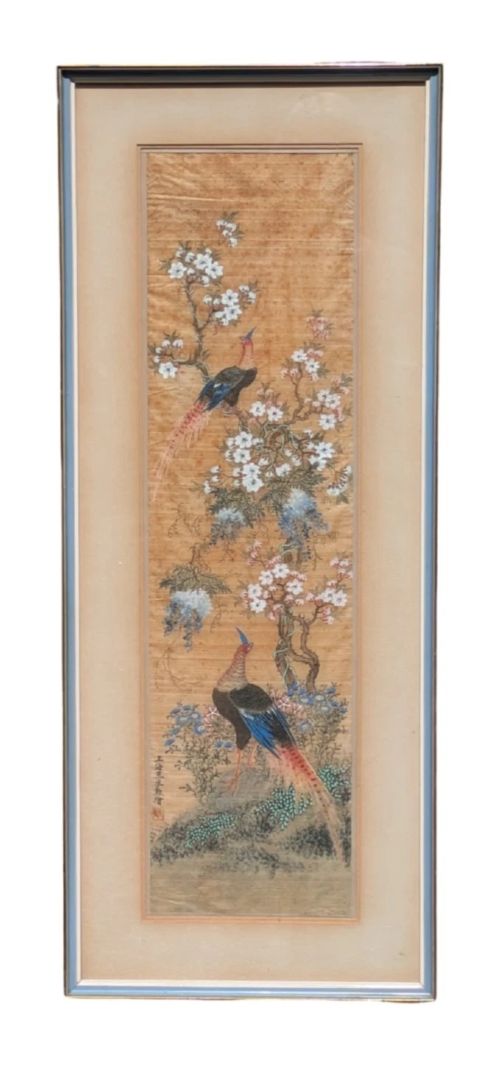
Artists relied upon oil paint applied to stretched canvas or wood panels, alongside watercolours and inks worked onto paper or silk. These primary materials determine the surface texture and define the preservation needs of each artwork.
Brushwork varies from the blended precision seen in nineteenth-century watercolours to the looser, expressive strokes characteristic of mid-century impressionist oils. Supporting elements typically include glass protection for works on paper and original wood framing.
Several artists recorded bustling scenes of everyday life, from camels crossing the desert to quiet moments on the Yorkshire coast.
Judgement of quality
Quality rests upon the confidence of the brushwork and the artist's command of light and atmospheric depth within a restrained palette. Stronger examples demonstrate assured composition and a purposeful handling of medium, whether in ink, watercolour or oil.
Condition and originality further distinguish the range, with preference given to works retaining their historical framing and stable pigment surfaces without excessive restoration. Signature clarity and documented provenance from established periods elevate individual pieces.
HECTOR CAFFIERI·Henry de Waroquier·William Frederick Settle·Cuthbert Crossley·Fred Lawson·Mercedes Legrand·Leslie Rackham·Kate E Booth·YA MING·George De Paris·JESSIE HALL
The Beige Landscape Painting Glossary
- Watercolour
- A painting method where fine pigment is suspended in a water-based, translucent solution. It is traditionally applied to paper to achieve delicate washes and light-filled tones.
- Impressionism
- A nineteenth-century artistic movement focused on capturing the visual impression of a moment, typically characterised by visible brushstrokes and an emphasis on natural light.
- Mixed media
- An artwork combining two or more distinct artistic materials, such as ink and watercolour used together on a single paper support.
- Provenance
- The documented history of ownership surrounding a work of art, which helps verify its authenticity and past exhibitions.
- Canvas
- A heavy woven fabric stretched across a wooden frame to serve as a durable support for oil painting.
Beige Landscape Painting: Frequently Asked Questions
What periods do these paintings cover?
The selection spans from the late Victorian period through the early twentieth century, extending into the 1940s and 1960s.
Works reflect the shifting artistic movements of these decades, moving from traditional nineteenth-century techniques towards mid-century impressionism.
Are these works original paintings?
The inventory consists of original hand-painted works, including unique watercolours, ink drawings and oil paintings on canvas.
Each piece represents a direct creation by the artist rather than a later mechanical reproduction.
How should I frame works on paper?
Watercolours and works on paper require conservation mounting with acid-free materials to prevent discolouration over time.
Glazing with protective glass shields the delicate pigments from ultraviolet light and atmospheric pollutants.
How do I identify a watercolour from an oil painting?
Watercolours are painted on paper beneath glass, displaying translucent washes where the white of the paper illuminates the colour.
Oil paintings utilise heavy pigments on canvas or wood, presenting a textured surface that often lacks protective glass.