

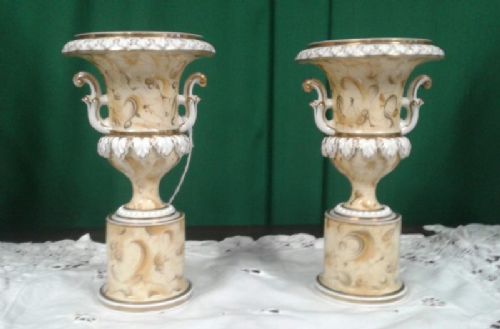


Beige Ceramic Urns
These beige ceramic urns bring tactile, earthen presence to a room, offering quiet classicism through muted tones and durable bodies.
Beige Ceramic Urns
When you search for beige ceramic urns, you encounter a selection of vessels spanning utility and ornament across several centuries. The pieces on this page include Victorian campana shapes, rustic storage jars, and delicate Art Nouveau forms.
Makers and potteries from England, Germany, Denmark, France, and Japan shaped these objects from clay, earthenware, and stoneware. Collectors find everything from miniature Doulton Lambeth garlands to large olive and walnut oil jars.
The aesthetic leans towards neutral palettes, encompassing unglazed terracotta, creamy biscuit porcelain, and soft enamel glazes. These historic vessels served various purposes, from holding garden plants in jardinieres to acting purely as decorative centrepieces.
How they were made
Potters shaped these vessels using traditional methods of throwing, moulding, and casting in various clay bodies. Stoneware and earthenware formed the robust structures of utilitarian jars, while finer porcelain and terracotta allowed for delicate sculptural detail.
Makers applied glazes, enamel, and sometimes gilding to the surfaces before firing them in kilns. Some pieces feature hand-painted decoration applied directly onto the ceramic body or over specialised patent finishes.
Beige Ceramic Urns Retail Price Guide 2026
Typical asking prices for beige ceramic urns among the pieces listed under this phrase on Sellingantiques today, from the lower quarter to the upper quarter. They describe what is for sale here now, not the wider market.
Listed items span several distinct movements, featuring Victorian, Art Nouveau, Neoclassical, and Art Deco styles.
What varies in quality
The standard of a piece rests on the crispness of its moulding and the control evident in its painted or glazed surface. Early works by established potteries demonstrate superior command over kilns and pigment application.
Proportion and decorative balance distinguish standard production wares from ambitious studio pieces. A well-executed glaze interaction and harmonious form elevate an ordinary vessel into a notable example of its period.
Ridgeways·Mettlach Pottery·Doulton Lambeth·Gallilleo Chini·Makuzu Kozan II·P. Ipsens Enke·Charlotte Rhead
The Beige Ceramic Urns Glossary
- Campana
- A bell-shaped vessel with a flared lip, often set on a pedestal base. This classic form frequently appears in Victorian decorative urns.
- Jardiniere
- An ornamental pot or stand designed to hold growing plants or flowers. These large vessels often feature rich surface decoration or rustic handles.
- Stoneware
- A sturdy, vitrified pottery fired at high temperatures. It resists liquid absorption without needing a porous earthenware body.
- Bisque
- Unglazed fired porcelain or ceramic that presents a matte, chalky white or cream surface texture. It mimics the appearance of carved marble.
- Terracotta
- A porous, brownish-red fired clay used for garden vessels and sculptural objects. Its natural warmth suits provincial and rustic forms.
Beige Ceramic Urns: Frequently Asked Questions
What periods do these urns represent?
The selection spans diverse eras, including Victorian, Edwardian, and early twentieth-century movements like Art Nouveau and Art Deco. Pieces also stretch back to older rustic traditions.
Specific dates on this page reach from the nineteenth century into the 1930s, showcasing shifting design philosophies across European and Japanese kilns.
How were these ceramic vessels used historically?
Many acted as decorative focal points on mantelpieces, dining tables, or in grand entrance halls. Others served functional roles as storage jars for pantry staples or as plant holders.
Larger jars held commodities like olive oil and walnuts, while smaller campana shapes and miniature vases existed purely for aesthetic display.
How do I distinguish between stoneware and earthenware?
Earthenware is fired at lower temperatures, resulting in a porous body that typically requires a glazed surface to hold water. It often feels lighter and less dense.
Stoneware undergoes high-temperature firing until the clay vitrifies, creating a non-porous, stone-like material that is heavier and far more durable.
How can I care for antique ceramic urns?
Keep them out of direct, harsh sunlight to protect delicate enamel work and hand-painted surface details. Dust them gently with a dry, soft cloth.
Avoid using harsh chemical cleaners or submerging porous terracotta and bisque pieces in water, as moisture can damage historic bodies.