

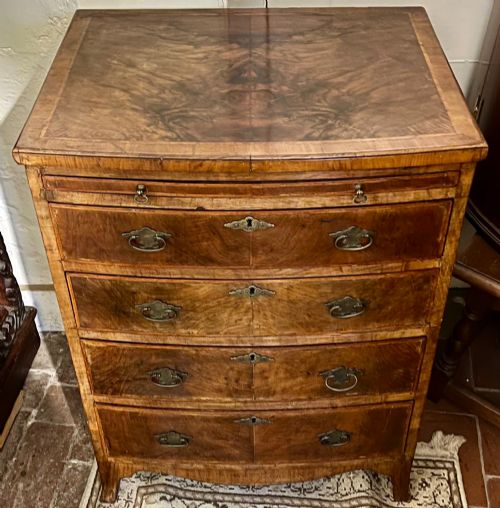
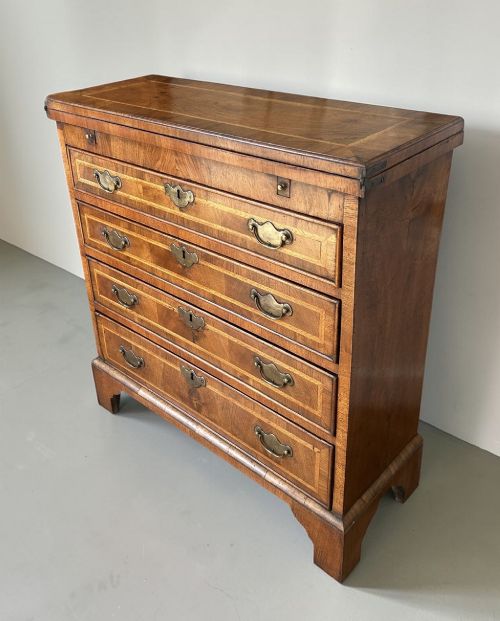
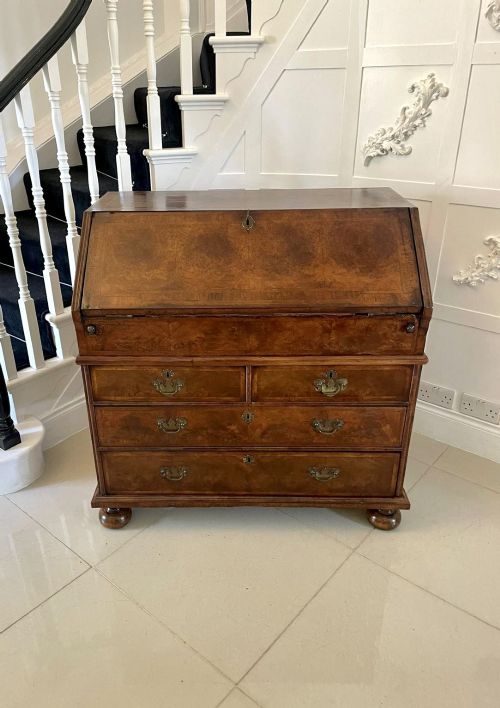
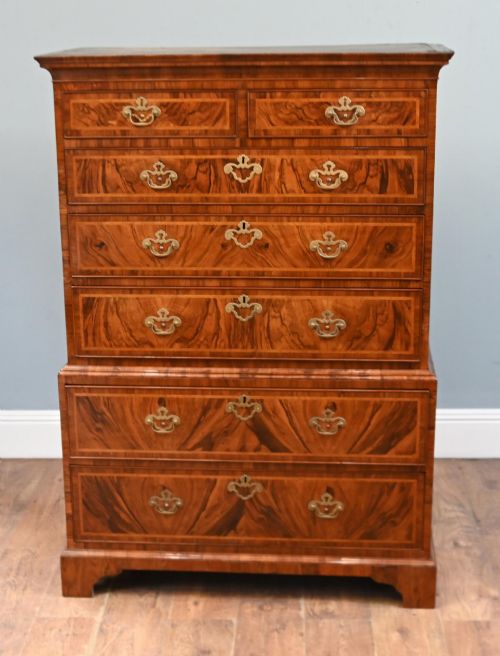
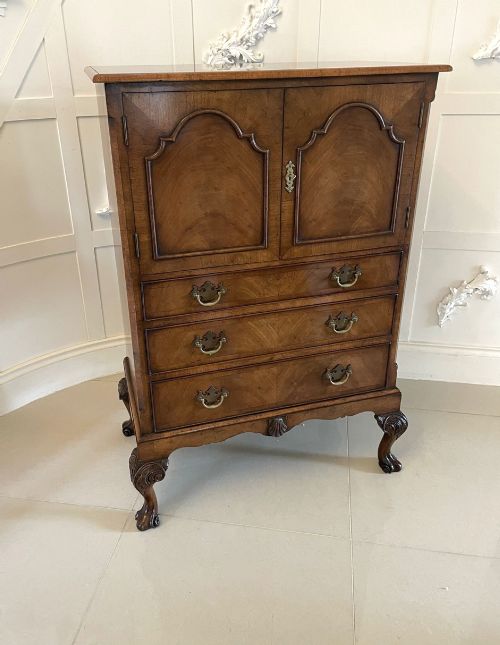
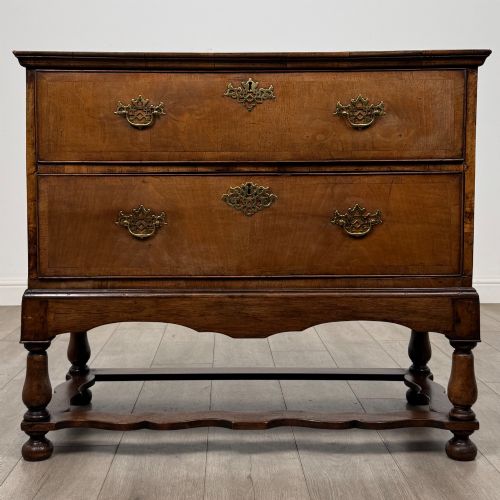
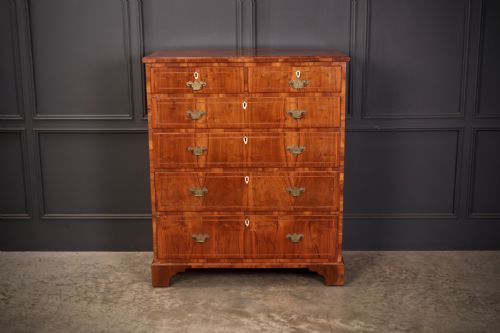
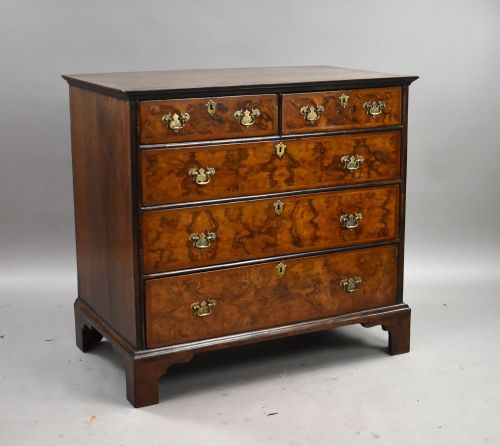


Banded Walnut Chest
A banded walnut chest brings rich grain and quiet warmth to a room, offering deep drawers set within figured timbers.
Banded Walnut Chest
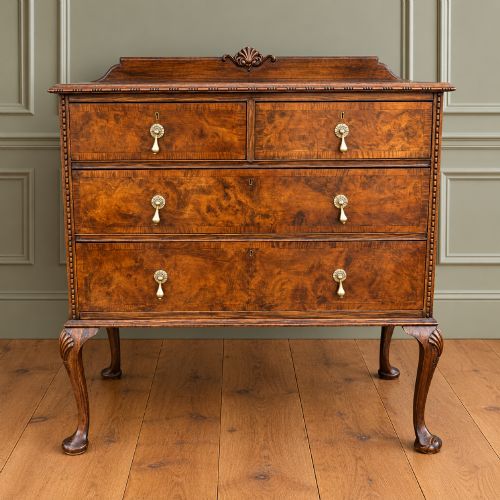
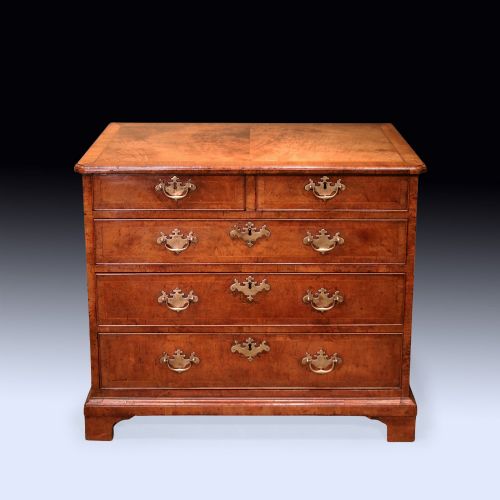
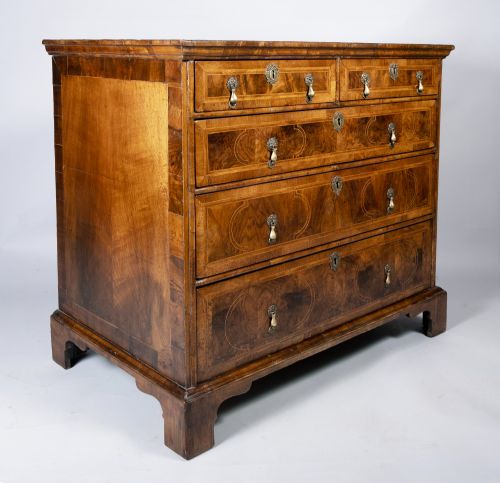
A banded walnut chest draws the eye through rich timber figuring framed by fine border inlay, making it a focal point in a traditional interior. When searching for a banded walnut chest, buyers encounter pieces spanning the late seventeenth century through the Georgian era, alongside later revival interpretations from the twentieth century.
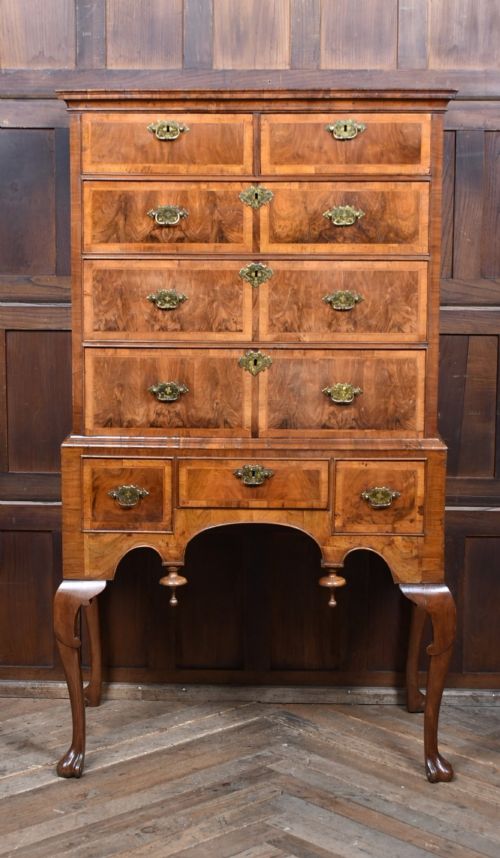
The selection ranges from low chests of drawers and bachelors chests to taller forms like chest on chest structures, tallboys, bureaux, and chests on stands. Pieces often incorporate feather banding, herringbone patterns, or boxwood lines that define the drawer perimeters against the darker walnut background.
Originating predominantly from seventeenth and eighteenth-century British cabinet-making traditions, these items appear alongside later pieces reflecting Queen Anne and Georgian design principles. The underlying carcase construction frequently utilises oak alongside the primary walnut exterior.
Materials and Technique
Cabinet-makers constructed these carcases using solid oak for internal framing and drawer linings, applying walnut veneers and burr walnut across the visible exterior surfaces. The characteristic banding involves careful cutting of contrasting timbers such as boxwood to create geometric borders around drawer fronts.
Master craftsmen utilised brass for key escutcheons and drop handles, while bone and leather occasionally appear on specialised writing surfaces within bureaux. Polishing techniques relied on traditional finishes that enhanced the natural figuring and deep brown tones of the timber.
Joinery techniques included dovetailed drawer construction and precise veneering, ensuring stability across large flat surfaces on chests and tallboys.
Banded Walnut Chest Retail Price Guide 2026
Typical asking prices for banded walnut chest among the pieces listed under this phrase on Sellingantiques today, from the lower quarter to the upper quarter. They describe what is for sale here now, not the wider market.
Some seventeenth-century bureau drawers hide tiny secret compartments originally designed for smuggled love letters and small family fortunes.
Assessing Quality
The distinction between tiers of craftsmanship lies in the selection of the timber veneer and the precision of the decorative banding. Superior examples display symmetrical burr walnut figures and meticulously aligned herringbone or feather banding that follows the drawer contours without interruption.
Proportion and architectural harmony dictate the upper echelon of these pieces, particularly in tallboys and chests on stands where the relationship between the upper section and the base determines visual balance. Original brass hardware, stable carcase construction, and untouched surfaces elevate a piece far above heavily restored alternatives.
The Banded Walnut Chest Glossary
- Banding
- A narrow strip of contrasting timber inlaid around the edges of a drawer front or tabletop. This technique frames the primary veneer and accentuates the geometry of the piece.
- Feather banding
- Two strips of veneer cut diagonally and laid edge-to-edge to form a repeating chevron pattern resembling a bird feather. It requires high precision from the cabinet-maker.
- Herringbone
- An arrangement of small rectangular veneer pieces laid in a staggered V-shaped pattern. It creates a dynamic zig-zag border around the main panels.
- Burr walnut
- Timber harvested from the irregular growth knots of a walnut tree, yielding a highly swirled and mottled grain pattern. Cabinet-makers reserved this prized material for prominent drawer fronts and top panels.
- Chest on stand
- A form comprising a drawer section elevated upon a separate open frame with legs. This configuration lightens the visual weight of tall storage furniture.
Banded Walnut Chest: Frequently Asked Questions
What is a banded walnut chest?
A banded walnut chest is a wooden storage unit featuring drawer fronts decorated with contrasting inlaid borders around figured walnut or burr walnut veneers.
These pieces typically date from the seventeenth and eighteenth centuries, as well as later revival periods, and serve as both practical storage and decorative focal points.
How do I date a walnut chest?
Dating relies on examining the construction methods, secondary woods like oak drawer linings, and the style of the brass hardware and bracket feet.
Early pieces from the seventeenth century often show different dovetailing and carcase assembly compared to mid-Georgian examples or twentieth-century revival items.
What is feather banding?
Feather banding is a decorative inlay technique where thin strips of veneer are cut and laid to form a central dividing line resembling a feather.
Cabinet-makers used this detail to outline drawer fronts and panels on fine walnut furniture during the late seventeenth and early eighteenth centuries.