
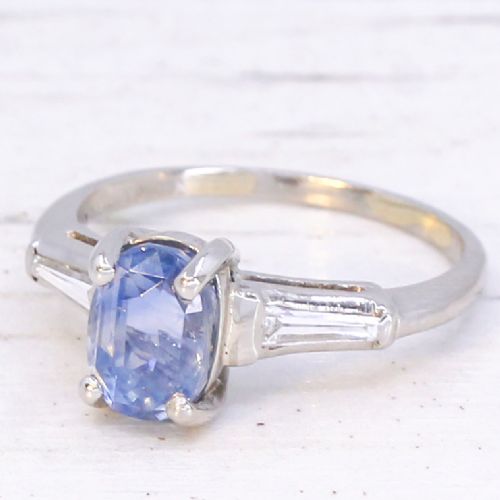


Baguette Diamond Solitaire Ring
A baguette diamond solitaire ring offers a sharp, architectural silhouette that defines mid-century and art deco elegance.
Baguette Diamond Solitaire Ring
A baguette diamond solitaire ring combines a central stone with step-cut side stones, creating a clean linear profile.
You will most frequently encounter platinum mountings from the nineteen-twenties and nineteen-thirties alongside mid-century interpretations.
These pieces function primarily as engagement rings or statement dress rings, drawing on art deco, retro, and mid-century modern design principles.
How they were made
Goldsmiths utilised platinum and fourteen-carat white gold to construct sturdy yet delicate settings that secure both the central diamond and the linear side stones.
Master cutters shaped diamonds into old cuts, transitional cuts, brilliant cuts, and rectangular baguettes to maximise geometric brilliance.
Listings span periods from 1910 to 1960, featuring platinum, white gold, diamonds, and sapphires.
What varies in quality
The architectural harmony between the central diamond and the step-cut baguette shoulders determines the visual balance of the piece.
The precision of the metalwork in platinum or white gold dictates how cleanly the geometric lines are preserved over decades of wear.
Boucheron
The Baguette Diamond Solitaire Ring Glossary
- Baguette cut
- A rectangular diamond cut with step facets and straight or tapered edges, commonly used for side stones.
- Platinum
- A dense, durable white metal frequently utilised in art deco and mid-century high jewellery mountings.
- Solitaire
- A ring setting designed to showcase a single primary gemstone, occasionally flanked by smaller accent stones.
- Old European cut
- An early brilliant diamond cut characterised by a high crown, small table, and open culet, prevalent in antique pieces.
- Transitional cut
- A diamond cut bridging old cut styles and modern brilliant cuts, spanning the nineteen-twenties to the nineteen-forties.
Baguette Diamond Solitaire Ring: Frequently Asked Questions
What periods do these rings date from?
The pieces span from the nineteen-tens through to the nineteen-sixties, capturing distinct eras of design.
Art deco and mid-century modern aesthetics dominate the selection.
What metals are used in the mountings?
Platinum is the predominant metal found across the listings, paired with fourteen-carat white gold on select items.
These durable white metals support the secure claw and channel settings.
How do old cut diamonds differ from modern ones?
Old cut and transitional cut diamonds exhibit smaller tables and distinct facet patterns compared to modern brilliant cuts.
These older cutting styles produce a softer, candlelit sparkle.
Are these pieces suitable for daily wear?
Platinum and white gold provide the structural integrity required for everyday engagement ring use.
Regular checks by a jeweller help maintain the security of the claw-set stones.