


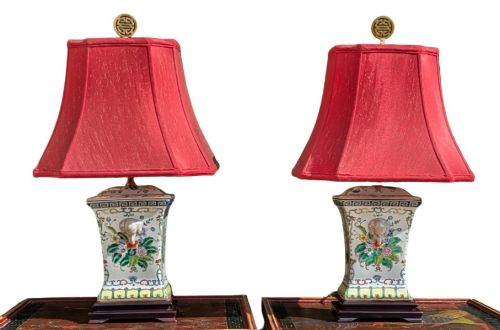







Asian Porcelain Bedside Lamps
These asian porcelain bedside lamps bring rich colour and history into a room, offering practical light paired with centuries of decorative artistry.
Asian Porcelain Bedside Lamps
Most examples appear as matched pairs, incorporating styles such as Chinoiserie, Meiji period, and Qing Dynasty influences. These objects combine historic ceramic bodies with twentieth-century electrical fittings to create functional bedside lighting.
How they were made
The foundation of these pieces rests on traditional ceramic techniques, utilising porcelain, earthenware, and ceramic bodies shaped into vases and baluster forms. Makers decorated these surfaces using detailed enamel work, blue and white pigments, and cloisonné methods.
Mounting often incorporates brass and wood elements to secure the electrical components while supporting the fabric and silk shades that complete the lamp structure.
Asian Porcelain Bedside Lamps Retail Price Guide 2026
Typical asking prices for asian porcelain bedside lamps among the pieces listed under this phrase on Sellingantiques today, from the lower quarter to the upper quarter. They describe what is for sale here now, not the wider market.
Listings feature porcelain, earthenware, fabric, silk, brass, and wood materials across the nineteenth century and the early twentieth century.
What varies in quality
Quality in these lamps rests primarily on the finesse of the hand-painted enamel and the preservation of the original ceramic body. Pieces demonstrating superior artistic depth in their Meiji or Qing style decoration command greater visual presence.
The integration of the ceramic vessel with the brass and wood hardware also distinguishes finer examples, where the conversion respects the integrity of the antique vase.
Fukagawa
The Asian Porcelain Bedside Lamps Glossary
- Satsuma
- A type of Japanese earthenware featuring a ivory-coloured craquelure glaze decorated with polychrome enamels and gilt. It originates from the Satsuma Province on Kyushu island.
- Kutani
- Japanese porcelain and pottery characterised by bold pictorial designs and vibrant colour palettes, often including greens, blues, yellows, and purples.
- Famille Verte
- A Chinese ceramic palette dominated by green enamel hues, developed during the Qing Dynasty and frequently emulated in later export pieces.
- Blanc de Chine
- White porcelain produced in Dehua, China, known for its milky glaze and often moulded into figures such as the Dog of Fo.
- Cloisonné
- An ancient technique for decorating metal object surfaces, using enamel compartments separated by thin strips of metal.
Asian Porcelain Bedside Lamps: Frequently Asked Questions
Are these lamps converted from old vases?
Many examples begin life as nineteenth-century or early twentieth-century Chinese and Japanese vases before receiving electrical wiring and fittings for modern use.
This adaptation allows historic ceramic art to serve a practical function on a bedside table without losing its decorative character.
How do I care for silk shades?
Silk and fabric shades require gentle dusting with a soft brush to prevent the accumulation of dirt over time.
Keep them away from direct sunlight to preserve the original colour and fabric integrity.
How do I distinguish Satsuma from Kutani?
Satsuma wares typically display a characteristic fine craquelure glaze beneath intricate polychrome and gilt patterns on earthenware. Kutani pieces generally utilise hard-paste porcelain with bolder, highly vibrant enamel colour schemes.
Can these lamps fit modern bedside tables?
The selection includes various scales, from small pairs to impressive large vessels suited to different furniture proportions. Checking the specific dimensions in each listing ensures a proper fit for your bedside space.