
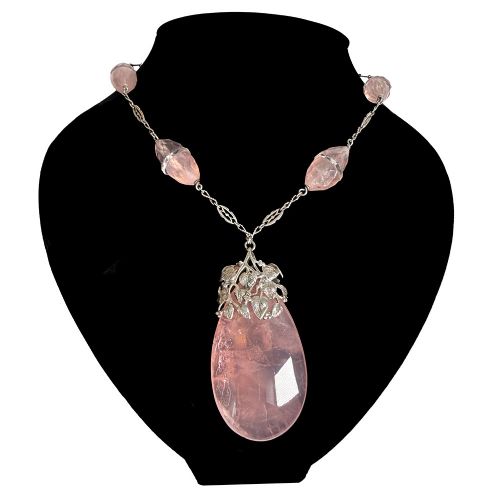

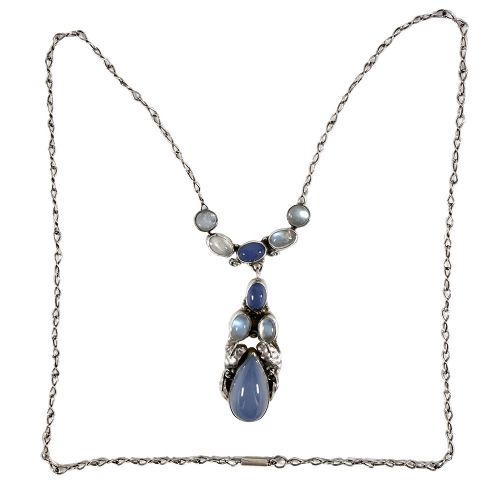


Arts Crafts Gemstone Necklace
These arts crafts gemstone necklace pieces combine distinct period metalwork with hand-selected stones, offering a tangible piece of early twentieth-century design history for your collection.
Arts Crafts Gemstone Necklace
An arts crafts gemstone necklace represents the foundational shift away from mass-produced jewellery towards handcrafted individual design, spanning the late nineteenth century through to the 1930s. You will encounter silver and gold settings that showcase both distinct Art Nouveau curves and the characteristic geometric restraint of the Arts and Crafts movement.
The pieces on offer encompass pendants, lavaliers, and longer sautoir or festoon configurations designed to sit gracefully against the wearer. Makers integrated local and imported stones into these frameworks, creating wearable items that emphasise artistic integrity over pure bullion value.
The period origins range from the 1890s through to the 1930s, capturing a golden era of independent silversmithing and studio jewellery production. Each item reflects the individual ethos of its maker while adhering to the broader stylistic language of the era.
Materials and Making
Makers constructed these pieces primarily in silver and gold, often employing wirework, granulation, and bezel settings to secure the stones by hand. Plique-à-jour enamel also appears in select examples, allowing light to pass through translucent coloured cells much like miniature stained glass windows.
The stones themselves were chosen for their colour and tactile appeal rather than strict standard calibrations, featuring cabochon cuts on moonstones, amethysts, and chrysoprase alongside faceted peridots and aquamarines. Pearl drops and rock crystal accents frequently complete the composition, suspended delicately from wire links or delicate chainwork.
Materials appearing across these selections include moonstone, amethyst, chrysoprase, and plique-à-jour enamel set in silver and gold.
Judging Quality
Quality rests heavily on the dexterity of the hand-hammered metalwork and the originality of the structural design rather than the sheer weight of the precious metals. Superior examples demonstrate a fluid integration between the organic shape of the silver or gold and the natural contours of the set stones.
Amy Sandheim·Mary Thew·Dorrie Nossiter·Murrle Bennett·Liberty and Co·John Paul Cooper·Arthur and Georgie Gaskin·George Hunt·Theodor Fahrner
The Arts Crafts Gemstone Necklace Glossary
- Cabochon
- A gemstone shaped and polished with a smooth, rounded surface rather than faceted. This cut is particularly common for moonstones and opals of the period.
- Lavalier
- A pendant necklace featuring a small drop suspended from a central motif or chain. This style enjoyed immense popularity during the Edwardian and Arts and Crafts eras.
- Plique-à-jour
- An enamelling technique where enamel is applied within a cellular framework without a backing, creating a translucent stained-glass effect. It requires great skill to execute successfully.
- Sautoir
- A long necklace, often featuring tassels or multiple pendant drops, popular during the early decades of the twentieth century. It provides a striking vertical line against garments.
- Festoon
- A necklace design composed of draped chains or bead strands hanging in curves between multiple points. This style highlights the decorative fluidity characteristic of turn-of-the-century jewellery.
Arts Crafts Gemstone Necklace: Frequently Asked Questions
What defines an arts and crafts necklace?
These pieces are characterised by handmade silver or gold settings, visible craftsmanship, and an emphasis on artistic expression over machine-led uniformity. They frequently incorporate cabochon gemstones and motifs drawn from nature.
Makers sought to revive traditional guild methods, ensuring every link and stone setting received individual attention rather than mass production.
How do I care for antique gemstone jewellery?
Store your necklace flat in a lined box away from direct sunlight and moisture to protect softer stones like moonstones and pearls. Avoid ultrasonic cleaners and harsh chemical dips, using only a soft dry cloth for gentle cleaning.
Many period stones and enamels are sensitive to sudden temperature changes and rough handling, so put your jewellery on last when dressing.
Are these necklaces suitable for daily wear?
While these items were built to be worn, their delicate wirework, pearls, and soft stones require mindful handling during everyday activities. They benefit from occasional checks by a specialist to ensure stone settings remain secure.
Treating them with the same care as historic textiles or fine art ensures they survive for future generations to enjoy.
How can I tell who made a piece?
Look closely at the reverse of the metalwork for stamped maker marks, initials, or specific model numbers associated with known workshops. Attribution often relies on stylistic traits, such as distinct bezel shapes or characteristic arrangements of gemstones.
Unsigned pieces can sometimes be attributed through comparison with documented works by prominent contemporary designers and guilds.