

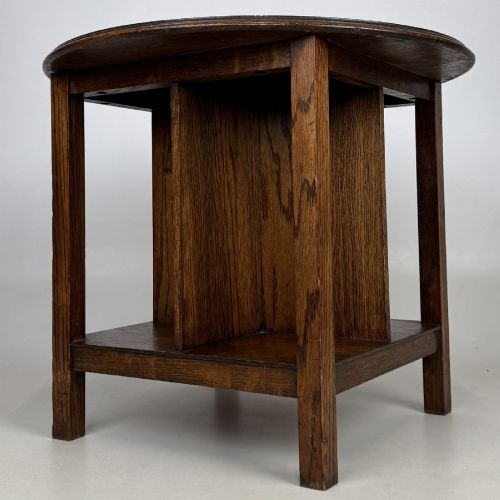
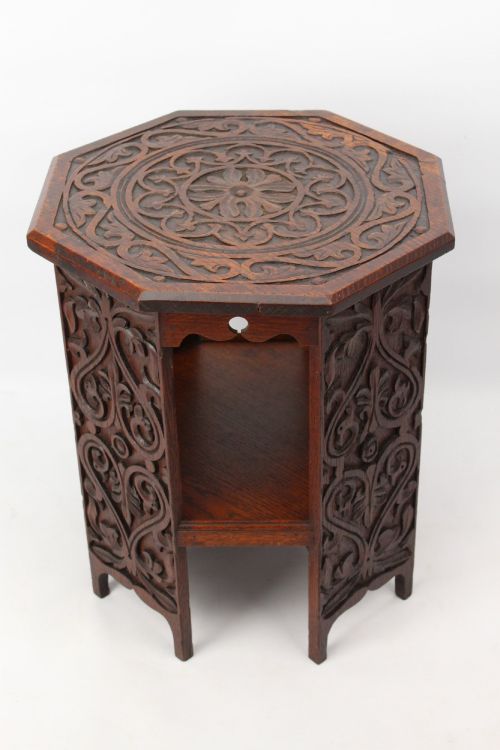
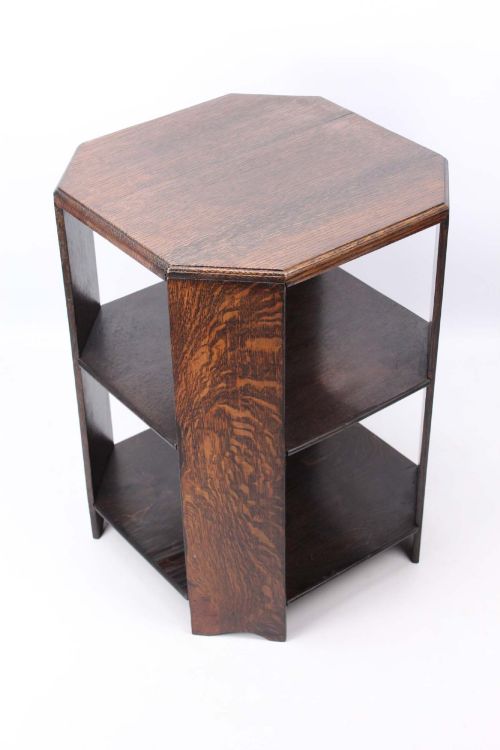
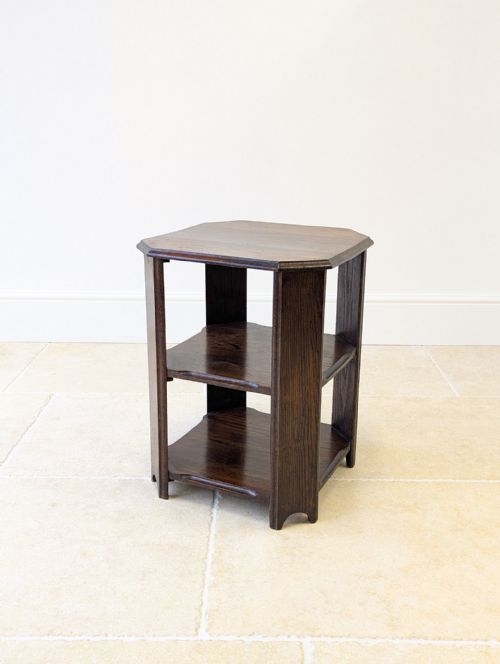
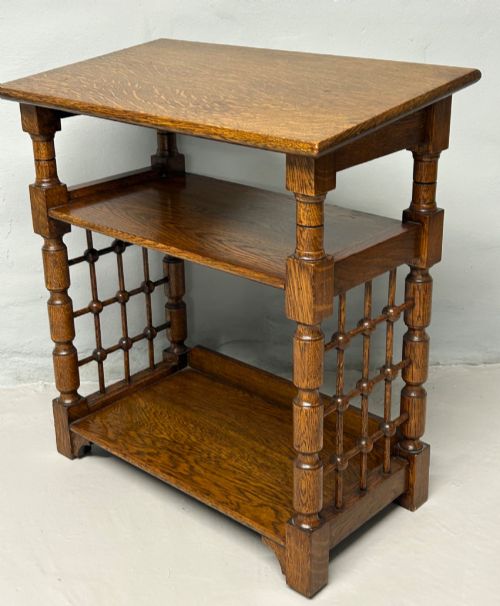


Arts and Crafts Book Table
These arts and crafts book table pieces unite utility and sturdy design, offering practical tiering and compartments for daily reading.
Arts and Crafts Book Table
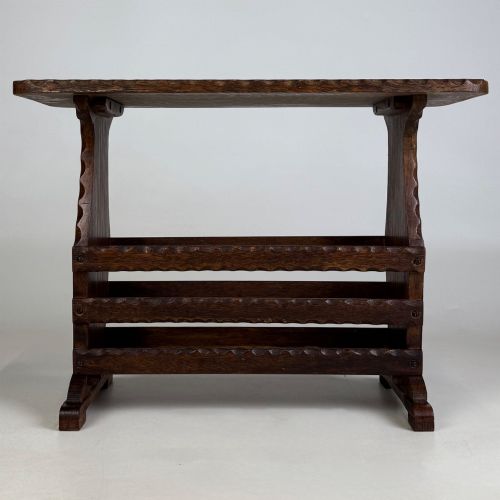
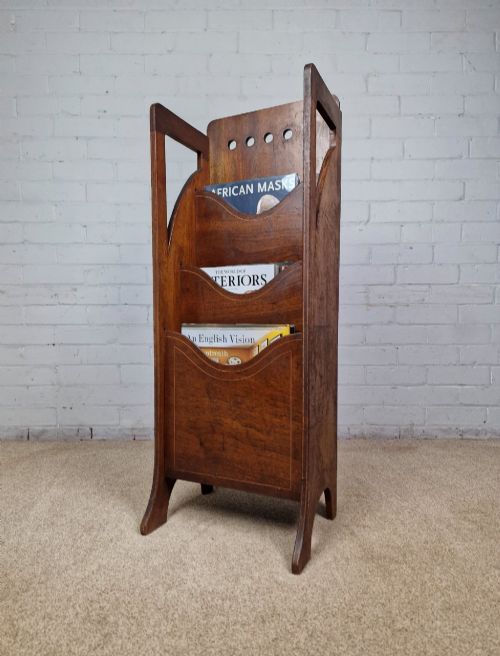
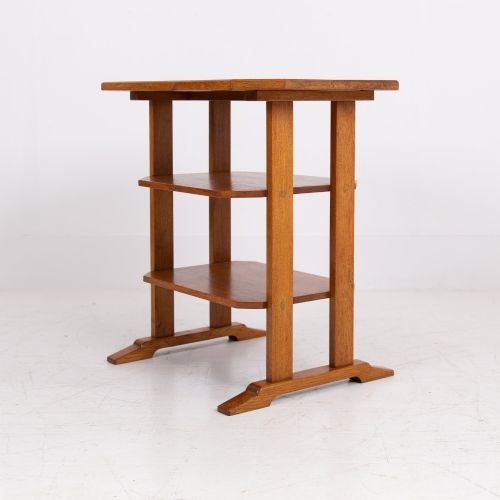
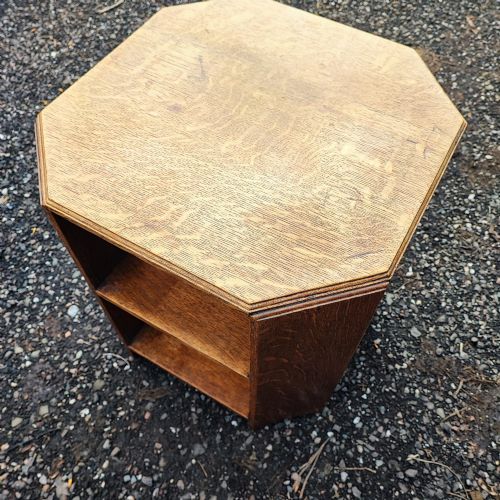
An arts and crafts book table combines a functional surface with built-in storage for volumes, taking forms such as octagonal side tables, hexagonal coffee tables, and shelved stands. These pieces emerge predominantly in oak across the Edwardian period, the 1920s, and the 1930s.
Buyers encounter revolving bookcases, magazine racks, and three-tier side tables alongside open-front slope-shelf bookcases and table-top bookstands. The construction leans towards solid timber utility, reflecting the broader ethos of the movement.
Originating from the late nineteenth century through to the interwar years, these items bridge Victorian room layouts and cleaner twentieth-century domestic arrangements. Oak predominates, though mahogany and boxwood inlay appear in specific iterations.
Materials and construction
Makers utilised solid oak and mahogany as the primary timber substrates for these tables, framing compartments and shelves to bear the weight of heavy volumes. Timber selection dictated the structural integrity of revolving mechanisms and tiered tiers.
Brass fittings and subtle boxwood inlay occasionally supplement the primary woodwork, adding understated decorative contrast without masking the natural grain of the material. Joinery relies on traditional methods to support complex forms like revolving cases and folding reading tables.
Arts and Crafts Book Table Retail Price Guide 2026
Typical asking prices for arts and crafts book table among the pieces listed under this phrase on Sellingantiques today, from the lower quarter to the upper quarter. They describe what is for sale here now, not the wider market.
Listings span periods from the Victorian era and 1880 through Edwardian years to 1920, 1930, and the interwar period.
Judging quality and execution
The sophistication of the joinery and the selection of timber grain dictate the distinction between standard utilitarian items and finer workshop pieces. Heavier gauge oak and precise geometric execution, particularly on octagonal and hexagonal tops, mark out superior examples.
The integration of functional elements such as smooth revolving mechanisms or well-fitted magazine compartments demonstrates the maker's competency. Subtle additions like boxwood inlay or attribution to notable firms elevate specific pieces above plain production.
Finnigans·Leonard Wyburd·Liberty and Co
The Arts and Crafts Book Table Glossary
- Revolving bookcase
- A freestanding or table-top unit mounted on a pivot that allows users to spin the tiered shelving to access books from any angle.
- Magazine rack
- A dedicated compartment or integrated slot designed to hold periodicals upright, frequently incorporated into the side of an occasional table.
- Slope-shelf bookcase
- A display tier angled backwards to hold books securely open or face-forward for easy title reading.
- Cotswold School
- A regional design movement associated with handcrafted oak furniture, emphasising honest construction and simple architectural lines.
Arts and Crafts Book Table: Frequently Asked Questions
What is an arts and crafts book table?
It is a piece of furniture combining a table surface with integrated shelving or compartments specifically sized for books and periodicals.
These designs prioritise practical storage while maintaining the characteristic aesthetic of the movement.
How do I date these tables?
Dating relies on stylistic markers, timber types, and construction methods spanning the late Victorian era through the Edwardian period and into the 1920s and 1930s.
Earlier pieces often exhibit Gothic Revival influences or heavy Victorian proportions, while interwar examples align more closely with Art Deco or Cotswold School sensibilities.
Where should I place a revolving bookcase?
Compact table-top versions sit comfortably on desks or larger sideboards, whereas freestanding revolving units suit corners or spaces beside armchairs.
Their design allows access from all sides, making them effective room dividers or central pieces in a study.
Are these tables suitable for heavy books?
Solid oak construction provides the structural strength required to support substantial volumes across multiple tiers or open compartments.
Checking the rigidity of the joints and the stability of the base ensures the piece handles daily loading safely.