
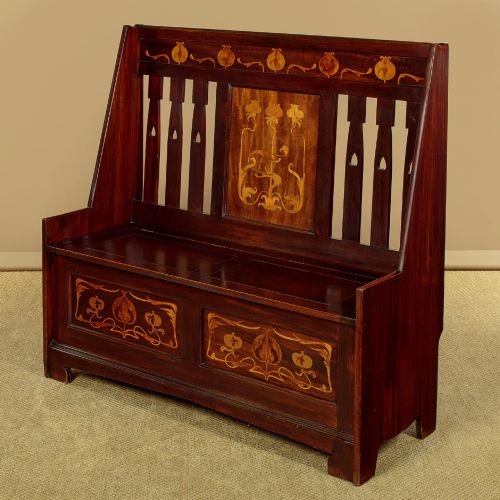


Art Nouveau Wooden Bench
An art nouveau wooden bench brings organic line and floral motifs into a hallway or salon.
Art Nouveau Wooden Bench
When you search for an art nouveau wooden bench, you encounter seating forms spanning the late nineteenth century through to the nineteen-twenties, including settees, hall benches, monks benches, and window seats. These pieces merge functional timber construction with the characteristic flowing lines and decorative flourishes of the movement.
You are most likely to meet mahogany frames decorated with marquetry inlay or boxwood inlay, alongside beech and oak variants representing Edwardian and Arts and Crafts aesthetics. The forms range from two-seater salon settees to convertible monks benches designed for domestic hallways.
How they were made
Makers utilised solid timbers such as mahogany, walnut, and golden oak as the primary structural chassis for these benches. Timber was shaped using traditional joinery methods to support upholstered textile pads and fabric cushions.
Decorative surface work relied on intricate boxwood inlay and marquetry inlay to depict floral and botanical motifs directly into the wood. Bentwood techniques also appear, shaping steam-softened timber into curved structural profiles.
Literary connections appear unexpectedly in this category, with a settee linked directly to the provenance of Daphne du Maurier's Rebecca.
What varies in quality
The sophistication of the marquetry and boxwood inlay sets the finer examples apart from simpler production pieces. Crisp, detailed botanical patterns demonstrate greater workshop skill than repetitive or block-printed surface decoration.
The selection of timber grain and the integrity of the structural frame determine the longevity and visual impact of the seating. Richly figured mahogany and walnut display a depth of finish that plain or utilitarian timbers lack.
James Shoolbred and Co·Thonet
The Art Nouveau Wooden Bench Glossary
- Marquetry inlay
- Decorative patterns formed by fitting small pieces of veneer into a prepared wooden surface. This technique allows for complex pictorial and floral designs across the backrests of benches.
- Boxwood inlay
- The insertion of pale boxwood into darker host timber to create sharp linear contrast. It highlights the organic curves typical of turn-of-the-century design.
- Monks bench
- A convertible piece of furniture featuring a hinged back that folds down to form a table top. It provides dual utility in compact domestic spaces.
- Bentwood
- Timber shaped by exposure to steam until pliable enough to bend into continuous curves. This method produces strong, lightweight frames without traditional joints.
Art Nouveau Wooden Bench: Frequently Asked Questions
What is an art nouveau wooden bench?
These pieces are domestic seating forms constructed from timbers like mahogany, walnut, and oak, featuring the curved lines and botanical motifs associated with the movement. They include settees, hall benches, and monks benches.
They serve as both functional furniture and decorative statements, often incorporating fabric upholstery and intricate wood inlay.
Where were these benches used?
Benches and settees were placed in entrance halls, formal salons, and reception rooms to provide seating for guests and residents. Monks benches were particularly useful in smaller spaces due to their convertible table function.
Window seats were also common, designed specifically to fit architectural recesses and provide a comfortable view.
How do I identify the period?
Dating relies on stylistic markers combined with timber choice and construction techniques from the eighteen-nineties through to nineteen-twenty. Edwardian and Arts and Crafts influences often overlap with the distinct floral curves of the era.
Makers' marks or stamps, where present, help pinpoint the exact decade of manufacture.
How should I care for the wood?
Maintain the timber surfaces by keeping them away from direct heat sources and strong sunlight, which can dry out the finish and fade the wood. Regular dusting with a dry cloth preserves the polish without building up residue.
Upholstered sections require gentle vacuuming with a soft brush attachment to protect delicate textiles.