


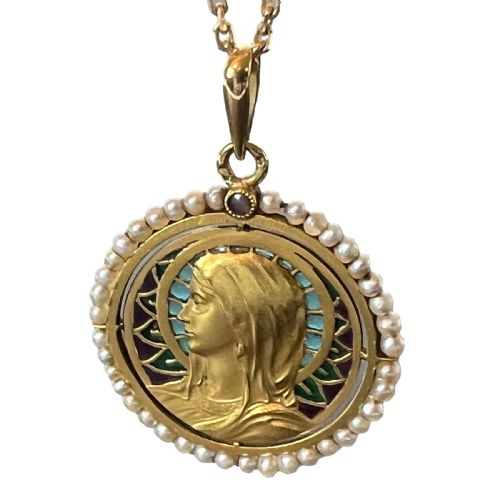
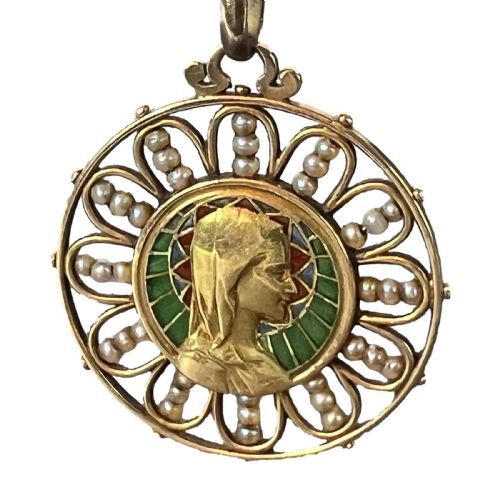


Art Nouveau Madonna Pendant
These art nouveau madonna pendant pieces are French religious medals fashioned in 18K yellow gold, offering delicate enamel work and pearl highlights.
Art Nouveau Madonna Pendant
When you search for an art nouveau madonna pendant, you encounter French religious medals and charms depicting the Virgin Mary or the Madonna and Child. These pieces originate predominantly from the early twentieth century, specifically between nineteen hundred and nineteen twenty.
You are most likely to meet pendant medals cast in yellow gold, often enhanced with translucent enamelling techniques and seed pearls. The designs belong firmly to the Art Nouveau and French Art Nouveau styles, showcasing fluid lines and devotional imagery.
How They Were Made
The makers formed these pendants primarily in 18K yellow gold, sometimes combining yellow and rose gold hues within a single piece. Metalwork involves piercing and stamping techniques to create intricate frames and devotional reliefs.
Plique-a-jour enamel provides a stained-glass effect without a backing, allowing light to pass through the coloured glass sections. Seed pearls and occasionally diamonds are set by hand to accent the borders and halos of the figures.
Art Nouveau Madonna Pendant Retail Price Guide 2026
Typical asking prices for art nouveau madonna pendant among the pieces listed under this phrase on Sellingantiques today, from the lower quarter to the upper quarter. They describe what is for sale here now, not the wider market.
Several French charms whisper the name Ave Maria right from their golden borders.
What Varies in Quality
The clarity and preservation of the plique-a-jour enamel distinguish finer examples from simpler metal stampings. Enamel work requires exceptional skill to fire without cracking, and intact translucent sections elevate the piece.
Emile Monier·Emile Dropsy·Arnault
The Art Nouveau Madonna Pendant Glossary
- Plique-a-jour
- An enamelling technique where enamel is applied cell by cell without a metal backing, creating a translucent, stained-glass appearance. This method requires great precision.
- Seed pearl
- A very small, natural or cultured pearl used in clusters or borders to accent jewellery. They are typically threaded or individually set.
- Medal
- A flat piece of metal struck with a commemorative or religious design, often worn as a pendant. These devotional pieces often honour the Virgin Mary.
- Art Nouveau
- An international style of art and architecture prominent from roughly eighteen ninety to nineteen ten, characterised by organic forms and curved lines. It heavily influenced French jewellery design of the era.
Art Nouveau Madonna Pendant: Frequently Asked Questions
What is an art nouveau madonna pendant?
An art nouveau madonna pendant is a French devotional medal from the early twentieth century depicting the Virgin Mary or the Madonna and Child. These pieces combine religious iconography with the flowing, organic lines typical of the Art Nouveau movement.
They were predominantly cast in 18K yellow gold and frequently decorated with plique-a-jour enamel and seed pearls to catch the light.
How were these pendants worn?
These items served primarily as devotional charms, medals or pendants worn close to the heart on fine gold chains. Their small scale made them suitable for daily personal wear as expressions of faith.
Many feature integrated loops or suspension rings designed specifically for hanging from necklaces or charm bracelets.
How do I care for enamelled gold jewellery?
Enamelled jewellery requires gentle handling because glass-based plique-a-jour can fracture under sharp impacts or sudden temperature changes. Store each pendant separately to prevent the gold or gemstones from scratching the delicate enamel.
Clean them only with a soft, dry cloth and avoid harsh chemical dips or ultrasonic cleaners that might damage the pearls and enamel.
How can I tell the period of a pendant?
You can date these pieces by examining the stylistic hallmarks of the Art Nouveau movement, such as whipped-line curves and naturalistic floral motifs. The materials, including 18K yellow gold and plique-a-jour enamel, point directly to workshops operating around nineteen hundred to nineteen twenty.
Signatures or maker's marks stamped directly onto the gold surface also help trace the piece to specific French medallists of the era.