


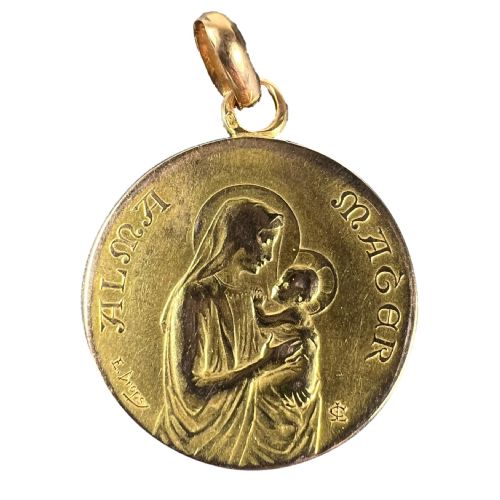


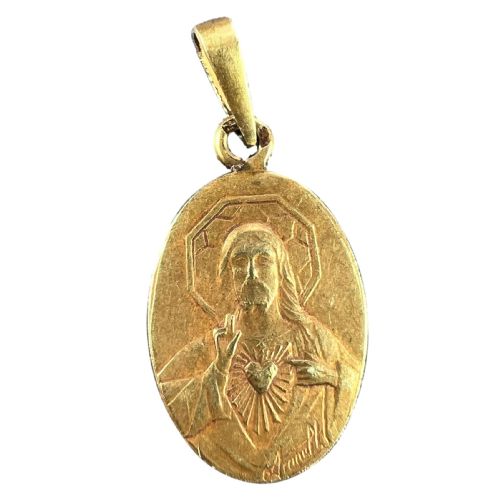


Madonna and Child Medal
A madonna and child medal carries quiet devotion in gold, worn close to the heart as a personal token of faith.
Madonna and Child Medal
Every madonna and child medal on this page originates from France, spanning the early decades of the twentieth century from 1900 to 1930. These pieces function primarily as pendants and charms, designed to be suspended from a chain for daily wear.
The most common examples you will encounter are cast in yellow gold, often incorporating the sacred heart motif alongside the traditional depiction of the Virgin Mary and the infant Jesus. Stylistically, they draw heavily on French devotional traditions and Art Nouveau aesthetics.
Makers and designers from this period frequently signed their small medallic works, leaving a mark of authorship on pieces that bridge the gap between fine jewellery and religious art.
Materials and construction
Gold forms the foundation of nearly every piece, predominantly appearing as 18 carat yellow gold, alongside occasional variations in rose gold. This precious metal provides a warm, enduring frame for the religious iconography.
Enamel work occasionally enhances the design, utilising translucent plique-à-jour techniques to allow light through the coloured glass elements. Stamping and casting methods shape the detailed figures of the Madonna and child, accompanied by crisp lettering and border ornamentation.
Madonna and Child Medal Retail Price Guide 2026
Typical asking prices for madonna and child medal among the pieces listed under this phrase on Sellingantiques today, from the lower quarter to the upper quarter. They describe what is for sale here now, not the wider market.
Even the smallest gold charms manage to squeeze a sacred heart, a halo, and a French maker's signature into the space of a thumbnail.
Distinctions in quality
The integration of artist signatures and specialised techniques like plique-à-jour enamel elevates specific examples beyond standard devotional output into the realm of fine Art Nouveau jewellery. Preservation of the original gold surface and any polychrome enamel details further distinguishes the finer pieces in the field.
Mazzoni·Dropsy·Perriat·Arnault·Lavrillier
The Madonna and Child Medal Glossary
- Plique-à-jour
- An enamelling technique where the enamel is fired without a backing, resembling miniature stained glass that catches the light. This method requires exceptional skill to prevent the delicate metal partitions from warping.
- Sacred Heart
- A Christian devotion representing the heart of Jesus as a symbol of divine love, frequently depicted on these medals alongside the Madonna. It often appears with flames, a crown of thorns, or rays of light emanating from the centre.
- Art Nouveau
- An international style of art and jewellery popular around the turn of the twentieth century, characterised by flowing, organic lines and natural motifs. In religious medals, it manifests in the sinuous framing of the holy figures.
- Medal pendant
- A medallic art object adapted with a suspension loop to be worn around the neck as jewellery. These pieces combine sculptural relief on the face with smooth or inscribed reverses.
Madonna and Child Medal: Frequently Asked Questions
How old are these gold medals?
The pieces recorded here date from the opening decades of the twentieth century, specifically between 1900 and 1930. This era encompasses the late flourishing of Art Nouveau design in France.
During this timeframe, French workshops produced devotional jewellery that balanced traditional religious iconography with contemporary artistic sensibilities.
Are these medals made of solid gold?
The evidence points exclusively to 18 carat yellow and rose gold for these French devotional pieces. This high standard of precious metal ensures durability while maintaining a rich, warm tone.
Such gold content was standard for quality jewellery production in France during the early 1900s.
What is the difference between a medal and a charm?
While both serve as pendants, medals typically feature flat or low-relief religious imagery intended for devotional observance. Charms often share similar iconography but may exhibit more playful sizing or varied suspension loops for charm bracelets.
In practice, many pieces on this page are described interchangeably as pendant medals or charm pendants due to their dual functionality.
Who signed these medals?
Prominent French medallists and sculptors such as Dropsy, Arnault, Mazzoni, Perriat, and Lavrillier signed their work on these devotional pieces. Their signatures signify artist-designed items rather than anonymous factory output.
Collectors prize signed examples for their superior sculptural depth and documented authorship.