
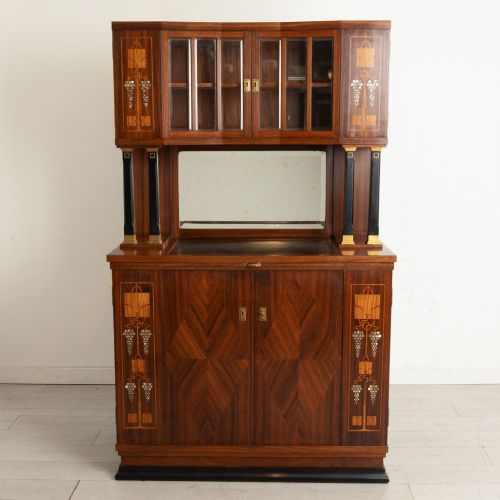


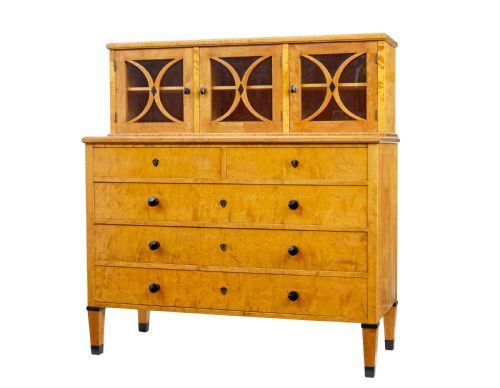


Art Nouveau Display Sideboard
An art nouveau display sideboard brings together sinuous naturalistic design and practical storage, offering a striking focal point for any interior.
Art Nouveau Display Sideboard
When searching for an art nouveau display sideboard, buyers encounter forms that merge cabinetry with glazed display space, rooted in periods from the late nineteenth century through the Edwardian era.
The pieces appearing on this page span diverse European origins, featuring English makers alongside continental workshops from Vienna, Holland, and Sweden.
Common configurations include sideboards with mirrored backs, dressers, and tall cabinets in oak, mahogany, and birch, reflecting both Arts and Crafts influences and Viennese Secessionist design.
Materials and construction
Makers utilised solid and veneered timbers such as oak, mahogany, ebonised wood, and Swedish birch, often enhancing surfaces with intricate wood inlay and marquetry.
Metalwork played a defining role in the construction, incorporating brass and copper for decorative hinges, handles, and escutcheons that complemented the organic wooden lines.
Glazed panels formed central elements in the upper display sections, housing collections while protecting items behind leaded or clear glass.
The inventory spans Victorian, Edwardian, and nineteenth-century periods, alongside specific 1900, 1905, and 1910 dates.
Judging quality and craftsmanship
The distinction between standard production and exceptional work rests on the ambition of the design and the precision of the timber selection, particularly in pieces bearing workshop attributions.
Integration of decorative elements defines the upper tiers of the craft, where brass and copper hardware, marquetry, and glass are harmonised with the primary wood structure rather than applied as mere ornamentation.
August Ungethüm·Shapland and Petter
The Art Nouveau Display Sideboard Glossary
- Marquetry
- The art and craft of applying small pieces of veneer to a structure to form decorative patterns. This technique allowed makers to create floral and geometric motifs across door panels and drawer fronts.
- Secessionist
- A stylistic movement originating in Central Europe that rejected historicism in favour of geometric clarity and stylised natural forms. It appears frequently alongside traditional Arts and Crafts aesthetics.
- Ebonised wood
- Timber treated with a finish to resemble ebony, providing dark contrast against lighter woods and metallic hardware. It was often employed to accentuate the linear qualities of the design.
- Mirror back
- A wooden superstructure incorporating a reflective glass panel above the main sideboard surface. This feature opened up interior spaces and displayed objects from multiple angles.
Art Nouveau Display Sideboard: Frequently Asked Questions
What defines an art nouveau display sideboard?
These pieces combine functional storage surfaces with glazed display cabinets, united by the flowing, plant-inspired lines characteristic of the turn of the twentieth century.
They draw on related movements like Arts and Crafts and the Viennese Secession, appearing in regional variations across Britain, Holland, Sweden, and Austria.
How do I care for polished wood and marquetry?
Maintain timber surfaces by avoiding direct sunlight and keeping them away from extreme temperature fluctuations that can cause veneers to lift.
Apply high-quality beeswax sparingly and buff gently with a soft cloth to preserve the natural lustre of oak, mahogany, and birch.
Where were these cabinets made?
Production was widespread across Europe, with English firms like Shapland and Petter working alongside continental workshops in Vienna, Amsterdam, and Sweden.
Each region brought distinct interpretations to the style, utilising local timbers such as Swedish birch alongside imported mahogany and oak.
How do I distinguish between periods?
Pieces span the late nineteenth century, the Victorian era, and the Edwardian period, often reflecting transitional styles between heavy historicism and lighter modernist forms.
Examining the underlying structure, timber choices, and hardware styles helps place a specific cabinet within its historical context.