

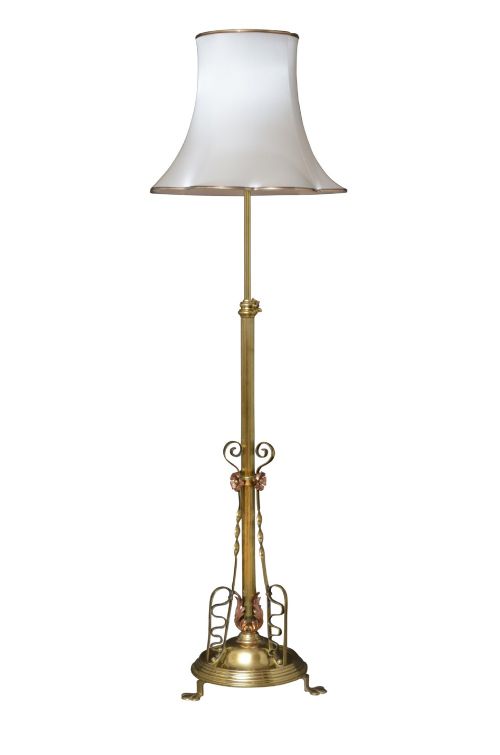


Art Nouveau Brass Floor Lamp
An art nouveau brass floor lamp brings organic fluidity and warmth to a room, cast in gleaming metal from the turn of the twentieth century.
Art Nouveau Brass Floor Lamp
An art nouveau brass floor lamp is a tall standing lighting fixture designed to illuminate a room from floor level while displaying the sinuous, plant-inspired lines typical of the movement. You will most frequently meet standard lamps and uplighters from the Victorian, Edwardian, and early twentieth-century periods.
These pieces encompass standard lamp forms alongside occasional adjustable heights and reading variations. The selection includes examples incorporating copper and glass elements alongside the primary brass structure.
How they were made
Makers fashioned these lamps primarily from brass, frequently combining it with copper for contrasting tones and occasionally mounting shafts on marble or iron bases. Structural elements often involved adjustable height mechanisms to suit domestic needs.
Lampshades incorporated fabric and glass, sometimes finished with thread detailing, while metalwork reflected the organic forms of the Belle Epoque and Art Nouveau styles.
One past piece featured herons and water lilies, proving that brass floor lamps occasionally fancied themselves as pond life.
What varies in quality
The distinction between standard and superior pieces lies in the crispness of the chased metalwork and the integration of mixed metals like copper. Heavier gauge brass and sophisticated adjustable mechanisms elevate an example significantly.
The inclusion of original decorative elements, such as specific glass shades or heron and water lily motifs, marks out the most accomplished workshops from simpler production pieces.
The Art Nouveau Brass Floor Lamp Glossary
- Standard Lamp
- A floor-standing lamp designed to illuminate a living space from a vertical post. These fixtures became popular in British homes during the late nineteenth century.
- Uplighter
- A lighting fixture directing its illumination upwards toward the ceiling rather than downwards. This form provides ambient room lighting.
- Belle Epoque
- A period of French history spanning the late nineteenth century and the outbreak of the First World War. The aesthetic shares much with Art Nouveau.
- Height Adjustable
- A mechanical feature allowing the lamp stem to extend or shorten. This practical addition catered to varying ceiling heights and reading requirements.
Art Nouveau Brass Floor Lamp: Frequently Asked Questions
What periods do these lamps come from?
These lamps originate primarily from the Victorian and Edwardian eras, spanning the late nineteenth century through to about nineteen ten. They capture the design ethos of the Belle Epoque and early twentieth century.
Makers working within these decades produced standard lamps that reflect the distinctive flowing lines of the movement.
How were these lamps used originally?
Homeowners placed them beside seating areas or in corners to provide reading light and ambient illumination before electricity became universal. Many began life as oil lamps before conversion to electric lighting.
Height-adjustable stems allowed users to alter the light level depending on the room arrangement.
What materials appear alongside brass?
Copper frequently pairs with brass to create contrasting colour tones on the standard and base. Glass and fabric feature heavily in the shades, supported sometimes by iron or marble foundations.
Thread detailing also appears on certain fabric shade constructions.
How do standard lamps differ from floor lamps?
In British antique terminology, standard lamp and floor lamp are largely interchangeable terms for a tall lighting fixture standing on the floor. Both describe vertical shafts designed to hold a light source well above ground level.
The historical listings use both descriptions for pieces sharing identical forms.