


Art Nouveau Amethyst Jewellery
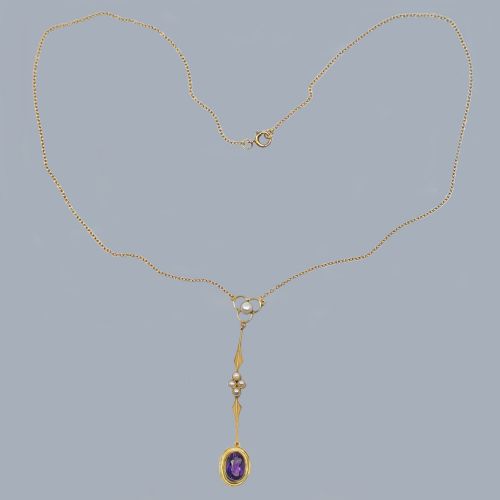
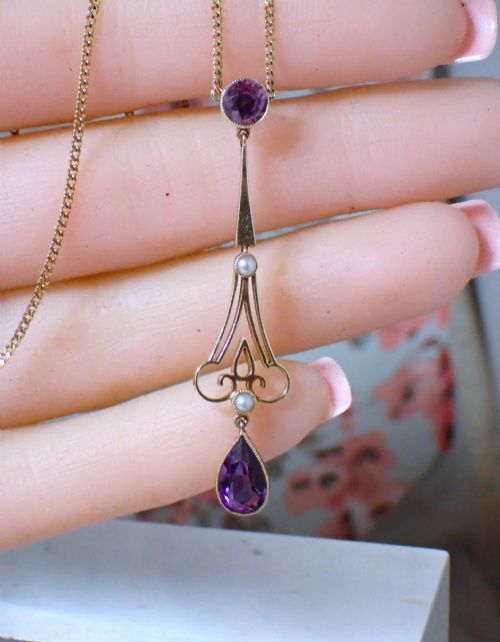
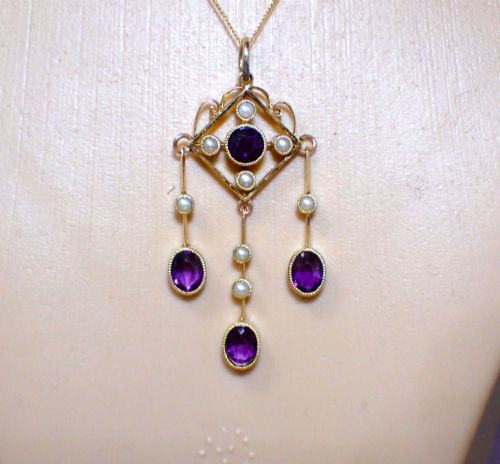
Art nouveau amethyst jewellery brings together fluid organic lines, rich purple stones and delicate pearls.
Art Nouveau Amethyst Jewellery
Art nouveau amethyst jewellery encompasses pendants, necklaces, brooches and rings created around the turn of the twentieth century. These pieces combine the sinuous botanical motifs of the art nouveau movement with the deep purple hues of amethyst.
The versions most commonly met on this page are pendants and necklaces fashioned in gold or silver. They often incorporate pearls or seed pearls alongside the central amethyst stone.
Objects date from the late nineteenth century through to the Edwardian period and the nineteen-twenties. Influences from the arts and crafts movement and sknvirke appear frequently among the pieces.
How they were made
Goldsmiths and silversmiths utilised nine carat gold, fifteen carat gold, twelve carat yellow gold and sterling silver to set the stones. Enamel work, particularly plique a jour enamel, adds translucent colour to the metal frameworks.
Gemstones include amethysts alongside diamonds, seed pearls, coral and moonstone. Setting techniques focus on highlighting the natural variations of the amethyst within flowing metallic tendrils.
Some pendants manage to combine amethysts, seed pearls, coral and moonstone all in one dangling metallic garden.
What varies in quality
Quality rests upon the delicacy of the metalwork and the integration of enamel elements such as plique a jour. Finer examples display meticulous handcrafting in the botanical curves and secure stone settings.
The choice of supporting gems also defines the tier of a piece, with well-matched seed pearls or small diamonds elevating simpler silver or gold mounts.
Eduard Loss·Georg Jensen
The Art Nouveau Amethyst Jewellery Glossary
- Plique a jour
- Enamelling technique with no backing, creating a stained-glass effect that lets light pass through the transparent coloured areas.
- Seed pearl
- Very small natural or cultured pearl, often drilled and threaded onto wire or silk in clusters.
- Lavaliere
- Pendant necklace featuring a dangling component suspended below the main drop.
- Sknvirke
- Danish term for the arts and crafts style associated with Scandinavian metalwork of the period.
- Festoon necklace
- Style featuring draped chains or swags of beads and drops across the collarbone.
Art Nouveau Amethyst Jewellery: Frequently Asked Questions
How do I care for antique amethyst jewellery?
Clean these pieces gently with a soft cloth and warm soapy water, avoiding harsh chemical dips that might damage softer stones or enamel work.
Store them separately in lined boxes to prevent scratching between the softer pearls and harder amethysts or diamonds.
Can I wear these antique necklaces daily?
These items require gentle treatment due to their delicate gold or silver wirework and seed pearl settings. Reserve them for occasional wear to preserve the antique materials.
Particular care is needed with pieces containing plique a jour enamel, as the openwork cells are fragile.
How do I distinguish art nouveau from arts and crafts pieces?
Art nouveau designs emphasise asymmetric, whiplash curves and stylised floral motifs inspired by nature. They often incorporate enamelling and faceted gemstones.
Arts and crafts pieces tend to highlight hand-hammered metal textures, visible construction marks and cabochon stones rather than fluid lines.
What gold purities should I expect to find?
Jewellery from this era commonly uses nine carat or fifteen carat gold, alongside sterling silver and silver gilt. Twelve carat yellow gold also appears in specific continental or transitional pieces.
Lower or higher gold purities reflect the manufacturing standards and regional hallmarking practices of the period.