


Edwardian Gold Lavaliere
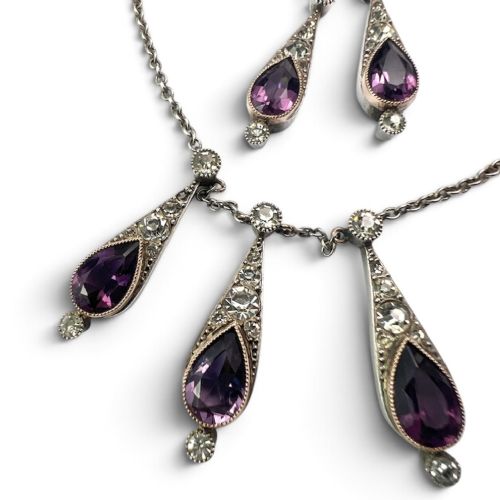
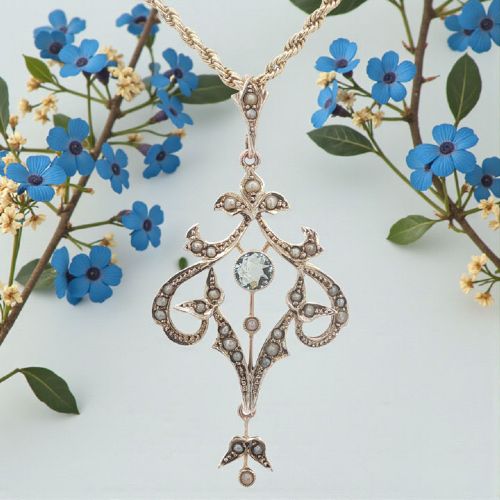
An edwardian gold lavaliere hangs with delicate symmetry, offering the fluent drop motifs that collectors prize.
Edwardian Gold Lavaliere
An edwardian gold lavaliere is a pendant necklace featuring articulated drops, suspending stones or pearls on slender chains. You meet these pieces most frequently in Edwardian, Victorian, and Art Deco styles, often spanning the opening decades of the twentieth century.
The form relies on symmetrical or flowing arrangements, frequently incorporating central gems with smaller dangling elements. These jewels capture the graceful aesthetic of their period, combining delicate metalwork with targeted gemstone placement.
How they were made
Goldsmiths shaped these pieces using 9ct and 15ct gold, along with yellow, white, and rose variations. Metal frames were fashioned to support intricate drop configurations without adding undue weight to the wearer.
Workshops set diamonds, seed pearls, natural pearls, amethysts, aquamarines, garnets, pink sapphires, and tourmalines into the gold structures. Artisans balanced central stones with smaller accent gems to create the signature cascading silhouette.
Listings feature 9ct and 15ct gold alongside silver-gilt settings, incorporating diamonds, seed pearls, amethysts, aquamarines, and garnets across Edwardian and Victorian periods.
What varies in quality
The sophistication of the articulation separates different tiers of these necklaces, determining how fluidly the pendant drops move. Superior examples demonstrate precise hinge work or secure looping that allows natural motion without rigidity.
The selection and matching of stones also define the calibre of the piece, particularly where seed pearls and coloured gems are integrated. Well-chosen materials maintain consistent colour and lustre across every suspended element.
The Edwardian Gold Lavaliere Glossary
- Lavaliere
- A pendant necklace featuring one or more dangling drops suspended from a central motif. This style gained immense popularity during the early twentieth century.
- Seed pearl
- A very small, naturally formed pearl, often unnucleated, used extensively in clusters and borders. These tiny pearls add a soft, luminous texture to gold settings.
- Art Nouveau
- A design style characterised by flowing, organic lines and asymmetrical plant-inspired motifs. This aesthetic heavily influenced early pendant architecture.
- Plique-à-jour
- An enamelling technique where enamel is applied without a backing, resembling miniature stained glass. Light passes directly through the translucent coloured cells.
- Cabochon
- A gemstone shaped and polished with a smooth, rounded surface rather than faceted edges. This cut highlights the deep, soft colour of garnets and amethysts.
Edwardian Gold Lavaliere: Frequently Asked Questions
How do you wear a lavaliere?
A lavaliere is designed to be worn close to the collarbone, allowing the central drops to rest centrally against the chest. The cascading nature of the pendant makes it suitable for evening wear or open necklines.
Because the drops feature articulation, the piece moves with the wearer. Pairing these necklaces with simple attire ensures the intricate goldwork and suspended stones remain the focal point.
How do you tell Edwardian from Victorian lavalieres?
Edwardian lavalieres often display lighter, airier platinum or yellow gold frameworks with diamond and pearl accents. The aesthetic favours lace-like symmetry and bright, light-reflecting stones.
Victorian examples tend to employ heavier 15ct gold settings with deeper-coloured gems like garnets or amethysts. Structural elements in Victorian pieces are typically more robust and grounded than their later counterparts.
What stones appear in these necklaces?
These necklaces feature diamonds, seed pearls, natural pearls, amethysts, aquamarines, and garnets. Pink sapphires and tourmalines also appear as central accent stones within the gold drops.
Combinations of diamonds and seed pearls dominate many Edwardian examples, while coloured quartz varieties frequently anchor Victorian and Art Deco iterations.