
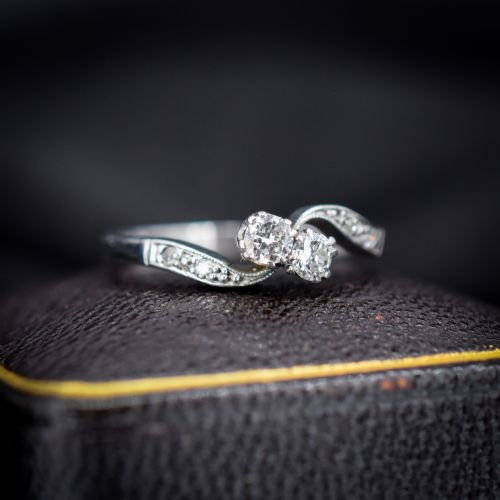
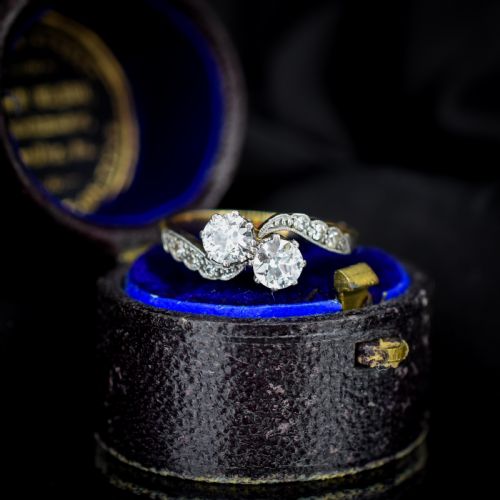
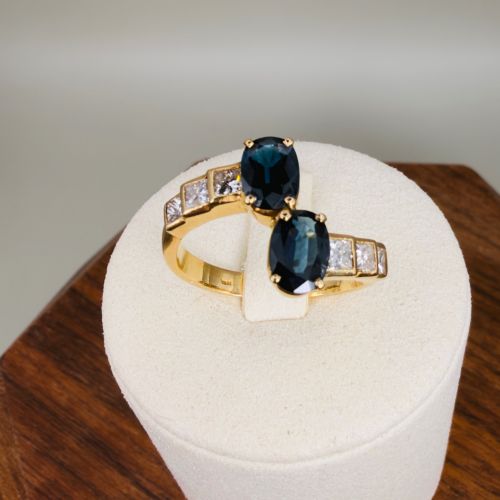

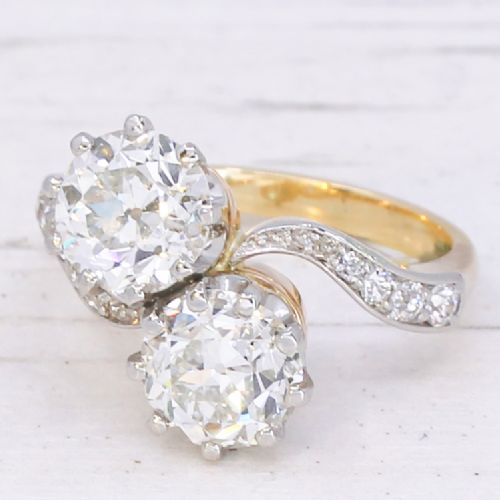


Art Deco Toi Et Moi Ring
An art deco toi et moi ring couples two distinct gems in a sinuous setting designed to symbolise two souls bound together.
Art Deco Toi Et Moi Ring
An art deco toi et moi ring centres on a two-stone configuration, uniting contrasting or complementary gems in a flowing bypass or twist formation. Pieces from this selection span the Edwardian era through the nineteen-forties, capturing the geometric vigour and streamlined curves characteristic of the period.
The layout typically pairs diamonds with sapphires, rubies, or emeralds, creating a visual dialogue between the two principal stones. Such designs serve as traditional tokens of romance, constructed to sit low upon the finger with clean, architectural lines.
How they were made
Metals such as platinum, eighteen-carat white gold, yellow gold, and occasional fourteen-carat variations provide the structural backbone for these rings. Platinum became the preferred medium for securing stones with minimal metal visibility, allowing intricate piercing and bezel settings.
Gems feature old European, old cut, princess, transitional, and oval cuts, meticulously selected to balance the dual focal points. Goldsmiths shaped the shanks into dynamic twists and crossover bands that guide the eye smoothly toward the twin centerpieces.
These rings pack twice the romance into a single band, perfect for indecisive romantics who refuse to choose just one favourite gemstone.
What varies in quality
The caliber of an art deco toi et moi ring rests primarily in the proportional harmony and weight of the two principal gems. Masterful lapidary work ensures both stones share a comparable brilliance and depth, even when one is a coloured sapphire or ruby and the other a diamond.
Metalwork finesse further separates fine examples from standard workshop output. Crisp claw work, precise millegrain edging, and robust shank integrity demonstrate superior craftsmanship that preserves the delicate geometry under daily wear.
The Art Deco Toi Et Moi Ring Glossary
- Toi et moi
- French for you and me, denoting a ring style featuring two main stones set closely together in a shared band.
- Bypass ring
- A band that sweeps around the finger in a continuous loop, crossing over itself rather than meeting in a traditional symmetrical head.
- Old European cut
- An early round diamond cutting style characterised by a small table, high crown, and a noticeable open culet visible through the top.
- Millegrain
- A decorative technique applying a fine border of tiny raised metal beads along the edges of a setting.
- Transitional cut
- A diamond facet arrangement bridging the older antique cuts and modern round brilliants, prevalent during the early twentieth century.
Art Deco Toi Et Moi Ring: Frequently Asked Questions
How do I care for my ring?
Regular gentle cleaning in warm soapy water maintains the brilliance of both the diamonds and the surrounding precious metals.
Avoid exposing antique settings to harsh chemicals or ultrasonic cleaners that might compromise older claw work and delicate millegrain.
Are these rings suitable for daily wear?
Platinum and high-carat gold constructions offer robust durability suitable for everyday use when handled with reasonable care.
Consider removing the ring during heavy manual tasks to protect the underlying twist structure and secure the principal stones.
How do I identify the period?
Period identification relies on observing the combination of metal choices, such as platinum top-settings paired with yellow gold shanks, alongside specific gemstone cuts like old European or transitional styles.
Design motifs also transition from flowing Edwardian garland elements into the bolder, geometric lines typical of nineteen-twenties and thirties production.