



Art Deco Silver Picks
These art deco silver picks bring sharp lines and bright colour to the tray, turning a simple olive or shrimp into a polished detail.
Art Deco Silver Picks
When you search for art deco silver picks, you are looking at small functional items designed for the cocktail hour and formal dining during the interwar years. The pieces appearing here span the nineteen twenties, nineteen thirties, and nineteen forties, originating from British and French makers.
You will encounter sets intended for various uses, from cocktail sticks and barware to seafood and lobster picks. Most examples are found grouped in sets of six, frequently accompanied by their original presentation cases or stands.
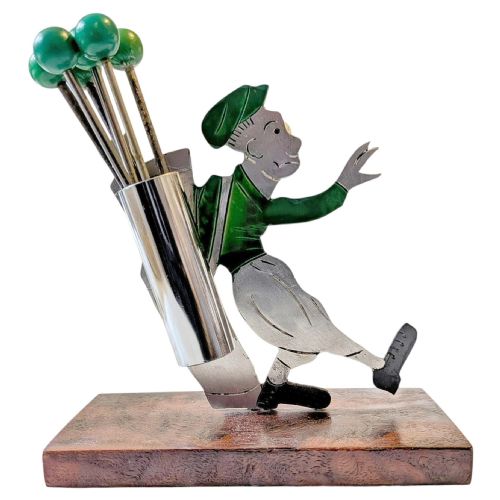
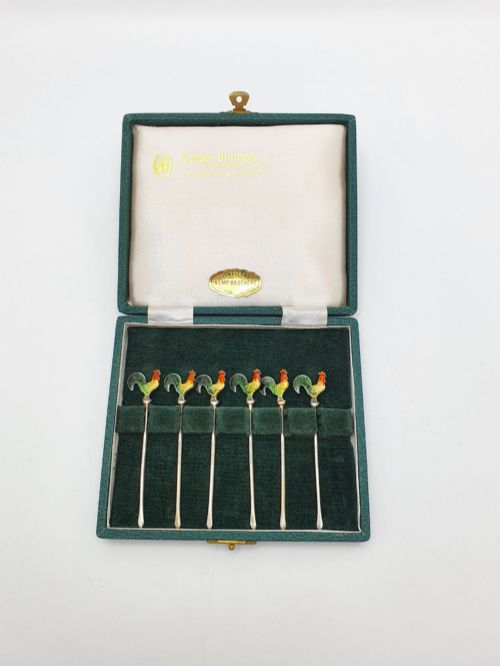
The forms range from plain sterling shafts to novelty figural terminals such as comical golfers, cherry men, and birds. Alongside standard sterling silver and silver plate, you will frequently find combinations incorporating enamel, chrome, and bakelite.
Materials and construction
Makers utilised solid sterling silver and silver plate as the primary structural metals for the shafts and handles. These metals were often paired with contrasting modern materials such as colourful enamel, dark wood, chrome, and bakelite.
Figural elements and decorative finials were cast or hand-formed, capturing the distinct geometric and stylised motifs of the period. Skilled artisans applied vitreous enamel in bright tones to create patterned details on the terminals of the sticks.
Many sets were housed in fitted boxes lined with materials like velvet to protect the delicate metallic surfaces and enamel work during storage.
A comical golfer with a caddy stands ready on the end of a cocktail stick to referee your evening drinks.
Factors that distinguish quality
The standard of an item rests heavily upon the crispness of the casting in novelty terminals and the condition of any applied enamel. Clean, undamaged enamel work with vibrant colour demonstrates superior craftsmanship compared to simpler, plain metal shafts.
Complete sets housed in their original fitted presentation cases or holders command greater interest than loose, mismatched examples. Maker marks and clear hallmarks indicating specific assay offices and dates provide reliable markers of origin and metal purity.
Sudre·Suckling Ltd·William Hutton
The Art Deco Silver Picks Glossary
- Sterling silver
- A silver alloy containing 92.5 percent pure silver by mass, standard for high-grade British tablewares of the period.
- Silver plate
- A base metal substrate coated with a thin layer of silver, offering a bright finish at a different price point.
- Bakelite
- An early form of synthetic plastic used by makers for handles and bases, prized for its durability and rich colour.
- Enamel
- A glassy substance fused to metal through firing, used to add decorative colour and pattern to the handles of sticks.
- Hallmark
- An official stamp applied by an assay office indicating metal fineness, maker, and year of manufacture.
Art Deco Silver Picks: Frequently Asked Questions
What are art deco silver picks used for?
These pieces were created to spear cocktail garnishes like olives and cherries, or to extract meat from seafood and lobsters during formal dining and home entertaining.
They function as both practical tableware and decorative accessories, often presented alongside other barware items on a tray.
Are most sets complete with a box?
Many surviving sets are found complete with their original fitted presentation cases, sometimes featuring velvet linings or cut glass holders.
Loose examples also appear frequently, having survived independently from their original storage boxes.
What materials are used alongside silver?
Makers frequently combined silver and silver plate with vitreous enamel for colour, as well as modern industrial materials like chrome and bakelite.
Some examples also incorporate wooden elements or feature glass holders designed to store the set when not in use.
How can I tell the date of a set?
British pieces often carry hallmarks that include date letters and assay office marks, allowing for precise dating to years such as nineteen twenty-seven or nineteen thirty-four.
Stylistic indicators like geometric motifs and novelty figural designs also point firmly to the nineteen twenties and nineteen thirties.