

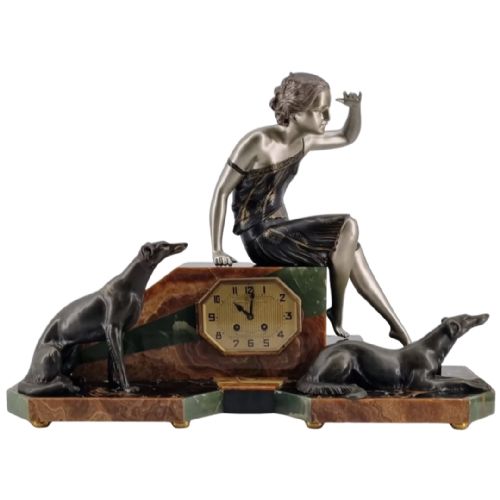
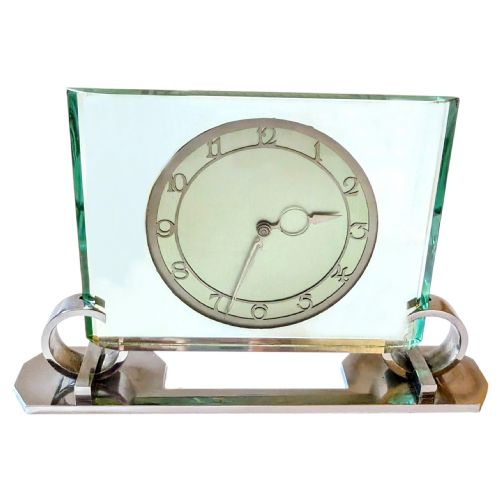


Art Deco Green Timepiece
An art deco green timepiece brings striking geometric colour to a mantelpiece, combining vibrant materials with functional design.
Art Deco Green Timepiece
When you search for an art deco green timepiece, you find decorative clocks shaped by the design movements of the early twentieth century. These objects serve both practical timekeeping and visual display within a room.
The pieces on this page mostly date from nineteen thirty, displaying the characteristic lines of the period. Forms range from compact desk clocks to substantial mantel clocks and garniture sets.
Materials such as green onyx, opaline uranium glass, and marble give these items their distinctive colour palette. Makers pair this green ground with chrome, brass, and enamel details.
How they were made
Craftsmen built these clocks using solid blocks of natural stone like marble and green onyx for heavy, architectural bodies. They shaped glass through moulding and casting to create translucent green cases that catch the light.
Metal elements in chrome-plated brass and copper provide structural contrast and polished bezels around the dial faces. Enamel work adds coloured accents to metal surfaces, while wind-up and eight-day movements drive the mechanical hands.
Art Deco Green Timepiece Retail Price Guide 2026
Typical asking prices for art deco green timepiece among the pieces listed under this phrase on Sellingantiques today, from the lower quarter to the upper quarter. They describe what is for sale here now, not the wider market.
Materials documented across the selection include chrome, glass, brass, metal, marble, green onyx, uranium glass, and opaline glass.
What varies in quality
Quality rests in the harmony between the clock movement and its housing, separating standard production items from workshop pieces bearing maker names. Heavier stone cases and substantial metal plating indicate superior construction.
The integration of sculptural elements, such as mounted figures or cast metal animals, elevates the piece from a simple timekeeper to a work of art. Finer examples combine complex glass or stone work with dependable wind-up mechanisms.
Smiths Clockmakers·Elliott·Mappin & Webb·Michel Decoux
The Art Deco Green Timepiece Glossary
- Garniture
- A matching set of ornamental objects, typically a clock flanked by two matching vases or sculptures for a mantelpiece. This arrangement creates a balanced display on a fireplace.
- Onyx
- A banded variety of chalcedony stone used for solid clock bodies. Its natural green tones provide a smooth, polished surface.
- Uranium glass
- Glass containing trace amounts of uranium dioxide that glows under ultraviolet light. It produces a distinct green hue in art deco pieces.
- Movement
- The internal mechanism that drives the clock hands and measures time. These pieces utilise wind-up and eight-day systems.
Art Deco Green Timepiece: Frequently Asked Questions
How do I wind an art deco green timepiece?
Most of these clocks use a key or manual thumb-turn attached directly to the movement behind the dial face. Turn the mechanism gently until you feel resistance, taking care not to over-wind the spring.
For eight-day models, winding is required significantly less often than standard daily movements. Consult the specific mechanism type before applying tension to the spring.
Where should I place a mantel clock?
A mantel clock suits a central position on a fireplace mantel, a sideboard, or a sturdy desk. Ensure the surface is level so the pendulum or balance wheel ticks evenly.
Keep the piece away from direct sunlight and damp areas to preserve the integrity of the stone, glass, and metal finishes over time.
What is an eight-day clock?
An eight-day clock is a mechanical timepiece designed to run for roughly eight rotations before needing another wind. This provides convenience for daily living while retaining traditional wind-up mechanics.
Such movements appear frequently in quality desk and mantel clocks from the period.
How do I identify uranium glass?
Uranium glass displays a vivid green colour and emits a bright neon glow when exposed to a blacklight. This material was commonly moulded into decorative clock cases during the nineteen thirties.
The glass contains harmless trace elements that create this optical property.