

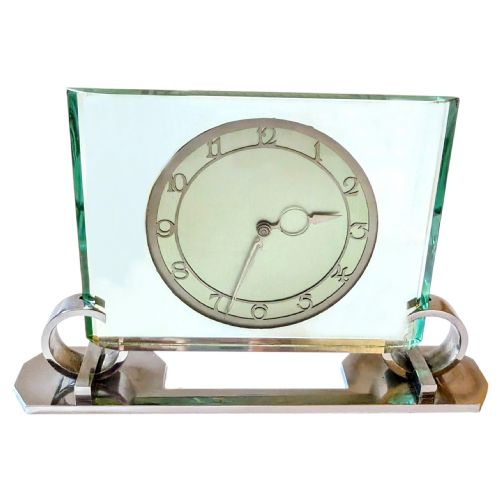
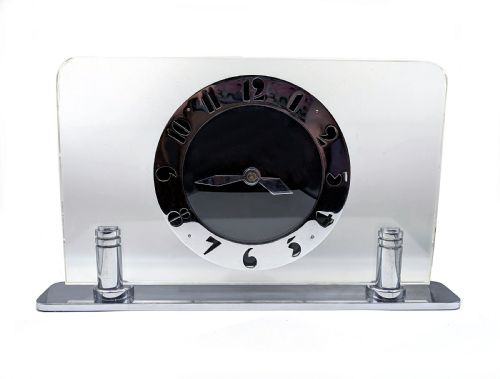


1930s Chrome Glass Clock
These 1930s chrome glass clock pieces capture modernist geometry through polished metal and tinted glass.
1930s Chrome Glass Clock
A 1930s chrome glass clock brings together the industrial gleam of metal and the smooth planes of coloured or mirrored glass. These pieces are predominantly mantel clocks, though wall clocks and desk variations also appear.
Most examples found here date from the 1930 period, designed within the prevailing Art Deco style. Makers employed modernist lines, circular frames, and see-through structures to define the domestic interior.
How they were made
Makers shaped chrome and brass to form the structural casings, bezels, and stands that supported the dial. This metalwork was paired with sheets of glass, mirrored glass, opaline uranium glass, and tinted blue, green, or peach glass.
Movements ranged from standard wind-up mechanisms and eight-day systems to electric sectric calibres and mystery clock designs. Dials and glass panels were assembled cleanly into modernist geometric silhouettes.
1930s Chrome Glass Clock Retail Price Guide 2026
Typical asking prices for 1930s chrome glass clock among the pieces listed under this phrase on Sellingantiques today, from the lower quarter to the upper quarter. They describe what is for sale here now, not the wider market.
Listings feature chrome, brass, and mirrored glass applied to mantel clocks, wall mirrors, and desk clocks.
What varies in quality
The refinement of the glass cutting and the purity of the coloured or mirrored surfaces set finer examples apart. Thick bevelled glass plates and well-finished chrome plating reflect superior workshop standards.
Recognition of the maker also shifts standing, particularly pieces by established firms like Smiths, Mappin & Webb, or Jaeger-LeCoultre. The complexity of the movement, such as Westminster chimes or mystery mechanisms, elevates the piece.
Smiths Clockmakers·Mappin & Webb·Jaeger-LeCoultre·GEC England·Jaz·Enfield
The 1930s Chrome Glass Clock Glossary
- Chrome-plated
- Covered with a thin layer of chromium to provide a durable, polished metallic finish. This treatment protects the underlying metal while offering a bright surface.
- Uranium glass
- Glass that contains trace amounts of uranium dioxide, causing it to glow brightly under ultraviolet light. It appears in transparent green shades on certain modernist dials.
- Mystery clock
- A timepiece where the mechanism driving the hands is concealed, often making the hands appear to float without a visible connection to the movement. These require careful engineering.
- Sectric
- A proprietary trade name used by Smiths for their electric clocks introduced during this period. These movements operate via mains electricity rather than a mainspring.
- Peach mirror glass
- Mirrored glass tinted with a warm pinkish-orange hue, characteristic of interior design palettes. It softens the reflective quality compared to standard silvered glass.
1930s Chrome Glass Clock: Frequently Asked Questions
What is a mystery clock?
A mystery clock hides its movement so the hands appear unsupported against the glass dial.
This illusion relies on clear glass discs or concealed gear trains within the chrome bezel.
How do electric sectric clocks work?
Sectric clocks connect to standard mains electricity to drive the internal electric motor directly.
They replaced traditional manual wind-up springs with continuous electrical power.
Where were these clocks placed?
Mantel clocks sat upon living room fireplaces, while smaller versions served on desks or dressing tables.
Wall variants were hung in hallways and public rooms to display modernist style.
How do I identify the period?
The combination of chrome framing, coloured glass plates, and geometric Art Deco styling points directly to the 1930 era.
Signatures or stampings from makers like Smiths on the dial help confirm the date.