



1930s Green Desk Clock
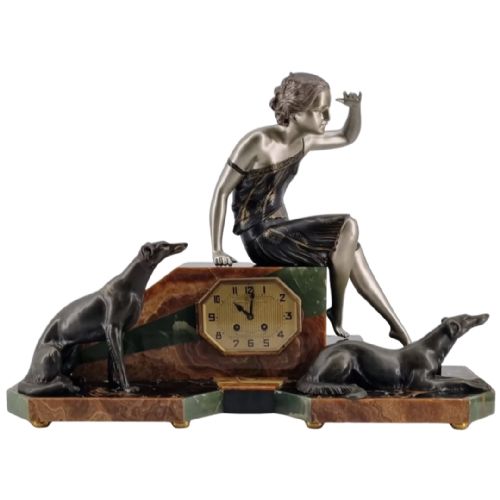
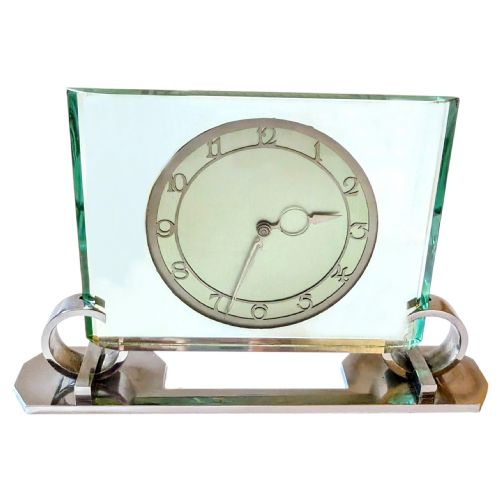
These pieces of 1930s green desk clock capture the geometric forms and striking materials of the period.
1930s Green Desk Clock
A 1930s green desk clock represents the distinct design language of the Art Deco era, combining practical timekeeping with striking visual geometry. Buyers will encounter various forms, including mantel clocks, desk clocks, and combined clock sets featuring lamps or sculptures.
The materials defining these objects typically incorporate green onyx, green marble, and uranium glass paired with contrasting metal elements. Many examples originate from renowned makers and workshops of the period, reflecting both British and continental European manufacture.
How they were made
The construction of a 1930s green desk clock relies on heavy stone bodies such as onyx and marble, shaped to house mechanical movements. Chrome-plating and brass details provide sharp linear accents that contrast with the organic patterns of the natural stone and glass.
Specialised glass forms like opaline uranium glass are moulded into geometric profiles characteristic of the Modernist aesthetic. Enamel and copper elements occasionally supplement the primary stone and metal framework to add depth and colour.
1930s Green Desk Clock Retail Price Guide 2026
Typical asking prices for 1930s green desk clock among the pieces listed under this phrase on Sellingantiques today, from the lower quarter to the upper quarter. They describe what is for sale here now, not the wider market.
What varies in quality
The distinction between tiers of quality rests upon the sophistication of the design and the pedigree of the maker. Pieces bearing signatures from established clockmakers and silversmiths demonstrate superior finish and precision in their movement housings.
Material selection also dictates overall merit, where deeply figured green onyx or unblemished uranium glass elevates the presence of the object. The integration of sculptural metalwork by known artists further separates standard production items from exceptional works.
Smiths Clockmakers·Elliott·Mappin & Webb·DEP·Michel Decoux·Ferdinand Priess·GEC·Garrards
The 1930s Green Desk Clock Glossary
- Art Deco
- A design style spanning the 1920s and 1930s characterised by streamlined shapes, geometric ornamentation, and modern industrial materials. This aesthetic heavily influences the silhouettes of these timepieces.
- Uranium glass
- A specialised glass containing trace amounts of uranium dioxide that glows brightly under ultraviolet light. It appears in striking green shades across several period clock designs.
- Onyx
- A banded variety of chalcedony prized for its smooth polish and rich veining. It serves as a primary heavy stone chassis for many mantel and desk clocks.
- Garniture
- A set of decorative matching objects, typically comprising a clock flanked by matching ornaments or sculptures. These sets create a balanced arrangement on a mantelpiece or desk.
1930s Green Desk Clock: Frequently Asked Questions
How do I wind an 8 day clock?
An 8 day clock requires winding approximately once a week using a matching key inserted into the dial holes. Care must be taken not to overwind the mainspring.
Maintaining a regular winding schedule helps preserve the tension and accuracy of the internal mechanical movement over time.
Where should I place a heavy stone clock?
These dense onyx and marble timepieces need a sturdy, level surface such as a mantelpiece, heavy desk, or sideboard. Their substantial weight requires stable support to prevent accidental tipping.
Placement should also avoid direct sunlight and extreme temperature fluctuations to protect the stone and internal metal components.
What is the difference between a desk clock and a mantel clock?
Desk clocks generally feature compact dimensions suited for workspace tables, occasionally incorporating portable alarm functions. Mantel clocks are typically larger, heavier, and designed as static ornamental pieces for display on fireplace surrounds.
Both variants share the same stylistic Art Deco vocabulary but serve different spatial roles within a room.
How do I identify uranium glass?
Uranium glass exhibits a distinct translucent green or yellow hue under normal lighting conditions. When exposed to a blacklight or ultraviolet source, it emits a vivid neon green glow.
This specific property distinguishes it from standard decorative glass used in period accessories.