
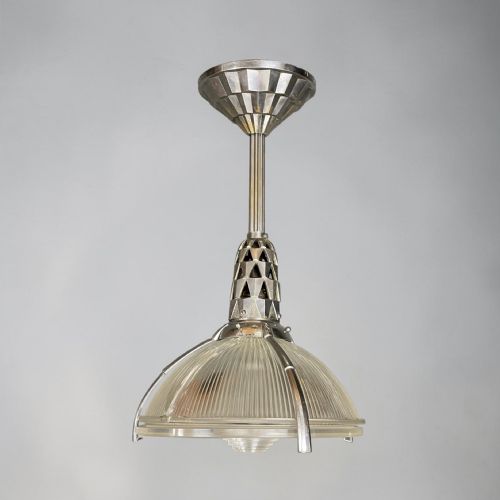
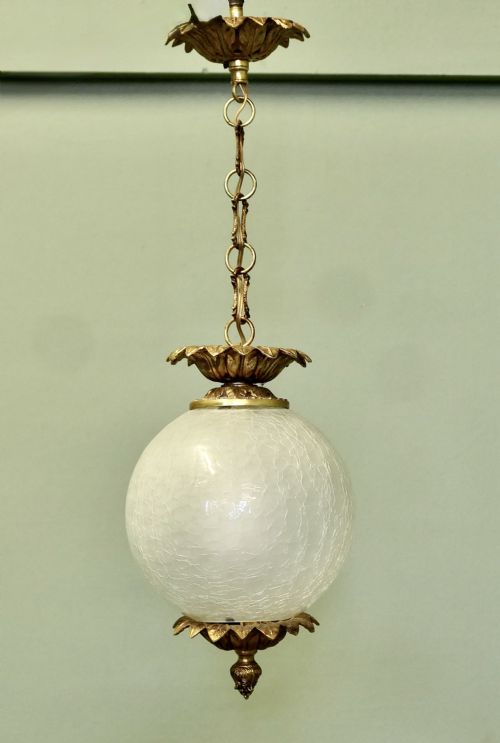
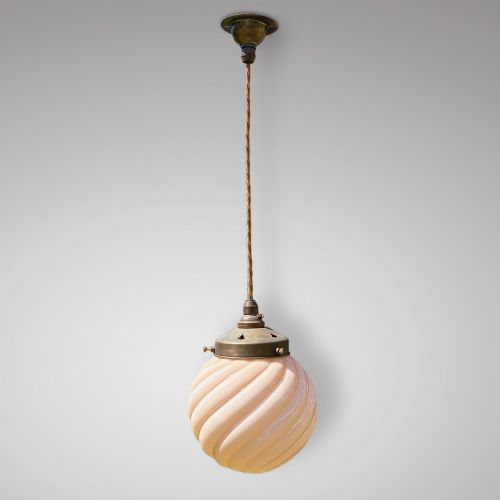


Art Deco Globe Pendant
An art deco globe pendant brings clean geometric lines and diffused illumination into a room, offering both functional light and period character.
Art Deco Globe Pendant
An art deco globe pendant is a suspended ceiling light featuring a spherical or domed shade designed during the early decades of the twentieth century. These fixtures serve as central illumination for hallways, living spaces, and rooms requiring understated architectural detail.
The versions most commonly met on this page date from the 1920s and 1930s, reflecting the streamlined aesthetics of the interwar period. French workshops feature strongly among these examples, alongside pieces created in the overarching Art Deco and Mid-Century Modern styles.
Forms range from simple spherical globes to large dome shades and specialised variations like fish scale or half-globe designs. Each piece operates as a pendant light or ceiling light, hanging from fixtures that integrate brass, chrome, or nickel-plated metal.
How they were made
Makers shaped the characteristic shades of an art deco globe pendant using various forms of glass, including opaline, frosted, moulded, crackle, and etched crystal. These glass types were chosen to soften the glare of electric bulbs while casting an even, warm light across the room.
Metal components such as brass, bronze, chrome, and nickel-plated metal formed the suspension mechanisms, galleries, and fixings. These metallic elements provided structural support and contrasted with the smooth, pale surfaces of the glass globes.
One exceptional ceiling light sports a fish scale pattern on its glass shade, proving that interwar designers loved bringing aquatic textures indoors.
What varies in quality
Quality in an art deco globe pendant rests primarily on the depth and weight of the glass, alongside the refinement of its surface treatment. Thick opaline or heavy etched crystal displays superior light diffusion and structural substance compared to thinner, simpler press-moulded alternatives.
The finish and substance of the metalwork also distinguish finer examples from standard production. Solid brass, bronze, and plated metals that retain crisp casting details and substantial gauge thickness elevate the overall integrity of the pendant.
Émile-Jacques Ruhlmann
The Art Deco Globe Pendant Glossary
- Opaline glass
- A milky, translucent glass type that diffuses light softly without complete transparency. It became a primary material for twentieth-century lighting.
- Frosted glass
- Glass treated to create a textured, matte surface that scatters light and reduces glare. This technique accentuates the geometric forms typical of the period.
- Pendant light
- A hanging light fixture suspended from the ceiling by a cord, chain, or metal rod. These units position illumination directly over a specific area.
- Chrome
- A hard, corrosion-resistant metallic coating applied to base metals to provide a bright, reflective finish. It remains characteristic of modern industrial and interwar design.
Art Deco Globe Pendant: Frequently Asked Questions
How do I hang an art deco globe pendant?
Suspension typically involves attaching the fixture to a standard ceiling electrical junction box using the provided metal ceiling rose and rod, chain, or cord.
Professional installation by an electrician ensures the weight of the glass globe is safely supported and wiring complies with current standards.
What rooms suit an art deco globe pendant?
These fixtures work well in hallways, entryways, and rooms with sufficient ceiling height to accommodate a hanging glass sphere.
Their diffused light and clean silhouette also complement dining spaces and bedrooms requiring focused overhead illumination.
How do I clean opaline glass shades?
Wash the glass gently using warm water and mild dish soap, supporting the shade carefully with both hands during the process.
Avoid harsh abrasive cleaners or scouring pads that might scratch the delicate surface of historical glass.
How do I distinguish 1920s from 1930s lighting?
Pieces from the 1920s often incorporate more ornate French design elements, etched crystal details, and warmer bronze or brass tones.
By contrast, 1930s examples lean towards streamlined chrome hardware, frosted finishes, and functional geometric simplicity.