
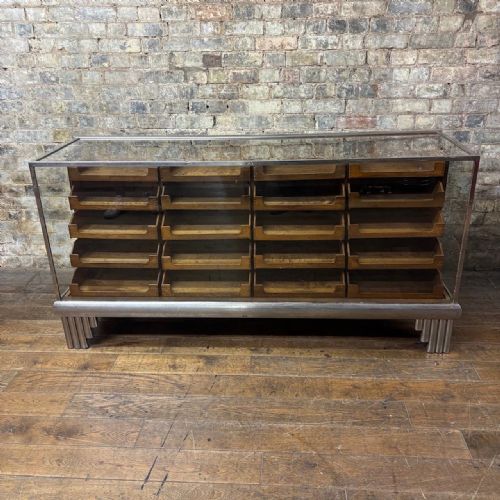


Art Deco Glass Counter
An art deco glass counter brings the clean geometry and metallic edge of the interwar shop floor directly into a modern interior.
Art Deco Glass Counter
When you search for an art deco glass counter, you find a commercial fixture designed to display goods through transparent panels. These pieces include haberdashery cabinets, shop display counters, and jewellers countertop shelves originating from the 1920s and 1930s. The selection on this page shows commercial shop furniture adapted for domestic display.
You are most likely to meet tall display cabinets and low counters built for retail use. These items combine transparent glass viewing areas with sturdy bases. The form serves the practical purpose of showing merchandise while protecting it from dust and handling.
The origins of these pieces lie in the retail fitouts of the interwar period. Makers constructed them for sweet shops, outfitters, and jewellers. Today, collectors use them to showcase collections in homes and modern retail spaces.
How they were made
Makers built the framework of an art deco glass counter using durable materials such as brass, chrome, and aluminium alongside woods like oak, mahogany, birch, and blonde maple. Metal framing provides structural support while keeping the sightlines thin and unobstructed.
Cabinetmakers combined sheet glass with solid timber carcasses and metal trim. The construction relies on tight joints and fitted channels to hold large glass panes securely in place without excessive hardware.
A mannequin head stands ready to model vintage hats among the display counters.
What varies in quality
The distinction between standard retail utility pieces and the finest examples lies in the choice of secondary materials and cabinetmaking detail. Pieces featuring luxury veneers like blonde maple and black lacquer sit at the upper end of the scale.
Makers such as H&L Epstein or Saml. Elliott & Sons applied superior finishing techniques compared to anonymous workshop output. The crispness of the metal framing and the integrity of the original glass top determine the standing of each piece.
Dudley & Co·Saml. Elliott & Sons·H&L Epstein·Pollards·Pierre Iman
The Art Deco Glass Counter Glossary
- Haberdashery counter
- A long shop fixture featuring multiple glazed drawers or sliding glass doors designed for selling textiles and small items. These counters offer exceptional internal visibility.
- Display counter
- A shop fixture with a glass top and upper viewing panels above a solid or framed base. Retailers utilised them to present goods to customers standing on the opposite side.
- Chrome
- A plated metal finish used extensively in interwar design to provide a bright, corrosion-resistant surface. This material defines the modern industrial aesthetic of the period.
- Blonde maple
- A pale timber with a fine grain utilised in high-end interwar cabinetmaking. It provides a striking contrast when paired with dark lacquer or metal framing.
Art Deco Glass Counter: Frequently Asked Questions
How are these counters constructed?
Makers built the structural frame using timber such as oak, mahogany, or birch, combined with metal elements in brass, chrome, or aluminium. Large glass panes fit securely into the framework to enclose the display area.
Cabinetmakers ensured that the joints remained tight to support the heavy glass panels safely during daily retail use.
What rooms suit these counters?
These counters work well in living rooms, kitchens, or retail spaces where visibility is a priority. The glass panels allow you to display collections or tableware while keeping them protected.
Their distinct interwar styling also complements modern dining rooms or hallways as statement furniture.
How do I identify the period?
Pieces from this era display specific geometric lines, streamlined metal framing, and materials characteristic of the 1920s and 1930s. Look for construction methods typical of interwar commercial joinery.
Maker marks or stamps on the timber frame often confirm the exact workshop origin.
Can I use them for storage?
These fixtures offer substantial internal space behind glass panels or within fitted drawers. They were originally designed to hold stock ready for customer inspection.
Today, that same compartmentalised layout suits the storage and display of books, ceramics, or textiles.