



Armorial Mahogany Chairs
Armorial mahogany chairs carry painted or carved heraldry on solid wood, offering a distinguished touch of country house provenance.
Armorial Mahogany Chairs
Armorial mahogany chairs combine dense tropical hardwood with carved or painted heraldic motifs, creating striking seating for hallways and reception rooms. These pieces originate across the eighteenth and nineteenth centuries, spanning Georgian, Regency, George IV, and Victorian periods.
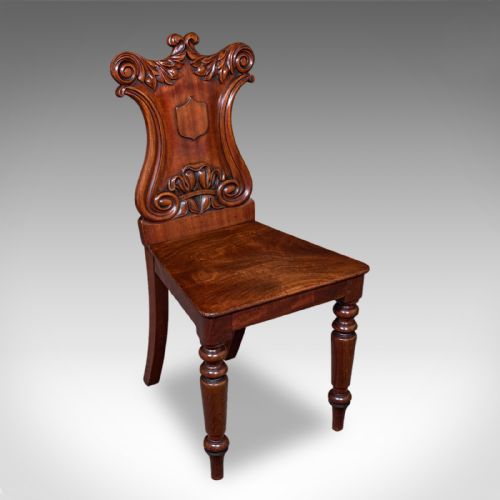
The selection on this page centres predominantly upon hall chairs, alongside occasional armchairs designed for formal spaces. Makers utilised substantial timbers to carve shells, crests, and hippocampus armorials into solid wooden backs.
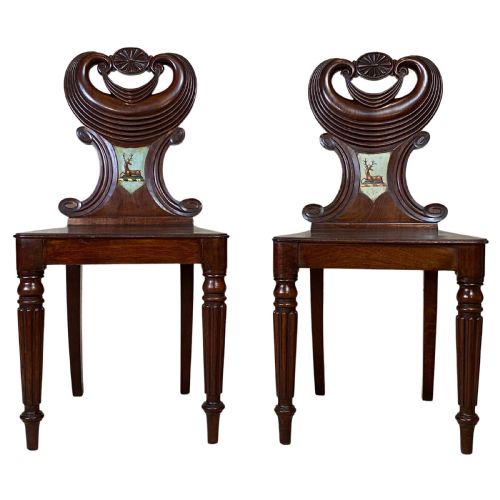
Examples appear in matched pairs or larger sets, such as sets of five, reflecting original commission scales for country houses. Scottish and English origins both emerge within the recorded pieces.
How armorial mahogany chairs were made
Cabinet makers selected heavy mahogany timber for its strength and rich grain, allowing crisp, deep relief carving on chair backs. Solid wood construction provided the durability required for hall seating subjected to daily use.
Workshops applied detailed paint finishes directly to wooden panels for heraldic crests, or carved the armorials straight into the solid mahogany back. Brass elements and tapestry details occasionally supplemented the timber structure on specific armchair forms.
Materials recorded across these pieces include solid mahogany, paint, brass, and tapestry.
What varies in quality
Depth and precision of the heraldic carving distinguish standard production from exceptional country house commissions. Sharp relief work on shell backs and hippocampus armorials indicates superior workshop execution by makers such as Gillows.
Scale and timber selection dictate the visual presence of the chair, with substantial proportions and well-figured mahogany commanding attention. The complexity of the painted or carved armorial display elevates the piece from a basic utility seat to a documented commission.
Gillows
The Armorial Mahogany Chairs Glossary
- Armorial
- Bearing a coat of arms or heraldic crest. This painted or carved insignia identifies the original owning family.
- Mahogany
- A dense, durable dark hardwood favoured for fine cabinet making. Its stability permits intricate carving without splitting.
- Hall chair
- A rigid wooden seat traditionally placed in entrance halls and corridors. These pieces focused on formal appearance rather than cushioned comfort.
- Regency
- A British design period spanning the early nineteenth century. Furniture from this era often incorporates classical motifs and clean lines.
Armorial Mahogany Chairs: Frequently Asked Questions
Where were armorial mahogany chairs placed?
These chairs stood primarily in grand entrance halls, corridors, and reception rooms of country houses. Their rigid wooden construction suited spaces intended for visitors rather than private family lounging.
Pairs and larger sets lined the walls as architectural statements, displaying the family heraldry to arriving guests.
How do I identify a Regency armorial chair?
Regency pieces date from the early nineteenth century and typically exhibit classical proportions influenced by Greek and Roman design. Look for crisp turned legs and bold carved crests.
The integration of specific armorial motifs, such as painted shields or carved hippocampus designs, marks out these commission pieces.
What is the difference between hall chairs and armchairs?
Hall chairs feature wooden seats without upholstery, designed for upright posture and occasional use in entrance spaces. They rely heavily on carved backs and painted crests for visual impact.
Armchairs offer wider proportions with armrests, sometimes incorporating materials like tapestry alongside the primary mahogany structure.
Can I use these chairs for daily dining?
These pieces were built as rigid hall seats rather than comfortable dining chairs. Their solid wooden seats lack cushioning, prioritising heraldic display and architectural presence.
Placing them in reception areas preserves their historic structure while maintaining their original visual purpose.