
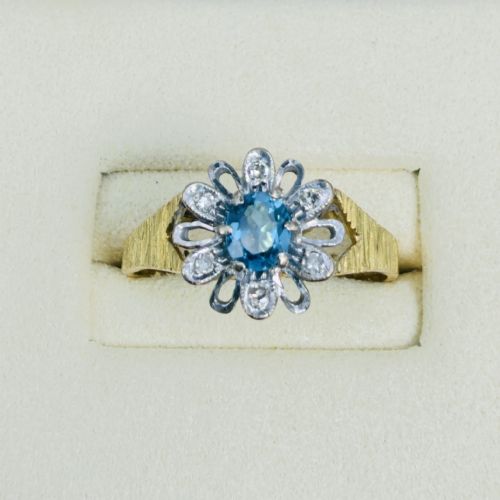
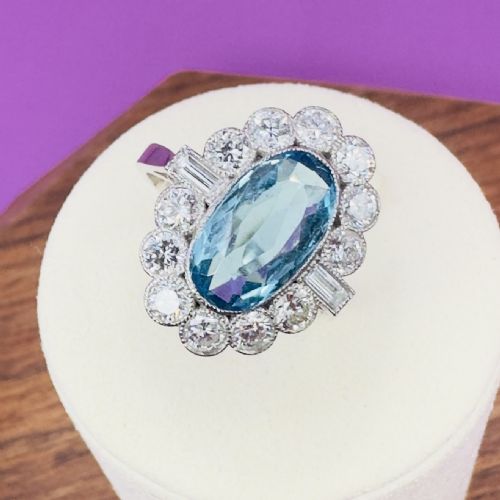


Aquamarine Diamond Cluster Ring
An aquamarine diamond cluster ring brings together cool blue beryl and brilliant sparkle, offering enduring mid-century and art deco style.
Aquamarine Diamond Cluster Ring
An aquamarine diamond cluster ring combines a central blue beryl surrounded by smaller diamonds, forming a distinct perimeter that highlights the main stone. When exploring an aquamarine diamond cluster ring, buyers encounter pieces originating from the nineteenth century through the mid-century decades, spanning styles such as art deco and art nouveau.
The most common formats on this page are platinum and gold rings housing oval, emerald cut, or marquise aquamarines encircled by brilliant, old cut, or baguette diamonds. These configurations range from floral motifs to geometric arrangements typical of nineteen-thirties design.
The assortment includes distinct structural variations, such as elongated oval cuts and marquise profiles, alongside traditional cluster shapes. These pieces bridge the Victorian, Edwardian, and mid-century eras, reflecting shifts in mounting techniques and stone cutting.
How They Were Made
Jewellers utilised platinum and various grades of gold, including eighteen-carat yellow, white, and fourteen-carat gold, to mount these stones securely. Platinum provides the strength required for delicate claw settings and intricate art deco geometric designs without adding excessive weight to the band.
Stones are shaped into diverse cuts, notably oval, emerald, marquise, and rose cuts, paired with old cut or baguette diamonds. Metalworkers shaped the precious metals by hand or cast them to support the central beryl alongside smaller diamond accents.
Materials recorded across these items include platinum, eighteen-carat yellow gold, eighteen-carat white gold, and fourteen-carat yellow gold.
What Varies In Quality
The quality of an aquamarine diamond cluster ring depends on the saturation and clarity of the central beryl and the matching brilliance of the surrounding diamonds. Superior examples feature stones with deep, uniform colour and minimal inclusions, complemented by precisely cut diamond borders.
Execution of the metalwork also differentiates pieces, as finer settings display seamless claw or bezel work that holds the stones securely while minimising visible metal. The balance between the central aquamarine and the surrounding diamond halo determines the overall visual harmony of the jewel.
The Aquamarine Diamond Cluster Ring Glossary
- Aquamarine
- A blue to greenish-blue variety of beryl that forms the central stone in these cluster rings. Its name derives from seawater, reflecting its characteristic pale to deep blue tones.
- Cluster ring
- A ring design featuring a prominent central gemstone encircled by a group of smaller stones. This arrangement maximises surface sparkle and presence on the hand.
- Art Deco
- A design style prevalent during the nineteen-thirties characterised by geometric symmetry, clean lines, and platinum settings. It remains a defining aesthetic for many cluster rings.
- Old cut diamond
- A precursor to modern brilliant cut diamonds, hand-faceted with smaller tables and higher crowns. These stones produce a distinctive softer candlelight glow.
- Marquise cut
- An oval-shaped gemstone pointed at both ends, sometimes called a navette cut. This profile elongates the finger when mounted in a cluster ring.
Aquamarine Diamond Cluster Ring: Frequently Asked Questions
What periods do these rings come from?
The pieces span multiple eras, including the nineteenth century, nineteen-thirties art deco, and mid-century designs from the nineteen-fifties and nineteen-sixties.
Each period brings distinct mounting styles, ranging from elaborate floral motifs to strict geometric platinum settings.
How do I care for my ring?
Clean your jewellery gently using warm soapy water and a soft brush to remove everyday oils from the aquamarine and diamond facets.
Avoid harsh chemical dips or ultrasonic cleaners, particularly with antique settings where stones might be foil-backed or delicate.
Are these rings suitable for daily wear?
Aquamarine measures well on the Mohs hardness scale, making it durable enough for regular daily use when set in robust platinum or gold.
Prongs and settings should still be inspected periodically by a jeweller to ensure the central stone and surrounding diamonds remain secure.
What is the difference between white gold and platinum?
Platinum is a naturally white, dense metal that maintains its colour without plating and offers high tensile strength for fine claw work. White gold is an alloy combined with other metals to achieve a pale colour and typically requires rhodium plating to maintain brightness.