


Antique Working Dog Artwork
Antique working dog artwork captures the keen intelligence and tireless energy of farm, field, and sporting breeds through traditional painting and needlework.
Antique Working Dog Artwork
Antique working dog artwork encompasses framed oil paintings, watercolours, and textile needlework depicting terriers, collies, spaniels, and setters in rural settings. Buyers hunting for antique working dog artwork typically encounter Victorian canvas works and mid-twentieth-century oils showing dogs engaged in ratting, guarding, or resting in landscapes.
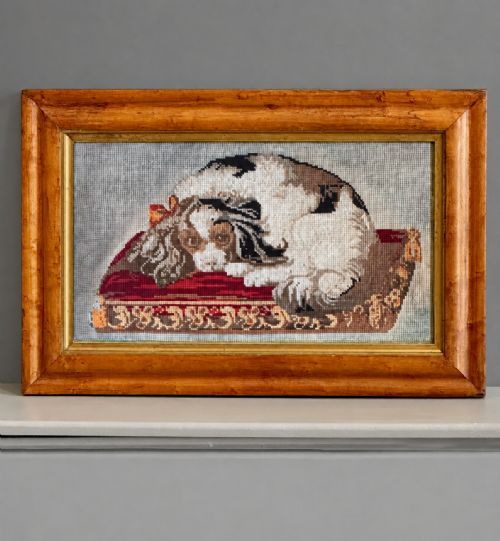
The pieces range from intimate wool needlework in burr maple frames to larger landscape oil paintings executed during the nineteenth century. These works document the close partnership between working dogs and rural labourers, ploughmen, and sportsmen across Britain.
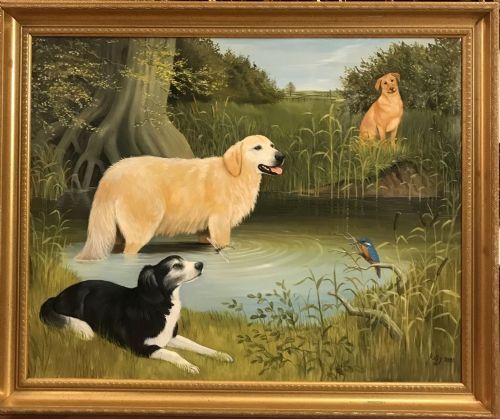
Victorian rural realism dominates the selection, showing terriers on the scent or collies posed attentively in pastoral environments. Each piece reflects the utility and character prized by rural communities of the nineteenth and early twentieth centuries.
How they were made
Artists applied oil paint to stretched canvas or board, building up rich textures to render the fur, expressive eyes, and muscular forms of working dogs. Canvas supports were frequently mounted within period gilt or burr maple frames that complement the naturalistic palette.
Watercolour pigments were worked onto paper for detailed pair portraits of setters, while textile artisans utilised wool in Berlin work needlework to construct detailed spaniel studies. These traditional methods ensured durable imagery that survived generations of domestic display.
Makers integrated landscapes and genre scenes into the backgrounds using layered oil paint, balancing the central dog portrait with atmospheric fields, farmyards, and wooded vistas.
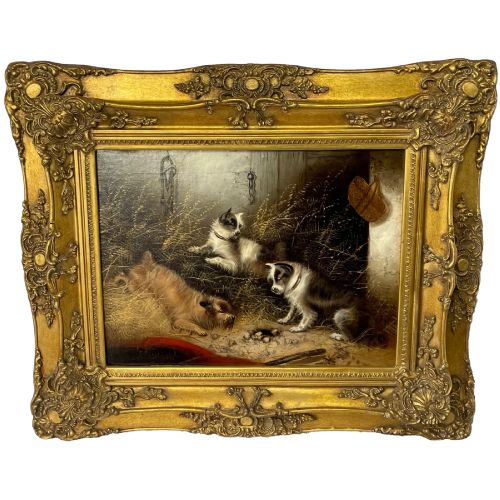
Several terriers are caught red-pawed guarding a trapped rat.
What varies in quality
Quality rests upon the artist's anatomical precision in rendering bone structure, posture, and coat textures rather than a generalized silhouette. Superior works capture the intense focus of a terrier on the scent or the alert posture of a collie with distinct brushwork.
The integration of the dog within its landscape setting separates accomplished paintings from simpler domestic records. Stronger pieces use light and shadow to create depth, whereas lesser works treat the background as an afterthought.
Original framing, such as burr maple or period gilt mouldings, contributes to the integrity of the piece. The preservation of the canvas surface and the absence of heavy overpaint determine the visual clarity of the original composition.
John Emms·John Trivett Nettleship·Colin Graeme Roe·George Armfield·Arthur Alfred Davis·Edward Armfield·George Cole
The Antique Working Dog Artwork Glossary
- Berlin work
- A style of counted-thread embroidery using wool on canvas, popular in the nineteenth century for domestic animal portraits.
- Burr maple
- A decorative wood veneer showing knotted growth patterns, frequently selected for nineteenth-century picture frames.
- Genre painting
- Artwork depicting scenes from everyday life, often featuring rural workers, horses, and farm dogs.
- Sporting art
- Depictions of hunting, shooting, and working animals associated with field sports and rural pursuits.
- Watercolour
- A painting method where fine pigment is suspended in a water-soluble binder, applied to paper for detailed studies.
Antique Working Dog Artwork: Frequently Asked Questions
What periods do these artworks come from?
The pieces span the nineteenth and twentieth centuries, with a strong concentration of Victorian rural realism and sporting art from the eighteen-fifties onwards.
Examples range from mid-nineteenth-century oil paintings to mid-twentieth-century canvases depicting multiple spaniels.
How were these dog paintings used originally?
Landowners, farmers, and sportsmen commissioned or purchased these works to celebrate valued working animals, hunting companions, and farm collies.
They hung in country houses and rural homes as testaments to the utility and loyalty of working breeds.
What dog breeds appear most often?
Terriers, collies, spaniels, and setters are the primary breeds recorded across the oil paintings, watercolours, and needlework pieces.
Many works specifically capture terriers ratting or guarding, reflecting their active roles on Victorian farms.
How should I care for an oil painting?
Keep oil paintings away from direct sunlight and fluctuating heat sources to prevent canvas tension issues and pigment degradation.
Dust the surface gently with a soft, dry brush and avoid using chemical cleaners on either the canvas or the frame.
Are the frames original to the pieces?
Many works retain period frames such as burr maple or gilt wood that match the era of the canvas.
Framing materials varied from simple moulded wood to decorative gilt surrounds depending on the commission and the period.