



Antique Wood Mosaic
Antique wood mosaic encompasses intricate Tunbridge ware, Damascus games tables, and Anglo-Indian boxes prized for their meticulous assemblage of small tesserae.
Antique Wood Mosaic
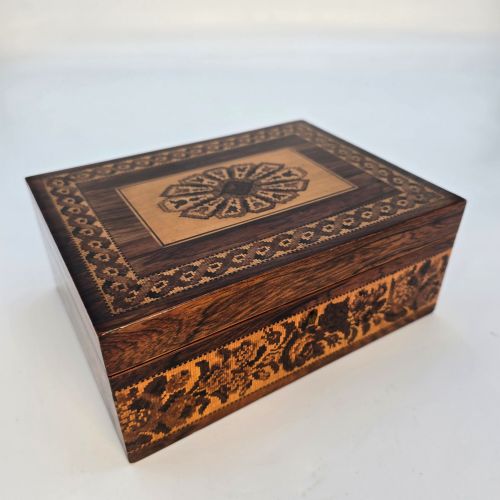
Antique wood mosaic items primarily appear as Victorian Tunbridge ware objects such as tea caddies, stationery boxes, and ladies boxes. These pieces display elaborate geometric and pictorial compositions built from thousands of tiny wood blocks.
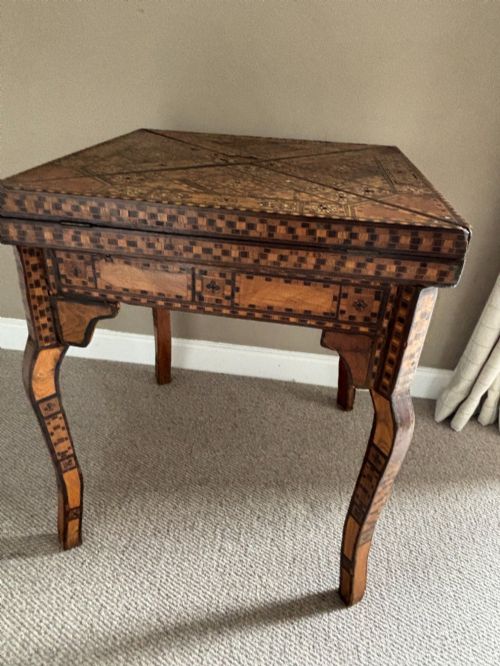
Beyond English Tunbridge ware, buyers encounter Damascus and Anglo-Indian tables and boxes featuring Arabic inlay and Sadeli work. These pieces combine wood mosaic with bone and mother of pearl to create striking geometric patterns.
Larger formats include centre tables and games tables from 19th century Italian, Ottoman, and Regency origins. These surfaces demonstrate the same mastery of micro-mosaic and marquetry on a grander architectural scale.
Materials and construction methods
Makers utilised a diverse palette of natural timbers including walnut, rosewood, boxwood, holly, fruitwood, and sycamore to achieve varied chromatic contrasts without artificial staining. These woods were sliced into microscopic strips, glued together in bundles, and cross-sectioned to produce identical mosaic motifs.
Many boxes and tables integrate supplementary materials such as bone, mother of pearl, and specimen marble alongside the primary wood mosaic elements. Ebonised wood and mahogany frequently provide dark structural framing that highlights the brightness of the mosaic panels.
Antique Wood Mosaic Retail Price Guide 2026
Typical asking prices for wood mosaic among the pieces listed under this phrase on Sellingantiques today, from the lower quarter to the upper quarter. They describe what is for sale here now, not the wider market.
Listings feature 19th-century Tunbridge ware alongside Anglo-Indian, Ottoman, and Italian works, utilising walnut, rosewood, and bone.
Factors determining quality
Quality rests upon the microscopic scale of the wooden tesserae and the precision of their alignment across the surface. Finer examples display thousands of infinitesimal pieces forming complex pictorial views or seamless geometric tessellations without visible gaps.
The choice of underlying timber and supplementary detailing dictates the grade of the piece, with dense hardwoods like rosewood and walnut supporting intricate inlay. Superior execution shows crisp architectural perspective and harmonious natural wood colouration throughout the mosaic panels.
Edmund Nye·Henry Hollamby
The Antique Wood Mosaic Glossary
- Tunbridge Ware
- A specialised form of British wood mosaic developed in Kent, using thousands of tiny coloured wood prisms to create pictorial and geometric designs. The technique reached its peak during the Victorian period.
- Sadeli Work
- An intricate form of mosaic inlay originating from British India, typically using geometric patterns composed of micro-mosaics in wood, bone, and metal. It frequently adorns small boxes and caskets from the nineteenth century.
- Pietra Dura
- A method of inlaying cut and fitted polished coloured stones to form images, appearing on tables and boxes alongside wood mosaic elements. This technique demands immense precision from the lapidary artisan.
- Marquetry
- The art of applying pieces of veneer to a structure to form decorative patterns and pictures. In these pieces, it works in tandem with block mosaic techniques.
- Tesserae
- The individual small blocks of wood, bone, or stone assembled together to create the overarching mosaic design. Their diminutive size dictates the resolution of the final picture.
Antique Wood Mosaic: Frequently Asked Questions
What is Tunbridge ware?
Tunbridge ware is a distinct British craft style characterised by wood mosaic surfaces built from thousands of minuscule timber blocks. These blocks form detailed geometric patterns or topographical views of castles and butterflies.
Craftsmen in Kent produced these items throughout the nineteenth century, applying the mosaic technique to everyday domestic objects like tea caddies, sewing boxes, and book-slides.
How were Damascus games tables made?
Damascus games tables incorporate Arabic inlay and intricate woodwork, combining wood mosaic with geometric bone or mother of pearl elements. Artisans constructed these tables to serve as functional furniture while displaying complex near-eastern decorative motifs.
These pieces reflect international trade and stylistic exchange during the nineteenth century, utilising contrasting timbers to form striking checkerboards and border patterns.
Where should I place a centre table?
Centre tables with mosaic or specimen marble tops function best in spaces where adequate lighting allows the intricate grain and tessellation to be appreciated. They suit reception rooms or libraries as statement display surfaces.
Care should be taken to protect the delicate wood mosaic and inlaid stone from direct sunlight and excessive temperature fluctuations.
How do I care for antique wood mosaic?
Antique wood mosaic surfaces require gentle dusting with a dry, soft cloth to prevent particulate accumulation between the tiny wooden tesserae. Avoid liquid cleaners and chemical polishes that might degrade the historic adhesives used in the mosaic assembly.
Maintaining stable ambient humidity in the room prevents the numerous small wood elements from expanding, contracting, or loosening over time.