


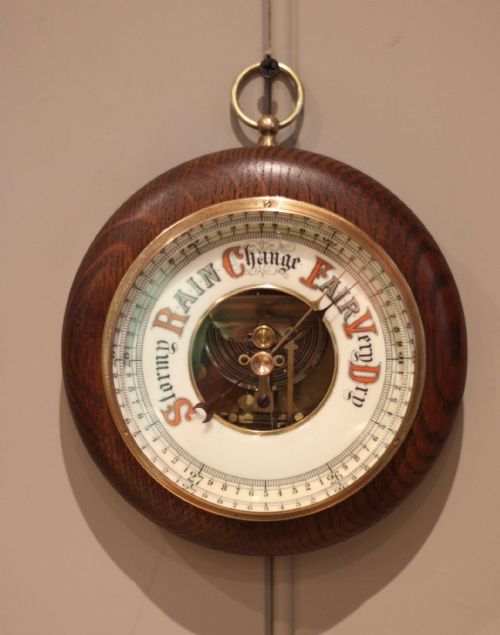


Antique Wall Weather Indicator
These antique wall weather indicators track atmospheric shifts and wind direction, offering both practical meteorological records and handsome interior decoration.
Antique Wall Weather Indicator
An antique wall weather indicator encompasses domestic barometers and exterior weathervanes designed to measure pressure or show wind direction. Buyers browsing this selection typically encounter domestic wall-hung barometers from the nineteenth century alongside outdoor metal vanes.
The domestic pieces take several distinct forms, ranging from stick barometers and banjo barometers to circular aneroid instruments. Oak, mahogany, and walnut case woods dominate the domestic category, housing complex brass and glass dial mechanisms.
Exterior indicators appear in wrought iron, steel, and copper, fashioned into silhouettes such as horses or simple directional arrows. These outdoor vanes served practical agricultural or maritime purposes before finding a place in architectural salvage and interior display.
How they were made
Cabinetmakers constructed the wooden housings using dense timbers like mahogany, oak, walnut, and boxwood, frequently adding delicate string inlay or carved ornamentation. These cases protected the delicate internal tubes containing mercury or the spring-loaded aneroid chambers.
Metalworkers shaped copper, wrought iron, and steel for exterior weathervanes, hammering and riveting the sheets to withstand exposure to the elements. Dials on barometers utilised engraved brass plates, silvered metal, and protective glass bezels to display pressure readings clearly.
Listings show nineteenth-century domestic barometers housed primarily in oak, mahogany, and walnut cases.
What varies in quality
The refinement of the cabinetwork and the reputation of the maker dictate the standing of a barometer within its class. Instruments signed by notable instrument makers often display superior dial engraving and more sophisticated movement calibration.
The choice of timber and the complexity of the case design also separate standard workshop output from higher-grade pieces. Figured veneers, boxwood and ebony stringing, and elaborate carving indicate a greater investment of time by the original maker.
Short & Mason·Maple & Co·A Rivolta·J Groce·George Dollond
The Antique Wall Weather Indicator Glossary
- Aneroid barometer
- A barometer that measures atmospheric pressure by the expansion and contraction of a flexible metal box called an aneroid capsule. This mechanism removes the need for liquid mercury.
- Stick barometer
- A tall, narrow barometer where the mercury column is exposed or partially visible against a scale. These long-case instruments represent the traditional form of atmospheric measurement.
- Banjo barometer
- A household barometer housed in a distinctive symmetrical wooden case shaped roughly like a banjo. It frequently combines a hygrometer, thermometer, and spirit level around the main dial.
Antique Wall Weather Indicator: Frequently Asked Questions
How do aneroid and mercury barometers differ?
Mercury barometers use a column of liquid metal balanced against atmospheric pressure in a glass tube. Aneroid versions rely on a sealed metal chamber that flexes with pressure changes.
This mechanical difference means aneroid instruments are much safer to transport and hang on interior walls without risk of fluid spills.
Where should I hang a wall barometer?
Wall barometers require a stable interior location away from direct sunlight, radiators, and heavy draughts. Sudden temperature swings can affect the delicate internal calibration.
Securing the instrument firmly to a wall stud ensures accurate readings and protects the wooden case from accidental knocks.
How do I date an antique barometer?
Stylistic details in the timber case, such as Regency stringing or Victorian carving, offer the first clues to age. Maker signatures and patent marks on the dial provide more precise chronological markers.
Examining the fixings and the construction of the backboard helps confirm whether the instrument dates to the nineteenth century or later.
Were weathervanes used indoors?
Historical weathervanes stood exclusively on exterior roofs, cupolas, and spires to catch the prevailing wind. Today, collectors frequently display them indoors as sculptural metalwork.
Mounting brackets allow these copper and iron figures to sit securely on interior walls or tabletops.