
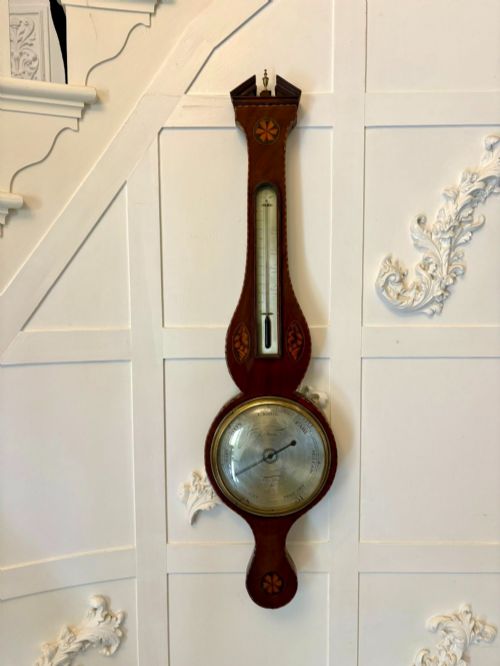
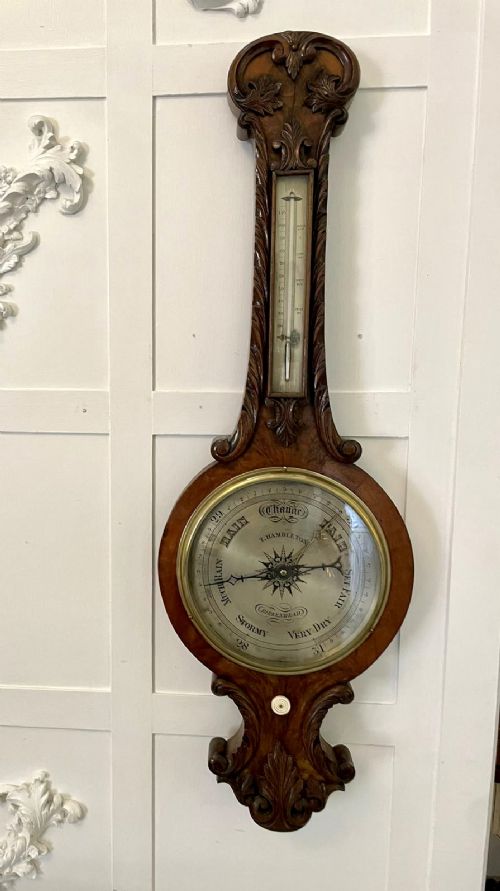
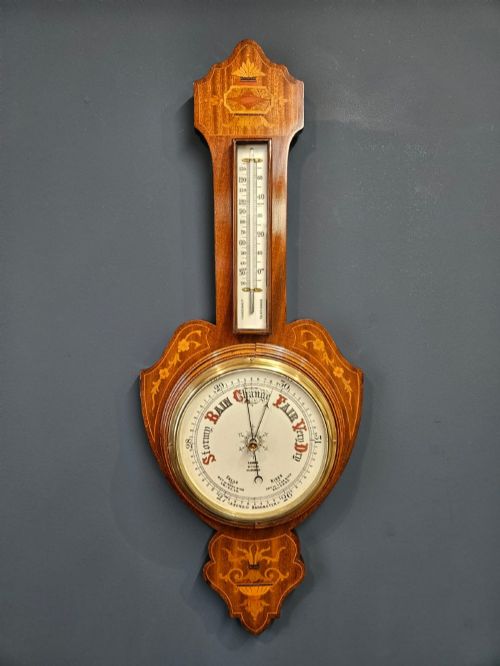
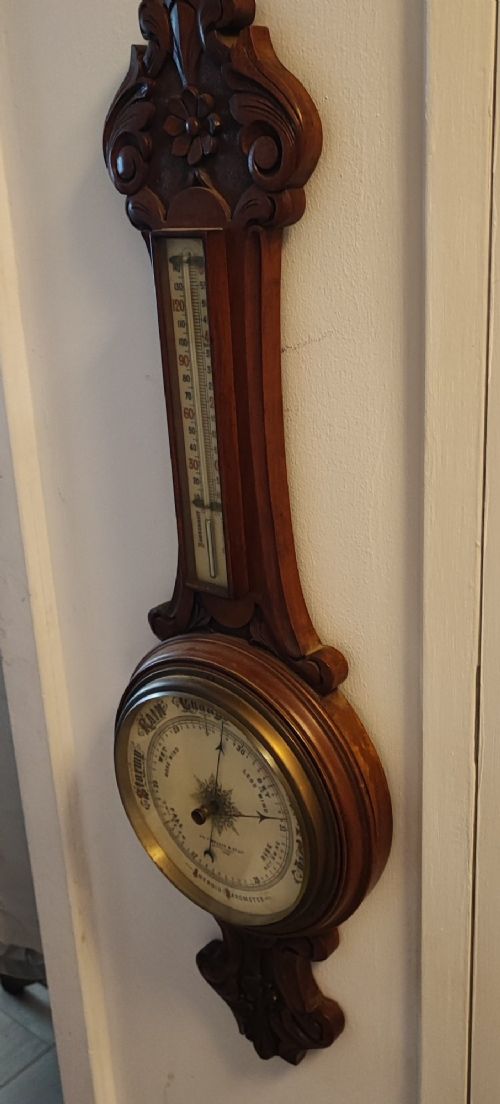


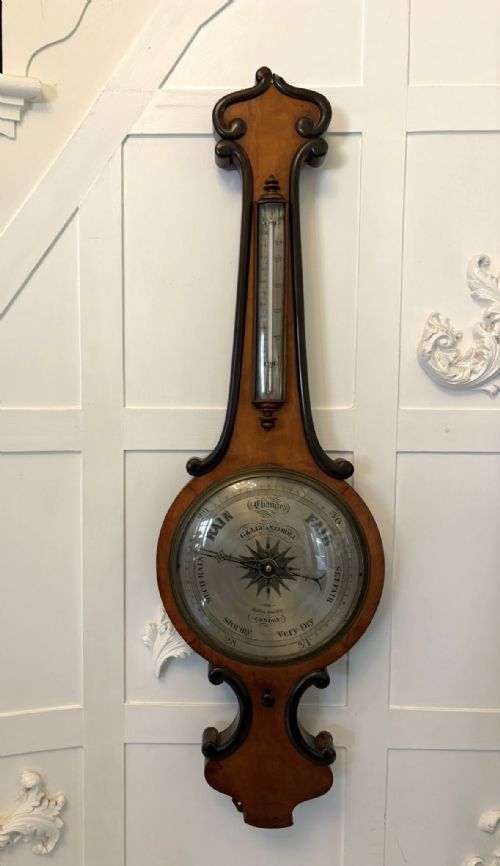


Banjo Wall Barometer
A banjo wall barometer brings both meteorological interest and striking woodwork to a room, offering a glimpse into domestic life from past centuries.
Banjo Wall Barometer
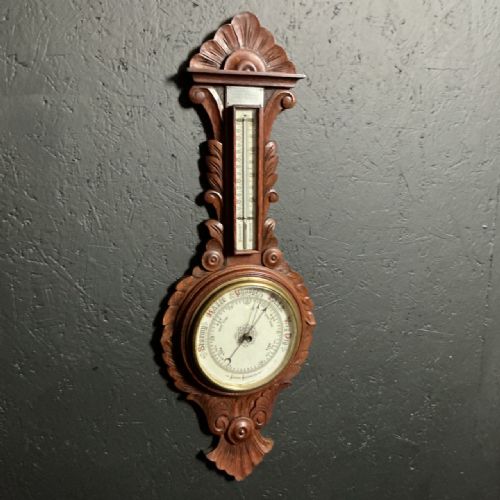
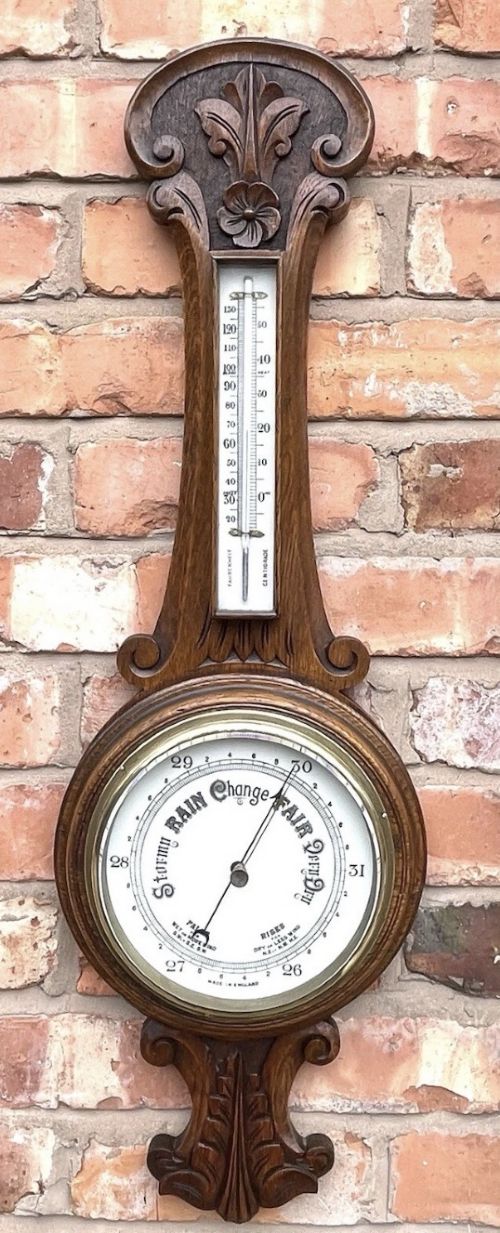
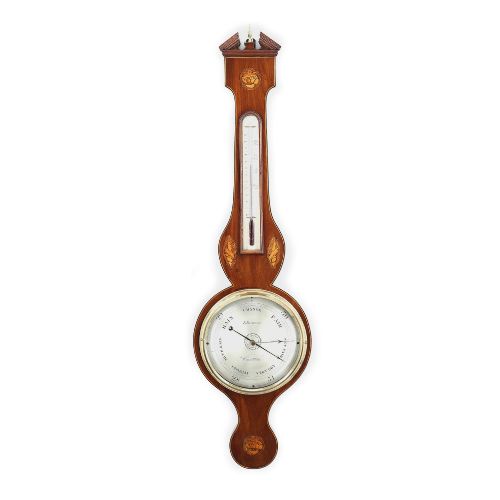
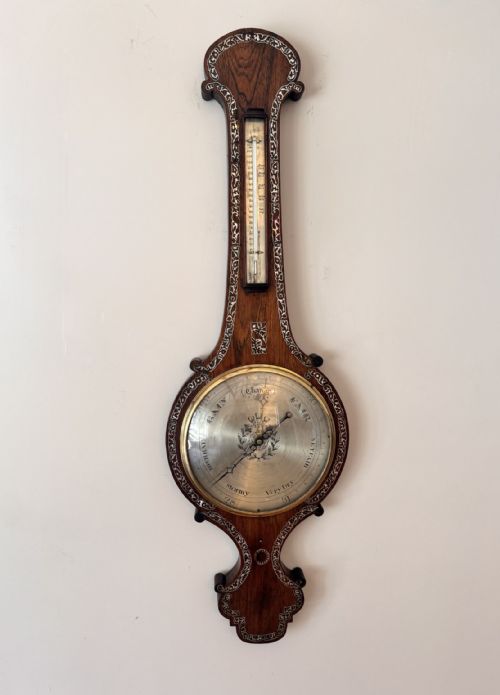
A banjo wall barometer takes its name from the distinctive shape of its wooden body, featuring a narrow stem widening into a circular base. When searching for a banjo wall barometer, buyers encounter instruments primarily from the Georgian, Regency, and Victorian periods.
These instruments span several eras including the 19th century, Edwardian period, and Georgian Revival. The selection includes works from makers active in London, Weymouth, Norwich, and Shrewsbury.
How they were made
Cabinet makers utilised dense timbers such as mahogany, oak, rosewood, and walnut for the bodies. These woods often received shell inlay, marquetry, or mother of pearl details.
Internal mechanisms relied on glass tubes containing mercury or aneroid systems paired with silvered metal dials and brass fittings.
Listings feature woods such as mahogany, oak, rosewood, and walnut, frequently accented with mother of pearl and brass.
What varies in quality
The refinement of the cabinet work dictates the standing of a piece, separating straightforward utilitarian instruments from those commissioned with intricate shell inlay or elaborate carved oak decoration.
The precision of the maker's signature on the silvered metal dial and the clarity of the surrounding woodwork influence the desirability of the barometer.
B Besozzi of Weymouth·G and L Guanziroli London·Ganthony of London·Prada of High Wycombe·Molton of Norwich·Luisetti of London·Fagioli of Clerkenwell London·W Watson and Sons·Jenkins of Old Swindon·Maple and Co·W N Telford Chester
The Banjo Wall Barometer Glossary
- Aneroid barometer
- A barometer that measures atmospheric pressure using a small flexible metal box rather than liquid mercury. This design became common during the Victorian era.
- Wheel barometer
- Another term for the banjo barometer format, describing the circular dial mechanism driven by a pulley and weight system connected to the tube. It allows for a large, easily readable face.
- Mercurial barometer
- An instrument that measures pressure through the rise and fall of mercury in a glass tube. These traditional pieces require careful handling during transport.
- Marquetry
- Decorative woodwork where thin pieces of various timbers or shell are fitted together to form patterns on the surface. It frequently appears on Georgian and Neo-Classical examples.
- Silvered metal
- A brass or copper dial treated to achieve a bright silver finish before engraving. The text and graduations are then typically filled with black wax for legibility.
Banjo Wall Barometer: Frequently Asked Questions
How do I read a banjo wall barometer?
The main circular dial shows atmospheric pressure changes, often marked with weather predictions like 'Fair' or 'Rain'. A secondary needle, adjusted by the central brass knob, allows you to track movement against the primary pointer.
Many examples also incorporate a thermometer on the stem above the dial to show ambient room temperature.
How do I tell a Georgian barometer from a Victorian one?
Georgian instruments often feature clean mahogany cases with delicate stringing or shell inlay, reflecting Neo-Classical tastes. Mercury tubes are more common in this earlier era.
Victorian and later examples frequently utilise carved oak, walnut, or rosewood, and more often employ aneroid mechanisms alongside thermometer attachments.
Are these barometers still accurate?
While many historical instruments retain working movements, accuracy can vary due to age or past transport. Collectors primarily value them for their decorative craftsmanship and mechanical history.
Professional calibration is sometimes required if you intend to track daily weather patterns.