



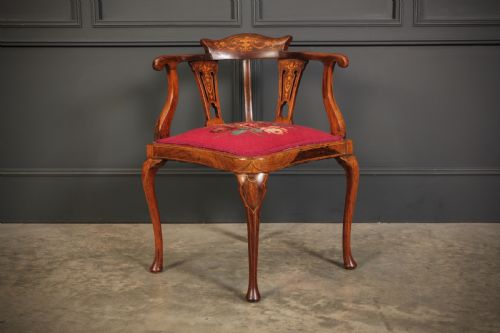
Antique Upholstered Corner Seat
An antique upholstered corner seat fits neatly into empty room angles, offering a practical place to sit.
Antique Upholstered Corner Seat
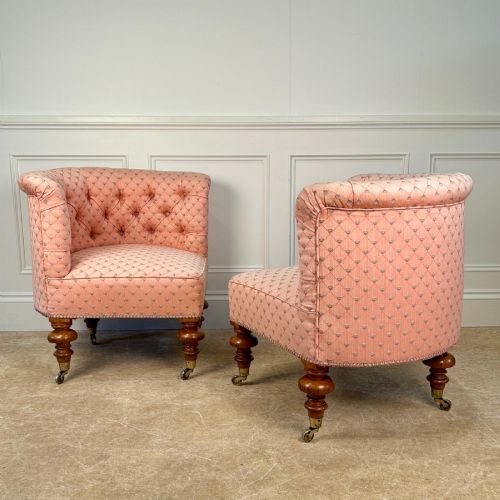
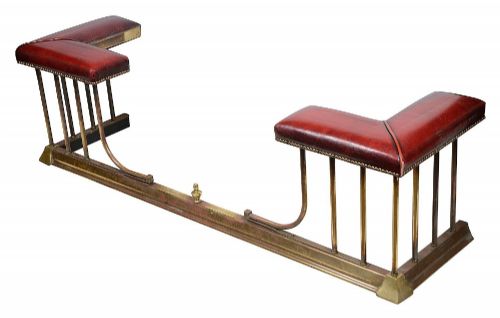
An antique upholstered corner seat is designed to utilise awkward angles and junctions in a room, turning unused space into practical seating. When you search for an antique upholstered corner seat, you encounter forms that range from compact bedroom chairs to low salon armchairs and occasional corner sofas.
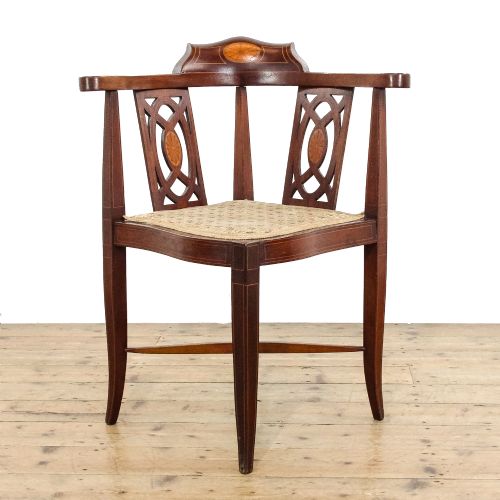
The pieces appearing here span several distinct eras, with Edwardian and Victorian examples forming the majority of the selection. You find variations shaped from mahogany, walnut, oak, and rosewood, often paired with textile, fabric, leather, or velvet upholstery.
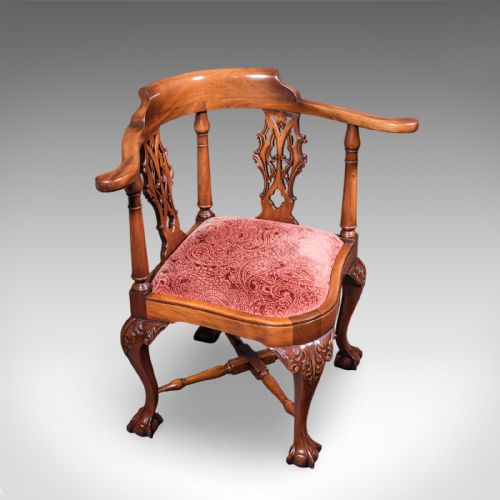
Makers and designers across the eighteenth, nineteenth, and early twentieth centuries approached this form with varying degrees of ornamentation. Some examples feature straightforward turned wooden frames, whilst others incorporate elaborate carving, wood inlay, or marquetry details.
How they were made
Cabinet makers built the structural frames of these seats using dense hardwoods such as mahogany, walnut, oak, and rosewood. These timbers provided the necessary strength to support angled joinery and load-bearing legs.
Surface decoration frequently involved intricate wood inlay, marquetry, and carved detailing applied directly to the wooden rails and splats. Upholstery techniques made use of textiles, fabrics, leather, and velvet secured over padding to create the seat pads.
Listings for this phrase include examples constructed from mahogany, walnut, oak, and rosewood across Victorian and Edwardian periods.
What varies in quality
The quality of these seats depends upon the selection of timber and the precision of the underlying joinery. Denser woods and tighter corner joints separate robust examples from simpler constructions.
Artistic execution in carved elements and wood inlay dictates the upper tier of the range. Refined execution of decorative details signals a higher standard of workshop production.
Miles and Edward's
The Antique Upholstered Corner Seat Glossary
- Mahogany
- A durable, reddish-brown tropical hardwood favoured by cabinet makers for its strength and fine grain. It accepts carving and polishing exceptionally well.
- Marquetry
- The art and craft of applying pieces of veneer to a structure to form decorative patterns. It often incorporates various coloured woods to create pictorial designs.
- Squab Seat
- A loose cushion placed upon the base of a chair or sofa. It can be removed for cleaning or reupholstering.
- Aesthetic Movement
- A late nineteenth-century design style that emphasised visual and material qualities over narrative or moral content. It promoted craftsmanship and artistic expression in household furnishings.
Antique Upholstered Corner Seat: Frequently Asked Questions
Where do you put an antique upholstered corner seat?
These seats are traditionally placed in the corner of a bedroom, hallway, or drawing room to utilise space that standard chairs cannot occupy.
Their diagonal orientation allows them to anchor an empty angle while keeping floor space open.
How do I identify an Edwardian corner chair?
Edwardian examples often feature lighter timbers like mahogany, frequently enhanced with delicate wood inlay or marquetry.
They tend to present a more slender silhouette compared to heavier Victorian counterparts.
Were these seats used at desks?
Certain corner chairs with supportive backrails and armrests were historically utilised as writing or dressing seats.
The curved back design provided comfort during prolonged periods of sitting.
What is the difference between a corner chair and a tub chair?
A corner chair is constructed specifically with a diagonal plan to fit room angles, usually featuring a square or horseshoe-shaped backrail.
A tub chair possesses a rounded, enclosed backrest that wraps continuously around the sitter.