
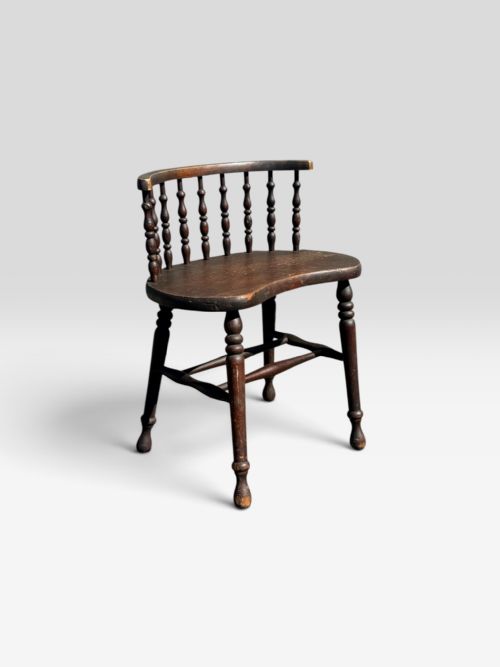
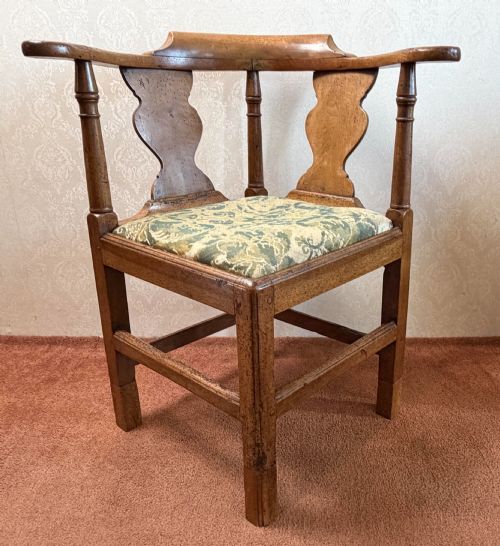
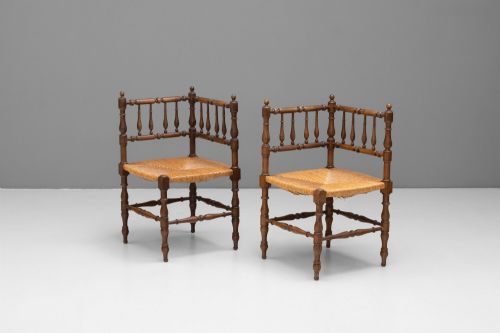


Brown Wooden Corner Chair
A brown wooden corner chair is a practical seat designed to tuck neatly into a room angle, offering sturdy timber construction and period charm.
Brown Wooden Corner Chair
When searching for a brown wooden corner chair, a buyer encounters a selection spanning the Georgian, Victorian, and Edwardian periods. These domestic seats utilise traditional timber frames designed to fit neatly into room angles.
The most common examples on this page date from the Georgian era through to the Edwardian period, often constructed from mahogany, oak, walnut, or fruitwood. They serve as functional seating with distinctive curved backs or solid elbow supports.
Makers historically produced these pieces for domestic interiors, resulting in variations that range from plain country elm to inlaid mahogany models. Their distinctive shape allows them to occupy unused space effectively.
What varies in quality
The standard of a brown wooden corner chair depends on the choice of timber and the crispness of any carved decoration on the frame. Denser hardwoods like mahogany or walnut generally indicate a more refined workshop origin.
Joinery execution dictates the overall durability of the piece, particularly at the joints of the curved armrests and corner posts. Finer examples display meticulous attention to timber grain matching and subtle inlay work.
Listings feature oak, mahogany, walnut, elm, and beech across Georgian, Victorian, and Edwardian periods.
The Brown Wooden Corner Chair Glossary
- Corner chair
- A seat designed specifically to fit into the corner of a room, featuring a diagonal orientation with a semicircular backrest supported by turned columns.
- Elm
- A tough, interlocking timber commonly used in country furniture for its resistance to splitting.
- Inlay
- A decorative technique where contrasting pieces of wood or other materials are inserted into depressions in the base timber.
- Bergère
- An enclosed upholstered armchair with a wooden frame, frequently utilising cane panels on the back and sides.
- Turner's chair
- A heavy, three-legged wooden armchair constructed entirely from turned wooden spindles and members.
Brown Wooden Corner Chair: Frequently Asked Questions
Where should I place a corner chair?
These chairs are specifically proportioned to slot into the dead space of a room angle, making them useful in hallways, bedrooms, or studies.
Because of their unusual footprint, they do not obstruct walking routes the way standard armchairs might.
Are these chairs comfortable for daily use?
Most period examples were built with wooden seats or modest drop-in pads, offering an upright posture rather than deep lounging comfort.
Adding a small scatter cushion can improve support if you intend to sit in one for longer periods.
How do I identify a Georgian corner chair?
Georgian models typically exhibit rich mahogany or walnut timber with restrained proportions and sturdy turned or square leg supports.
They often prioritise structural integrity and subtle joinery over excessive surface decoration.
What is the difference between Edwardian and Georgian versions?
Edwardian interpretations frequently incorporate lighter mahogany frames with decorative wood inlay, reflecting the tastes of the early twentieth century.
Georgian predecessors rely on heavier timbers and simpler structural lines without decorative stringing.