
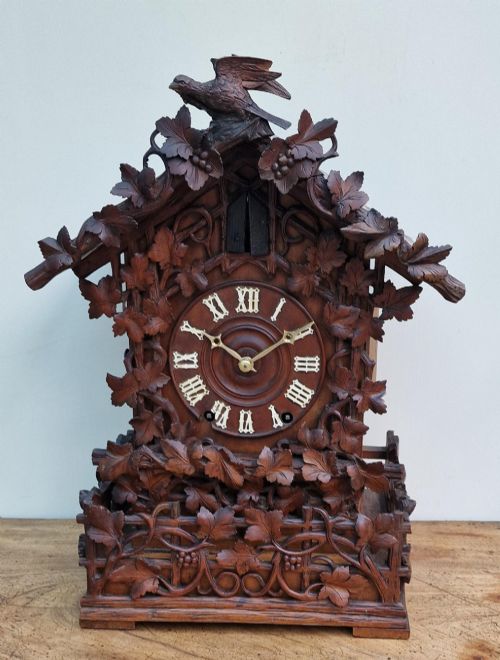


Antique Twin Fusee Movement
An antique twin fusee movement delivers precision timekeeping and steady power through an ingenious cone-and-chain system.
Antique Twin Fusee Movement
An antique twin fusee movement sits at the heart of fine 18th century, Regency, and Victorian timepieces, driving both the going train and the striking mechanism independently. These mechanisms appear in sturdy bracket clocks, elegant balloon clocks, and practical drop-dial wall clocks found across the periods.
The layout typically separates the timekeeping side from the bell-striking train, requiring two distinct conical pulleys and chains to equalise the mainspring's pull. Buyers most frequently encounter these movements housed in polished mahogany, rosewood, ebonised wood, or carved oak cases.
Originating from British workshops, these clocks range from simple drop-dial wall pieces to elaborate Victorian cuckoo clocks and early bracket clocks. Each piece demonstrates a specific regional or period aesthetic, from Georgian restraint to ornate Victorian styling.
Construction and materials
Clockmakers relied on heavy brass plates and precise gear cutting to build the frame and wheels of each movement, ensuring the intricate train could withstand constant tension. The fusee itself is cut with a spiral groove designed to wind the brass chain as the mainspring unwinds.
Cabinetmakers enclosed these movements in rich timber cases fashioned from mahogany, rosewood, and carved oak, frequently accented with bone or mother of pearl inlay. Glass doors and windows protected the delicate dials while allowing a clear view of the pendulum and face.
Current listings feature pieces spanning the 18th century through the Victorian era, utilising mahogany, rosewood, and brass.
Judging quality and craftsmanship
Superior examples distinguish themselves through the crispness of the wheel cutting and the precise hand-engraving found on backplates and brass dials. Master makers applied rigorous finishing to every tooth and pivot, ensuring minimal friction and sustained mechanical reliability over centuries.
Case construction likewise dictates the standing of a piece, separating straightforward utilitarian wall clocks from sculptural bracket and balloon clocks. Finer housings exhibit careful timber selection, such as figured mahogany or rich rosewood, alongside refined mouldings and quality hardware.
William Payne·Somersall London·John Leroux·John McGregor
The Antique Twin Fusee Movement Glossary
- Fusee
- A conical pulley with a spiral groove that equalises the diminishing torque of the mainspring as it unwinds. This mechanism ensures consistent force is delivered to the escapement throughout the running period.
- Twin Fusee
- A movement utilising two separate fusee assemblies, one to power the going train and the other to drive the striking mechanism. This configuration maintains equal tension across both functions.
- Bracket Clock
- A portable clock originally designed to sit on a bracket on the wall, though later forms stood directly on tables or mantelpieces. These often feature elaborate wooden cases and handle tops.
- Drop-Dial Clock
- A wall clock featuring a circular dial mounted above a longer, often rounded wooden trunk that houses the pendulum. This form was widely adopted in public spaces, hallways, and domestic rooms during the 19th century.
- Going Train
- The series of gears and wheels within a clock that drives the hands and tracks the passage of time. It relies on the steady power supplied by the fusee and mainspring.
Antique Twin Fusee Movement: Frequently Asked Questions
What is a twin fusee movement?
A twin fusee movement uses two conical pulleys and chains to regulate the power delivered from the mainsprings. One side drives the timekeeping train while the other powers the striking mechanism.
This dual setup ensures the clock maintains consistent force and accuracy as the springs run down over the course of the week.
How do I wind my clock?
Winding requires inserting the key into the appropriate dial winding square and turning it gently until the mechanism meets resistance. Most 18th and 19th century twin fusee clocks run for eight days on a full wind.
Take care not to overwind the mechanism, as this places unnecessary strain on the brass chain and mainspring.
Where should I place a bracket clock?
Bracket and mantel clocks need a stable, level surface away from direct sunlight, radiators, and heavy foot traffic that might cause vibrations. Placing the clock on a solid piece of furniture helps the pendulum swing evenly.
Ensure the surface allows easy access to the back door for setting and regulating the movement.
How do I identify the period?
Period identification relies on examining the casework timber, dial materials, and overall style, such as Georgian restraint or ornate Victorian revival. 18th century pieces often feature signature brass dial plates and maker signatures engraved directly onto the backplate.
Later Victorian versions display heavier rosewood or ebonised cases alongside distinct dial configurations like drop-dial wall formats.