




Antique Teak Tripod Table
An antique teak tripod table brings dense, richly carved colonial craftsmanship into a room, offering a sturdy surface with unmistakable regional character.
Antique Teak Tripod Table
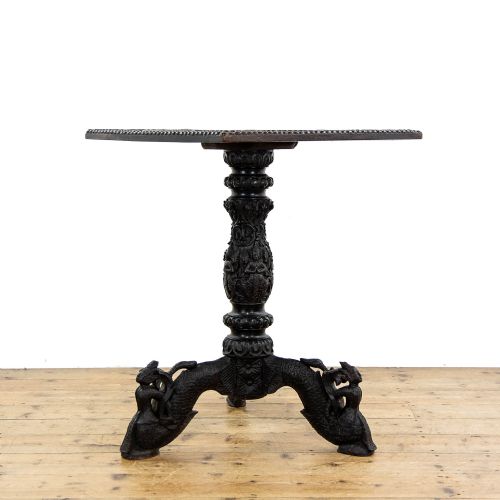
An antique teak tripod table combines a circular top supported by a central pillar and three legs, emerging primarily from nineteenth-century Anglo-Indian, Anglo-Burmese, and colonial contexts. These pieces function as side tables, occasional tables, and plant stands, often featuring tilt-top mechanisms that allow the surface to fold away when not in use.
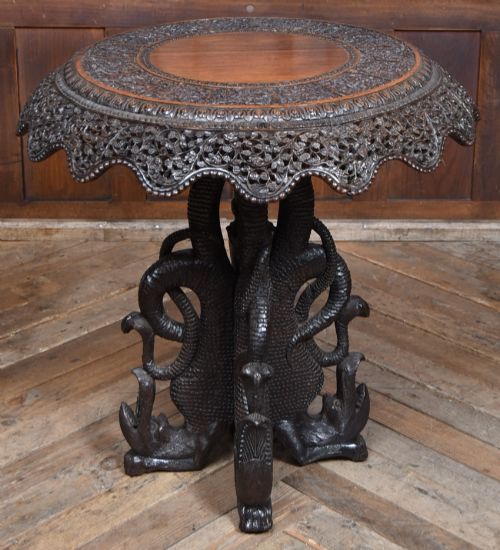
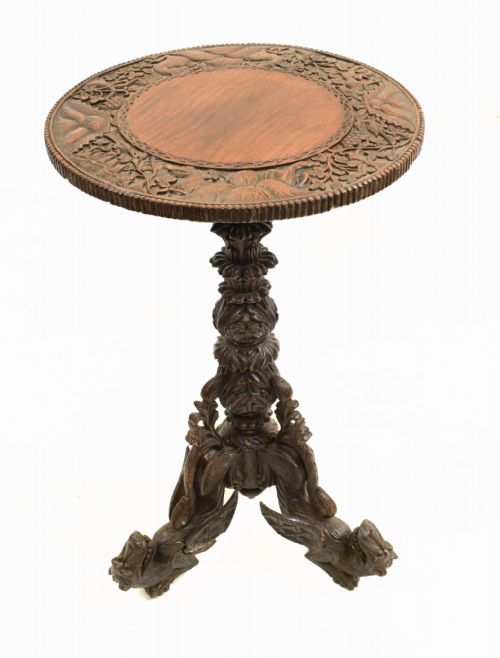
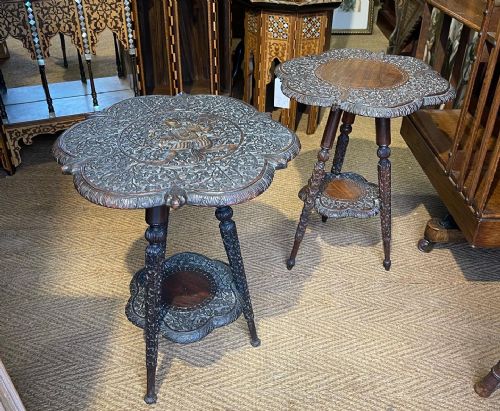
The version most commonly encountered on this page originates from Burma or the Bombay region, shaped by nineteenth-century colonial trade and local woodworking traditions. Surfaces typically display dense carving or intricate inlay work, transforming a simple domestic stand into a focal point of regional design.
Makers utilised native hardwoods to construct these tables, adapting traditional European tripod forms to local carving idioms. The resulting items range from small plant stands to larger occasional tables suitable for holding lamps or decorative objects.
Materials and construction
Makers constructed these tripod tables using dense tropical timbers, predominantly teak, padouk, and general hardwood. These woods provided the heavy, stable foundation necessary to support deeply carved surfaces and slender three-legged bases without warping.
Surface ornamentation relied on hand carving executed directly into the solid wood, alongside occasional bone and ebony inlay. Artisans shaped the central pillars and tripod legs by hand, often incorporating animal motifs such as elephants into the structural design.
Elephants appear regularly beneath these tabletops, standing ready to support your afternoon tea.
Distinguishing quality in carving and timber
The depth and crispness of the hand carving separate finer examples from simpler production. Superior pieces exhibit sharp undercutting and intricate detail across the entire top and base, whereas lesser items show shallow, repetitive incisions.
Timber selection and structural integrity also dictate the tier of a piece. Dense, well-figured teak and padouk with tight joints and original tilt-top mechanisms represent the upper end of the range, maintaining stability despite the natural weight of the carved top.
The Antique Teak Tripod Table Glossary
- Tilt top
- A table mechanism allowing the circular surface to pivot and lock vertically against the pedestal. This clever design enabled tables to be stored flat against a wall when not in use.
- Tripod base
- A support structure consisting of three legs branching from a central vertical pillar. This configuration ensures stability on uneven floors.
- Padouk
- A heavy, durable reddish-brown tropical hardwood utilised in nineteenth-century colonial furniture. It accepts fine detail work exceptionally well.
- Hoshiarpur
- A North Indian city renowned for intricate woodwork and inlay techniques. Pieces from this tradition frequently incorporate bone or ebony elements into teak surfaces.
Antique Teak Tripod Table: Frequently Asked Questions
What is an antique teak tripod table?
An antique teak tripod table is a nineteenth-century occasional or side table originating from colonial India or Burma, supported by three legs and a central pillar.
These pieces are typically defined by heavy hand carving and tilt-top mechanisms, reflecting both local woodworking skills and British colonial domestic tastes.
How were these tables used originally?
In colonial households, these tables served as movable surfaces for tea, lamps, and decorative display.
Because many feature tilt-top designs, they could easily be moved to the side of a room or folded away to create open floor space when needed.
How do I identify a Burmese table?
Burmese tables from the nineteenth century are typically characterised by exceptionally dense, deep-relief floral and figural carving across the entire top and base.
They often utilise native teak and feature robust tripod supports with substantial central pedestals.
Where does Anglo-Indian furniture come from?
Anglo-Indian furniture was produced in regions such as Bombay and Hoshiarpur during the nineteenth century, combining European furniture forms with traditional Indian craftsmanship.
Local artisans used native timbers like teak and padouk, often incorporating bone inlay or animal motifs.