
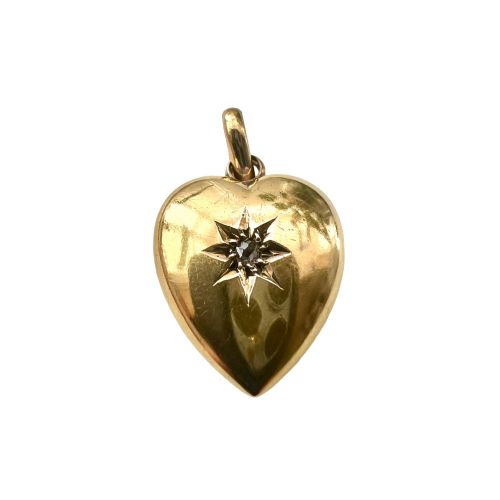
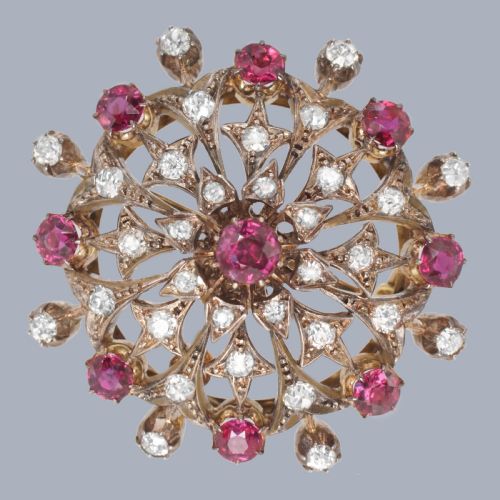


Antique Starburst Pendant
These pieces capture the celestial obsession of the nineteenth and early twentieth centuries, bringing diamond and gold starburst pendant designs to modern necklines.
Antique Starburst Pendant
When you search for an antique starburst pendant, you are looking at celestial jewellery spanning the Victorian, Edwardian, and Art Deco periods, though many survive in dual brooches and pendant forms.
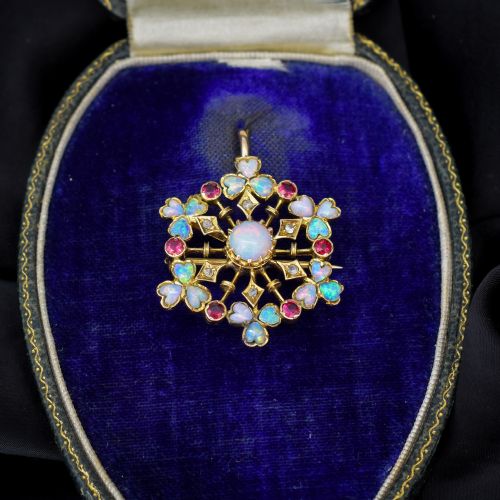
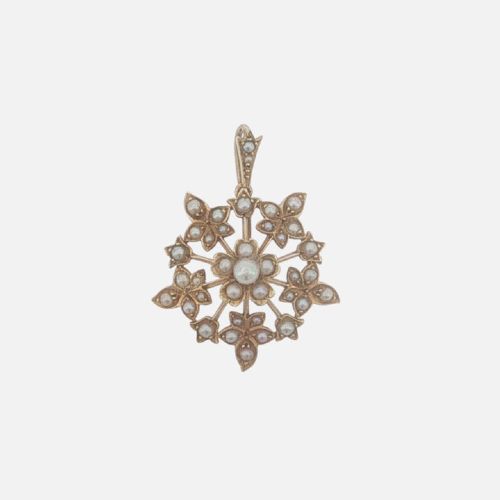
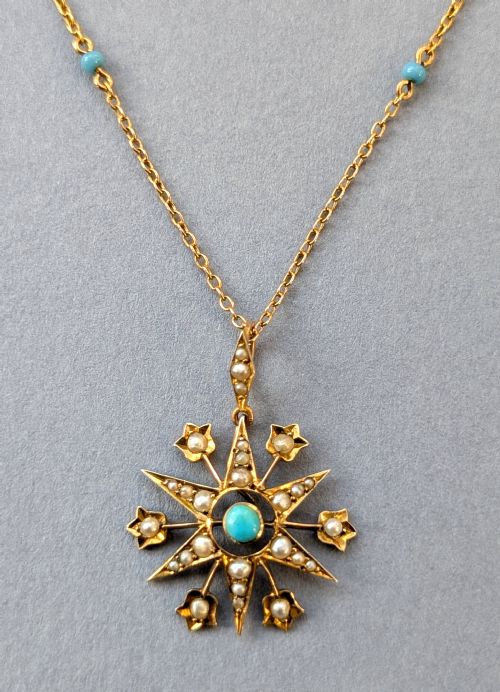
The selections here range from small nine-carat and fifteen-carat gold seed pearl sunbursts to substantial diamond and silver-set star brooches dated around eighteen-eighty to nineteen-ten.
Many of these designs double as brooches, featuring hidden bails or removable fittings that allow them to transition easily from a lapel to a neck chain.
Materials and Construction
Goldsmiths typically combined yellow gold or rose gold for the structural backing with silver top-settings to hold old-cut and rose-cut diamonds, as silver provided a bright white reflection that enhanced the stones.
Seed pearls, turquoise, peridot, and opals were meticulously hand-set into claw or collet mounts, often surrounding a central diamond core to mimic the twinkling points of a celestial body.
Listings feature Victorian, Edwardian, and Art Deco pieces in gold, silver, diamond, seed pearl, turquoise, and opal.
Evaluating the Craftsmanship
Quality rests in the precision of the stone-setting and the symmetry of the rays, where finer examples display individually articulated or tapering points rather than a flat, stamped backing.
The integrity of the original conversion mechanism - such as a secure screw-in pin or a well-concealed suspension loop - separates master jewellers' work from later alterations.
Hirsch & Oppenheimer
The Antique Starburst Pendant Glossary
- Old-cut diamond
- A hand-faceted diamond cut before the modern brilliant standard was established, typically featuring a smaller table, higher crown, and open culet that creates a soft, candlelit sparkle.
- Seed pearl
- A very small, naturally occurring or early cultured pearl, often drilled and threaded onto fine wire or silk to cluster closely in Victorian floral and celestial designs.
- Silver-topped gold
- A historical technique where a thin layer of silver is soldered over a gold backing, combining silver's bright face for white stones with gold's strength and resistance to tarnishing on the skin.
- Convertible brooch pendant
- A versatile piece of jewellery engineered with a removable pin and a fold-down loop so it can be worn interchangeably on a chain or pinned to fabric.
Antique Starburst Pendant: Frequently Asked Questions
How do I wear a convertible starburst pendant?
Most pieces feature a hidden or hinged loop on the reverse alongside a pin fitting, allowing you to slide a gold chain through for pendant wear or use the pin for a lapel.
Ensure the pin mechanism is safely latched or removed if possible when worn against delicate fabrics as a necklace.
How can I date an antique starburst pendant?
Dating relies on material combinations and stone-cutting styles, such as silver-topped gold settings pointing to the Victorian era, while lighter nine-carat gold and peridot often signal Edwardian work.
Hallmarks, pin types, and accompanying original fitted boxes also provide reliable chronological markers.
Are seed pearls fragile on old pendants?
Seed pearls were traditionally threaded on silk or held with fine seed-pearl wire, which can weaken after a century of exposure to skin oils and moisture.
Store them carefully and avoid immersing them in liquid jewellery cleaners to preserve the natural nacre.